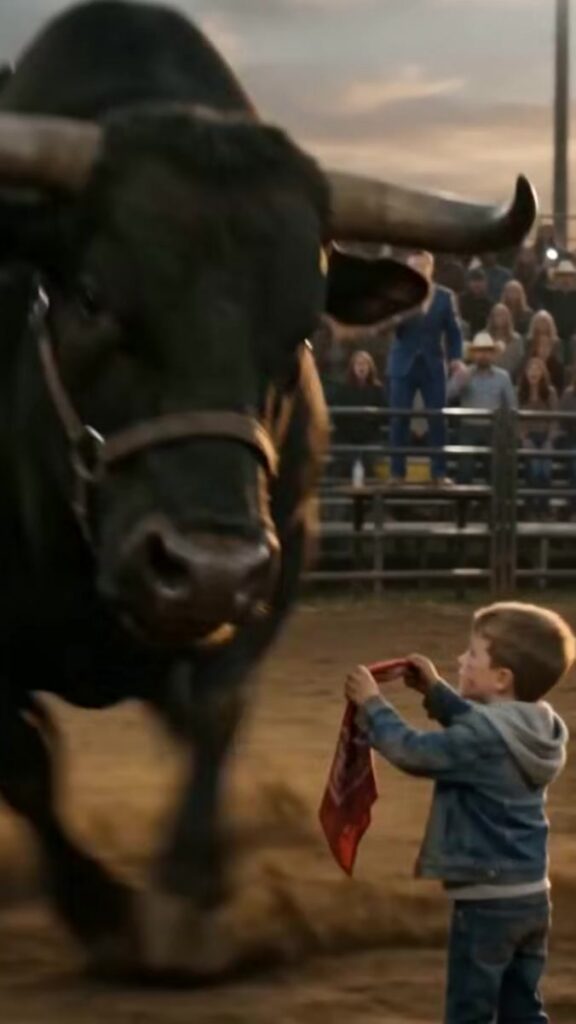
The county rodeo always began the same way: a bruise-colored sunset pooling behind the grandstands, the smell of fried dough and diesel, and a thousand voices layered into one restless hunger. Lights snapped on above the ring, turning the drifting dust into glitter. The band in the beer tent pounded out a familiar chorus, and the announcer’s laughter rolled from the speakers as if he could charm the night into behaving.
They had come for Ranger.
Ranger wasn’t just a bull; he was a story told with clenched teeth. Black as a burn mark, shoulders thick as fence posts, horns honed by years of anger and survival. Riders had climbed on his back like men climbing onto fate, and most had been bucked off so hard the ground seemed to reach up and swat them. The arena hands treated him with a reverence that looked like fear. The rodeo program listed him like a celebrity. The crowd said his name the way you said a storm’s name—half thrilled, half praying it would miss you.
So nobody noticed the boy until he swung a leg over the railing.
He was too small to be part of the show, narrow-shouldered in a denim jacket that didn’t fit, hood pulled up like armor. His face was smudged with dirt, as if he’d crossed the fairgrounds on his hands and knees. For a heartbeat the front row thought he was someone’s lost kid. Then he dropped into the ring and landed awkwardly, and the sound of his boots hitting packed earth made the entire stadium inhale at once.
The announcer’s voice cracked through the speakers. “Hey—hey! Somebody get that child out of there!”
Hands waved. Security started moving. The clowns on the far side hesitated, reading Ranger’s posture the way sailors read a wave. In the chute, Ranger snorted, and it wasn’t the impatient breath of an animal waiting for a gate. It was recognition—something old and heavy shifting behind his eyes.
The boy didn’t run. He stood alone in the center of the ring, the noise around him falling away as if the air itself had tightened. His chest rose and fell too fast. He reached into his jacket pocket with fingers that trembled so hard the motion looked like a stutter. When his hand emerged, it held a red bandana so faded it might once have been pink. The cloth was torn along one edge, stained by sun and sweat. In the corner, two stitched initials clung stubbornly to the fabric: J.R.
He lifted it like a flag. His voice, when it came, was thin but steady. “My dad said you’d understand.”
A hush crept up the stands, swallowing coughs and laughter. Even the band, sensing the wrongness, let their song die. Ranger stepped forward from the chute the moment the gate swung open—not in a panicked burst, but in a deliberate walk, hooves landing with a steady finality that made the ground seem smaller. The bull’s head lowered. Dust drifted from his shoulders. The crowd’s phones rose like a field of metal flowers.
“Kid!” the announcer shouted again, but his voice sounded distant now, swallowed by the space between the boy and the bull. “Move!”
The boy’s eyes shone. “He said you waited.” He swallowed hard, as if the next words hurt on the way out. “He said you didn’t forget.”
Ranger’s pace changed. The walk became a rush, a sudden acceleration that yanked the crowd into panic. People stood. Someone screamed a name that wasn’t the boy’s. The arena clowns broke into motion too late. Dust exploded from Ranger’s hooves as he bore down on the small figure like a living boulder.
And the boy did not flinch.
At the last instant, Ranger stopped so abruptly the sound of it traveled through the stands—a deep, thudding halt, a decision. The bull’s breath rolled over the boy in warm bursts. The boy’s hair lifted with it, fluttering against his forehead. For a moment the two of them stood inches apart, the most fragile thing in the arena facing the most feared.
Then Ranger lowered his head and touched the bandana with his nose, gentle as a confession. The motion was so careful it made the animal seem suddenly ancient, like he was carrying something far heavier than muscle. A ripple went through the crowd—an audible shiver of disbelief. The boy’s mouth opened on a whisper. “Ranger…” as if he were speaking to a dog at the kitchen door.
Hanging beneath Ranger’s thick neck, half-hidden by the strap and the shadow of his jaw, something caught the light. A small ring. Silver. And beside it, tucked under a plastic sleeve, a folded note protected from sweat and rain. The boy reached forward, not to grab, but to ask permission. Ranger did not move away. He stood like a guard at a grave.
The boy untied the bundle with hands that barely obeyed him. He stared at the ring first, turning it until the lights found the engraving. His throat worked as if he’d swallowed a stone.
“To Jake,” he read softly. “Come home safe.”
Somewhere in the stands, an older woman’s knees seemed to give out; people steadied her. The boy unfolded the note. It was written in block letters, the kind men used when they were afraid their hands might shake. He read the first line, and all the blood drained from his face so fast it was like watching someone get snowed on.
He looked up—not at the bull, not at the crowd, but toward the announcer’s platform where the microphone waited like a judge’s gavel. The announcer, a man who could talk over stampeding horses, had gone still. His grin had vanished. His fingers gripped the railing as if the wood might save him.
“It wasn’t an accident,” the boy said, and his voice carried without a microphone because the arena had gone perfectly silent. “That’s what the note says.”
A murmur rose, jagged and angry. The boy’s gaze didn’t waver. He swallowed again, then spoke the words that made the arena feel suddenly smaller than a barn stall. “Barn Three.”
The announcer’s hand opened. The microphone slipped and hit the platform with a dull knock that echoed like a closing door.
From the top row, a woman’s scream tore through the night. “Jake was my husband!”
The crowd turned as one body, eyes snapping from the ring to the stands, from the stands back to the announcer, searching for a shape to blame. Ranger shifted beside the boy, not charging, not bucking, but standing firm—as if he’d carried this message for years, waiting for someone small enough, brave enough, and broken enough to finally ask the right question.
The boy clutched the bandana to his chest. His eyes stayed locked on the platform. “My dad told me to bring this where everyone could see,” he said, voice thick now with tears he refused to let fall. “He said if I did, the bull would show me the rest. He said… he couldn’t come home, but the truth could.”
Behind the chutes, an arena hand glanced toward the shadowed service road that led to the barns, and his face tightened as if he’d been struck. Someone began to shout for the sheriff. Someone else shouted to shut the gates. The rodeo, built on noise and spectacle, had been stripped to something rawer: a child holding a ring, a note, and a relic of a man who never made it back from the stalls.
Ranger exhaled, slow and loud, and the dust lifted around him like a curtain. The boy stepped closer to the fence, as if the wood could steady him. “Barn Three,” he repeated, not as an accusation now, but as a destination. And when he looked back at Ranger, the bull’s dark eye held no rage at all—only the heavy patience of a secret finally set down in the open air.
In the silence that followed, the crowd began to understand what had really entered the arena that night. Not just a boy. Not just a bull.
Evidence.