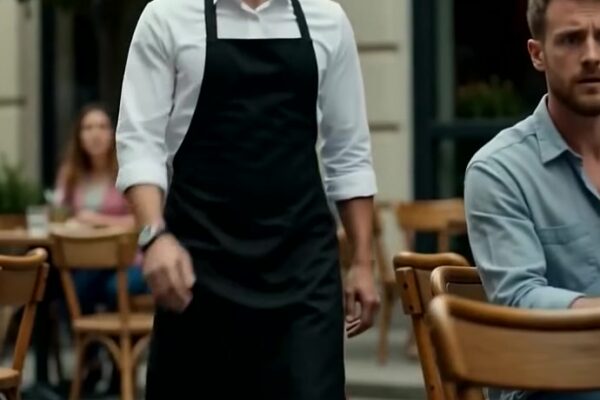
The diner was warm, bright, and busy—so bright it made the rainy night outside seem like a rumor. Light spilled from the big windows onto the parking lot, turning puddles into sheets of silver. Inside, red vinyl booths hugged the walls like old friends, and the black-and-white floor caught every gleam from the overhead fixtures. The air held the familiar mix of coffee, fried onions, and something sweet burning just a little at the edge, like memory.
It sounded normal, too. Cups clicked against saucers. Forks tapped plates in small, rhythmic conversations. A radio behind the counter murmured a song from decades ago. People spoke in low voices, the kind people used when they wanted to pretend the world was stable. If you only listened, you could believe it.
Then you noticed the man in the center booth.
He sat alone at a chrome-edged table, shoulders hunched inside a jacket that had seen too many winters. Mud dried in the seams. The cuffs were frayed, and his hair looked like he’d combed it with his fingers and lost. Not one person would have called him dangerous. But the hollowness in his eyes—like a house with its lights turned off—made people shift and look away.
Most diners had their own rules about who belonged. The man had learned them long ago. Sit quiet. Take up as little space as possible. Don’t meet anyone’s gaze. If you’re lucky, you’ll be ignored rather than removed.
He kept his hands on the table as if they were anchors. His stomach cramped with the insistence of hunger, but he didn’t ask for anything. Asking was its own kind of risk.
The waitress noticed him anyway.
She moved through the aisle with a practiced balance, slipping between booths with a tray in one hand and a pen in the other. Her uniform was crisp—black-and-white, buttoned neat—and her hair was pinned up in a way that made her look older than she probably was. But her eyes didn’t have that polished distance some servers developed. They were direct, human, and tired in the same way the night was tired.
At the pass window, she paused. The cook, a broad man with forearms like hams, slid a plate toward her. “Order up,” he said without looking up.
She didn’t take the plate meant for table seven. Instead, she lifted a smaller dish—a hot dog tucked in a bun, steaming, with a smear of mustard and a few fries like a shy entourage.
“That’s not on any ticket,” the cook muttered.
“I know,” she said, and her voice carried that quiet firmness that didn’t beg permission.
He glanced at her, then toward the booth in the center. He frowned, but he didn’t stop her. He’d seen enough nights to know when a person needed a meal more than a policy.
She carried the plate out as if it belonged there. The diner’s brightness reflected in the chrome rim, in the polished napkin dispensers, in her eyes. She approached the man carefully, not like someone handling a problem, but like someone approaching a stray dog that might bolt from kindness because it was unfamiliar.
She set the plate down with gentleness that bordered on reverence.
“Here you go,” she said softly. “Eat while it’s hot.”
The man stared. Not at her—at the food. His throat worked as if he were swallowing something heavier than hunger. For a moment, his face was blank, caught between wanting and disbelief.
Then his eyes lifted to hers, and what lived there wasn’t just gratitude. It was shock that anyone had seen him as a person instead of a stain on the evening.
“Thank you,” he said. The words came out small, as if they’d been unused for a long time.
The waitress nodded once. No lecture. No pity. Just a nod that said: you’re welcome, and you’re allowed.
She turned to leave.
Before his fingers could even reach the edge of the plate, a chair scraped across the tiles with a harsh, angry sound—like a match being struck.
Conversations snapped shut. Heads turned. The radio seemed to lower itself out of fear. Even the coffee machine hissed more quietly.
The manager strode from behind the counter with the rigid speed of a man used to being obeyed. He wore a dark suit that looked out of place among ketchup bottles and laminated menus. His tie was tight, his jaw tighter. The kind of man who treated a diner like a kingdom and customers like citizens who should be grateful for permission to sit.
“What is this?” he barked, voice cracking through the room like a whip.
The waitress froze in the aisle. Her shoulders lifted, her hands hovering as if she might catch whatever came next.
The manager didn’t look at her first. He looked at the man. His face twisted with something that wasn’t just anger—it was disgust, the kind some people wore like a badge.
He stopped at the booth, leaned in, and with a motion too quick to stop, he smacked the plate off the table.
Ceramic shattered on the checkered floor. The hot dog slid and split; fries scattered like fleeing birds. Mustard streaked the tiles in a bright, ugly line.
The sound lingered after the crash, thick as smoke.
The waitress gasped, one hand flying to her mouth. Her eyes filled instantly, not with tears yet but with the fierce, trembling start of them.
The man didn’t move. He stared down at the ruined meal the way someone might stare at a photograph of something they’d lost years ago. He didn’t flinch, didn’t plead, didn’t defend himself. He simply absorbed it, because that was what the world had trained him to do.
The manager pointed at him like he was pointing at garbage.
“This trash doesn’t deserve to eat!” he spat, loud enough for everyone to hear. Loud enough to make it a lesson.
All around, people looked at their plates, their napkins, their hands. A man at the counter cleared his throat and then decided against whatever words he might have offered. A couple in the corner held their breaths. Silence wasn’t neutrality here. It was permission.
The waitress stepped forward, voice thin. “Sir, I—”
“You,” the manager snapped at her without turning, “are going to pay for that, and you’re going to learn not to hand out food like you own the place.”
That’s when the man finally moved.
He slid out of the booth slowly, not with drama, not with flair—just with a steadiness that made the air feel different. He stood to his full height. He rolled his shoulders back as if setting something into place. His jacket was still worn. His hair still a mess. But the slouch was gone, and with it went the illusion that he was small.
He looked at the manager, and the calm in his eyes was more frightening than anger. It was the calm of someone who had already made a decision and did not need to raise his voice to enforce it.
When he spoke, it was low, clear, and it carried.
“I’m the owner.”
The words didn’t echo, but the effect was immediate. The manager’s face emptied as if someone had pulled a plug. Color drained from his cheeks. His mouth opened and closed once, searching for a new reality in the air and not finding it.
The waitress stared, her hand still at her lips, her eyes wide with a kind of astonished fear—fear of having made a mistake, fear of what power might do next.
The owner didn’t gloat. He didn’t smile. He looked down at the shattered plate, then at the streak of mustard, then at the waitress.
“You did something decent,” he said to her, voice steady. “In a room full of people pretending not to see.”
He turned back to the manager, and the warmth of the diner suddenly felt like it belonged to him alone.
“You,” he said, “are finished here. Effective immediately.”
The manager’s hands lifted in a useless gesture. “Sir, I didn’t— I had no idea—”
“Exactly,” the owner replied. “You didn’t know who I was, so you treated me like I wasn’t anyone.”
He leaned slightly forward, not threatening, just inevitable. “That is not how this place runs. Not while my name is on the deed.”
The manager swallowed, his eyes darting toward the watching customers as if they might rescue him. They didn’t. Now that permission had shifted, their silence changed sides.
The owner’s gaze swept the diner, taking in every turned-away face, every lowered eye, every hesitant breath. Then he looked back at the waitress.
“And you—” he began.
She stiffened, bracing for punishment. For the world to prove again that kindness was expensive.
The owner reached into his pocket and pulled out a worn leather wallet. He set it on the table gently, right beside the mustard-stained edge where the plate had been.
“You’re not paying for anything,” he said. “You’re getting a raise. And if anyone makes you feel small for feeding someone who’s hungry, they answer to me.”
The waitress blinked, the tears finally spilling, but they weren’t only grief now. They were relief, and something like vindication.
The owner crouched and began picking up pieces of broken plate with his bare hands, careful, deliberate. It was an act so simple it rewrote the room. A man with the power to command was choosing instead to clean.
“Someone get a broom,” he said, still calm.
A customer near the counter stood up as if waking from a spell. Another followed. A third voice finally broke the silence: “I’ll help.”
And just like that, the diner was still warm, still bright, still busy—but no longer with the old kind of normal. The sort that required cruelty to stay intact.
The owner looked up once, meeting the waitress’s eyes.
“Tonight,” he said quietly, “we start being the kind of place people think we are when they see the lights from the highway.”