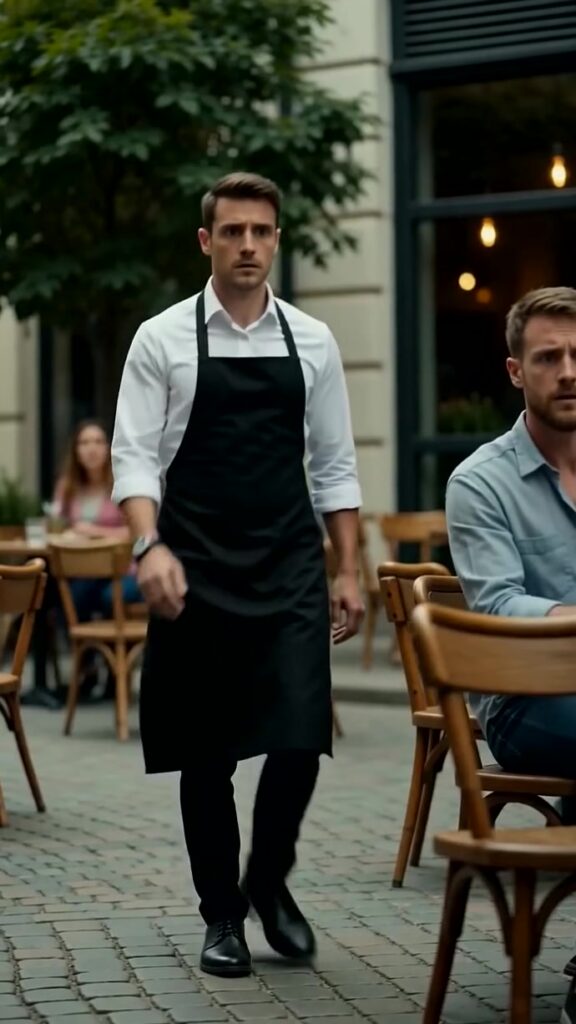
The patio outside Café Maribel glittered with late-afternoon sunlight, all silver spoons and clinking glasses, as if hunger were a myth told to frighten children. At a corner table beneath a striped awning sat a woman in a pale coat, her wheelchair angled to face the street. A half-eaten tart and a few scattered fries rested on her plate like an afterthought. She watched pedestrians pass with the careful, practiced distance of someone who had learned not to expect help from strangers.
The boy appeared as if the street had exhaled him—small, blond hair dulled by dust, sleeves too long and gray, cuffs frayed to threads. He moved with the tentative courage of the starving: drawn forward by the smell, cautious of being swatted away. He stopped beside her table and stared at the remnants, his gaze fixed so hard it seemed to hold the food in place. His throat bobbed once. He wiped his hand on his sleeve, leaving a darker streak of grime.
“Ma’am,” he said, barely louder than the birds on the railing. “One bite?”
The woman’s eyes flicked over him—thin wrists, worn shoes, a bruise blooming on one shin as if the world had pinched him for existing. For an instant her face tightened into something sharp, not cruelty exactly, but fear. In this neighborhood, pity was a door that could swing both ways. She felt the weight of being seen: the chair, the braces under her trousers, the immobility she wore like a sign.
She reached for her purse by instinct, then hesitated. Coins were easy. Contact was not. “Where’s your mother?” she asked, and heard the hollowness in the question. The boy didn’t answer. He only took one step closer and looked down at her legs resting on the supports, his stare suddenly too focused, too deliberate, as if the food had been an excuse to approach something else.
“I can help you,” he whispered. His voice trembled, but his eyes didn’t. They were the steady eyes of someone who had made a decision in the dark and carried it into the light.
“Help me?” The woman’s back stiffened against the chair. A server, balancing a tray, slowed as if sensing a storm. Nearby conversation thinned; forks paused halfway to mouths. The woman placed a palm on the armrest, ready to wheel back. “Don’t touch me,” she said, too late.
The boy dropped to his knees with a speed that startled even him, and his hands—small, shaking—closed around her lower legs. The wheelchair jolted. Metal squealed against stone. The woman screamed, the sound sharp enough to crack the afternoon. “What are you doing?!”
Faces turned like sunflowers. A man at the next table rose halfway, uncertain whether he was about to witness theft or tragedy. The server froze, tray trembling. The boy’s breathing came hard through his nose. He didn’t look up to plead or apologize; he lowered her feet toward the ground as carefully as if he were setting down glass. “Stand,” he whispered. “Please.”
Her heels touched the patio. The contact sent a shock through her body, not pain but memory—an old electric blueprint of walking that had been folded away for years. She tried to pull back, to wrench her legs from his grip, yet the boy held them firmly, not strong with muscle but with insistence. “Stop,” she hissed, but her voice wavered. The toes of her right foot twitched, a tiny betrayal.
She went still. Her breath snagged. Under her skin, something woke: the faintest response, as if her nerves had been asleep and someone had spoken their names. The boy leaned in, his forehead nearly touching her knee. “Just… push,” he said, and in his tone was the same hard hope that had led him to ask for one bite without shame.
The woman’s hands gripped the armrests until her knuckles paled. She had not stood unaided since the accident three years ago—the drunk driver, the cold rain, the months of therapy that ended in polite phrases and gentle resignation. She had learned to smile at sympathy and to pretend she didn’t miss the simple violence of walking. Now, with a filthy child kneeling before her, the floor felt suddenly too close, and the world too loud.
Her knees began to press upward. Not much—just a tremor, a reluctant lift, like doors moving on rusted hinges. The café seemed to tilt. Someone gasped. The server set the tray down with a clatter. The woman’s vision blurred. She wasn’t sure if she was rising or merely imagining it, but she felt her weight shift, felt her thighs engage with a remembered command.
“No,” she breathed, the word torn between terror and disbelief. “This can’t—”
“It can,” the boy said fiercely. “I saw you in my dream.” He looked up then, and his face, smudged and solemn, was too old for his years. “You were standing by the window. You were holding a plate. And you—” His voice cracked. “You gave me a bite.”
The honesty in it struck her harder than the movement in her legs. Not a scam, not a trick. A child with nothing but hunger and a dream, demanding the world prove him right. Her throat tightened until she could barely breathe. She swallowed and felt tears burn behind her eyes. She had spent years convincing herself that miracles were for other people, that she should be grateful for wheels and ramps and coping. And here was a boy who did not have the luxury of coping—only of asking.
She drew one shaking breath and pushed again. This time her hips lifted clear of the seat by a fraction, just enough that the air brushed the back of her thighs. The crowd’s silence became a physical thing. The boy’s hands steadied her ankles as if anchoring her to the earth. Her left knee wobbled; pain flared like a match. She nearly collapsed, but the chair caught her, and she sank back down with a sob that was half laughter, half grief.
For a moment no one moved. Then the server rushed forward. “Are you hurt?” he asked the woman, then turned on the boy. “What’s wrong with you?”
“Wait,” the woman said, surprising herself with how firm her voice sounded. She lifted one hand, palm outward, halting the server like a traffic signal. She looked at the boy—at his trembling wrists, at the dirt under his nails, at the stubborn hope in his eyes—and she understood something she hadn’t in years: help was not always a gift you bestowed; sometimes it was a door someone knocked down for you, because they needed you alive on the other side.
She reached for her plate and slid it toward him. “One bite,” she said, her voice breaking. “No—take it all. Sit.”
The boy blinked, as if the permission itself was a miracle. He didn’t grab. He didn’t bolt. He climbed carefully onto the edge of the chair opposite her and took a bite so small it was reverent, as if afraid the world would snatch it back for his audacity. Color rose in his cheeks after the first mouthful, and with it came a trembling relief that made the woman’s chest ache.
“What’s your name?” she asked.
He chewed, swallowed. “Eli.”
“Eli,” she repeated, tasting the syllables like a promise. She looked down at her legs, at her shoes positioned on the patio stones, and flexed her toes again. This time they moved without argument. The motion was slight, but it was hers. She exhaled, slow and shaky. “I’m Mara.”
He nodded solemnly, as if names were contracts. “You’re going to stand,” he said, not as a question. “I’ll help you. But you gotta help me too.”
She almost smiled. The dramatic absurdity of it—this boy, hungry enough to ask strangers for crumbs, bargaining like he held the world’s leverage. Yet she heard the deeper truth beneath his childlike demand. Help was a chain, and chains could pull in either direction. She could feel it in her bones now: the first link had clicked into place.
“Okay,” Mara said. Her voice was raw, but it did not shake. “We’ll help each other.”
Across the patio, the crowd slowly returned to their meals, though their eyes kept drifting back as if they’d witnessed a crack in ordinary life. The server, still wary, fetched a glass of water and set it near Eli without being asked. Mara’s fingers rested on her armrests, feeling the faint echo of standing. Eli ate, bite by careful bite, like he was feeding a future he could not yet see. And in the bright, indifferent afternoon, something in Mara’s legs—something in Mara’s heart—refused to stay asleep any longer.