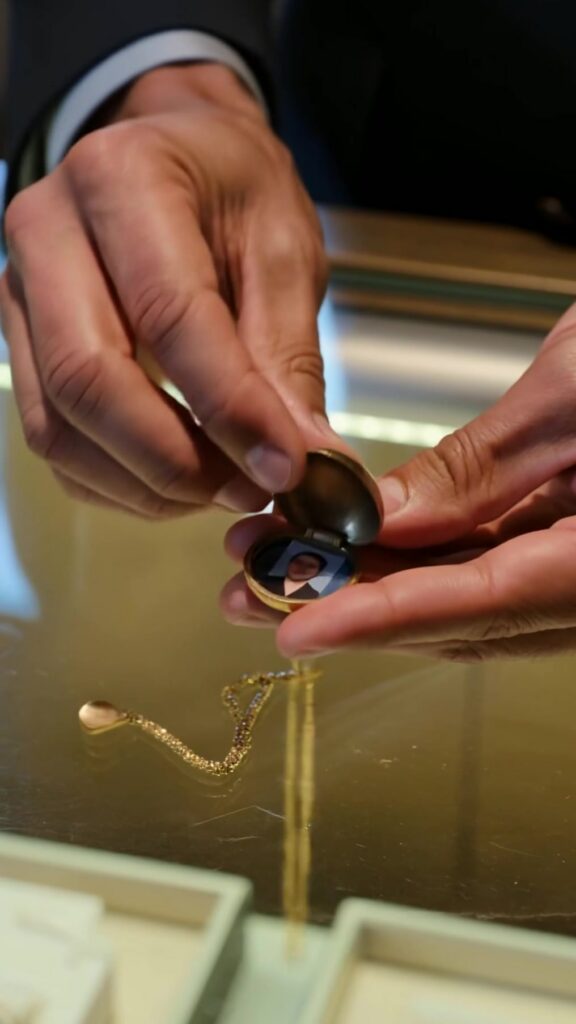
The bell above the glass door gave a tired jingle, the kind made for sunny shoppers and deliberate footsteps. This sound came from neither. It came from a stumble, from someone pushing inside as if the street behind her were a mouth snapping shut.
She didn’t belong in a jewelry store. Not like that—soaked through, hair plastered against her cheeks, jacket hanging heavy and dark as a storm cloud. Water gathered on the hem and dropped to the polished floor in steady, accusing taps. Her lips were pale, and her eyes were the kind of steady that came from having already exhausted panic.
Elliot Krauss looked up from his workbench. His hands were magnified beneath his loupe, a fine chain looped between his fingertips, and for a second he simply watched her as if the rain might explain her presence. Behind him, the store lights warmed the velvet displays, turning diamonds into tiny captured suns. In front of him stood a woman who looked like the lights had never reached her.
“Ma’am,” he began, voice quiet, automatically kind. “Are you all right?”
She ignored the question. Her gaze flicked to the locked cases, then to the counter, then to Elliot as if measuring him for weight.
She reached into her coat and withdrew a small object wrapped in a scrap of cloth. The cloth was cheap, faded with washing, its edges frayed as if it had been clutched too many nights. She laid the bundle on the counter and unwrapped it with careful fingers.
A necklace. A locket.
Even in the harsh overhead light, it was beautiful, the kind of piece made with intention rather than trend. The metal was gold, worked into a simple oval framed by a filigree of tiny leaves. It was old enough to have a softness to its shine, like something warmed by years of skin.
“How much is it worth?” she asked.
Elliot blinked. He was used to questions about appraisals, insurance, weddings. He was not used to questions delivered like verdicts.
He pulled the necklace closer, careful not to touch her fingers. “I can’t say without looking. Do you want to sell it?”
Her eyes did not move. “Yes.”
He glanced at the water spreading across the counter glass, at the way her hands trembled once and then stilled. Elliot had built his life around precious things—measured, cataloged, insured. He’d also learned that desperation didn’t always arrive with raised voices. Sometimes it arrived with someone who had already stopped pleading.
He lifted the locket. “Fifty,” he said, naming a number that was less about the necklace and more about what he could offer without inviting argument. It was a test: if she bargained, if she protested, he could steer her toward a fair appraisal. If she simply wanted the fastest escape—
She nodded immediately. “Fine.”
No indignation. No hesitation. As if the money was not an exchange but a countdown.
Elliot’s mouth dried. He had the odd sensation that he was about to do something irreversible, not because of the necklace, but because of the person attached to it.
“I need to confirm it’s real,” he said, reaching beneath the counter for his tools. “Standard procedure.”
She made a small gesture—permission, impatience, surrender. “Do whatever.”
Elliot brought the locket under the lamp. The clasp was stiff, the hinge intact. He turned it over and saw faint scratches along the back—signs of being carried against keys, against pennies, against a thousand unseen moments. He pressed gently at the seam.
The locket opened.
The air in the shop changed. It didn’t truly change, but Elliot’s lungs insisted it had, as if the oxygen had been replaced by something older and heavier.
Inside was a tiny photograph protected by a thin pane. A man’s face—his own face, younger, less carved by grief. Next to him, a child with a wide grin and missing front tooth, cheeks smudged with birthday cake. Beneath the photo, etched into the gold in looping handwriting: For my daughter, Clara.
Elliot’s hands went numb. The loupe slipped from his eye and clattered onto the bench. For a moment he couldn’t see the woman at all. He could only see the photo, the way Clara’s hair fell in the same rebellious curl his late wife used to tame with a clip, the way her small hand had been caught mid-wave as if she could still be called back.
“Where did you get this?” he whispered.
The woman’s throat moved as she swallowed. “It was given to me.”
“By who?” Elliot asked, though he already felt the answer approaching like thunder. His heart beat painfully, each pulse a name. Clara. Clara. Clara.
She said nothing. Her gaze went to the door as if measuring distance to escape. Elliot’s chair scraped hard against the floor as he stood. He came around the counter with the locket clenched in his fist, his feet moving before his mind had found permission.
“Wait,” he said, too loudly for the quiet store. “That necklace—this is mine. It belongs to my daughter.”
Her shoulders tightened. She backed up half a step, then stopped as if she’d hit an invisible wall. Outside, rain hammered the sidewalk in a furious sheet.
Elliot pushed through the door and onto the awning’s edge, holding the necklace like a proof of life. The storm slapped his face instantly, cold needles. “Clara’s necklace!” he shouted over the rain. “Where is she?”
The woman stood just inside the doorway, rainwater streaming down her hairline, along her jaw, over her lips. For a heartbeat, she looked ready to run again—then she turned slowly, fully, and met his eyes.
Something in her expression broke the practiced fury in him. It wasn’t fear exactly. It was recognition.
Her voice came out raw, as if it had been sanded down by years of holding back. “If she’s your daughter,” she said, each word catching on breath, “why did she make me promise never to bring it back to you?”
Elliot stared, the question striking harder than any accusation. The rain blurred the street into a smear of gray, but the woman remained painfully clear. He took one step toward her, then another, the locket’s chain sliding through his fingers like a memory he couldn’t hold tight enough.
“Who are you?” he asked. “Tell me your name.”
She hesitated, as if names were dangerous. “Mara.”
“Mara,” he repeated, tasting it like a clue. “Did you know her? Did you see her?”
Mara’s eyes shone. Whether from rain or tears, he couldn’t tell. “I lived in the same place she did,” she said, words forced out as if they were hooked. “A place where girls stop being called by their names.”
Elliot’s stomach fell. He had filed reports. He had posted flyers. He had hired private investigators and watched them return with polite defeat. He had replayed his last conversation with Clara—an argument about a party, about curfews, about trust—until the words turned into knives. He had imagined her stolen by strangers, by monsters. He had never allowed himself to imagine she might have been taken by something worse: by the world’s quiet indifference.
“She was alive,” he said, voice cracking on the truth. It wasn’t a question, but it sounded like one.
Mara nodded once, small and heavy. “She was.”
Elliot’s knees threatened to give. He gripped the doorframe with one hand, the locket with the other, rain slicking his fingers. “Where is she now?”
Mara’s lips trembled. “She’s the reason I’m here,” she said. “She told me if I ever got out, if I ever found my way back to a life with sidewalks and windows and lights, I had to carry this. Not to sell it. Not to keep it. Just… to make sure it didn’t end up in their hands.”
“Then why ask me what it’s worth?” Elliot demanded, but the anger was thin, frightened.
“Because I’m hungry,” Mara said simply, and the honesty in it was brutal. “Because freedom is expensive in ways people don’t talk about. And because she said if I got desperate, I could trade it for a few more days. But she also said I wasn’t allowed to give it back to you.”
Elliot’s throat tightened. “Why?”
Mara’s gaze dropped to the open locket. “She said it would destroy you,” Mara murmured. “She said you’d spend the rest of your life trying to buy her back, and you’d end up dead. She said you had to stay alive. She said you had to keep hoping, even if she couldn’t.”
The rain hissed on the awning. The street smelled like wet asphalt and exhaust and the metallic tang of lightning. Elliot closed the locket with shaking fingers, as if he could protect the photo from the story it had just been given.
“Mara,” he said, stepping back into the doorway, bringing her with him into the light. “I’m not letting you leave. Not like this.”
Her chin lifted, defensive. “You can’t keep me here.”
“I’m not trying to trap you,” he said, fighting for steadiness. “I’m asking you to help me. And I’m offering you help in return. Food, a dry coat, a phone. Whatever you need. But you have to tell me everything you know.”
Mara’s eyes flickered with something like relief, quickly buried beneath caution. “If I talk,” she said, “they’ll come.”
Elliot leaned closer, lowering his voice as if the jewels themselves might overhear. “Then we make sure they don’t,” he said. “I’ve spent years losing her in every possible way. I’m done losing.”
Mara looked at the cases of glittering rings, at the warmth of the lights, at the rain still pounding the world outside. Her shoulders sagged as if she’d been carrying Clara’s promise like a weight tied to her ribs.
“She called you ‘Dad’ even when she was angry,” Mara said softly. “Even when she swore she’d never forgive you. She still said it like a prayer.”
Elliot’s eyes burned. He opened his palm and held out the locket, not as an item for sale, but as an offering returned. “Bring me to her,” he said, and his voice broke on the words. “Or bring me to the place she can’t leave. Either way. Please.”
Mara stared at the locket for a long moment, then closed her fingers around it. Her hand covered his briefly—cold, trembling, real.
“You have to promise me something first,” she whispered.
“Anything,” Elliot said.
Her gaze lifted, fierce despite the water on her lashes. “If we find what’s left of her,” Mara said, “you don’t go in there thinking money makes you powerful. You go in there knowing you’re just another man they’ll happily break. And you don’t let them take you too.”
Elliot nodded once, the motion heavy with terror and resolve. “I promise,” he said, though he didn’t know how to keep it. “Just don’t disappear on me.”
Mara’s mouth tightened as if holding back a sob. Outside, the storm raged, uncaring. Inside, a father and a stranger stood over a locket that had survived what a girl hadn’t. And in the gold, Clara’s name gleamed—still claiming a place in the world, still demanding to be answered.