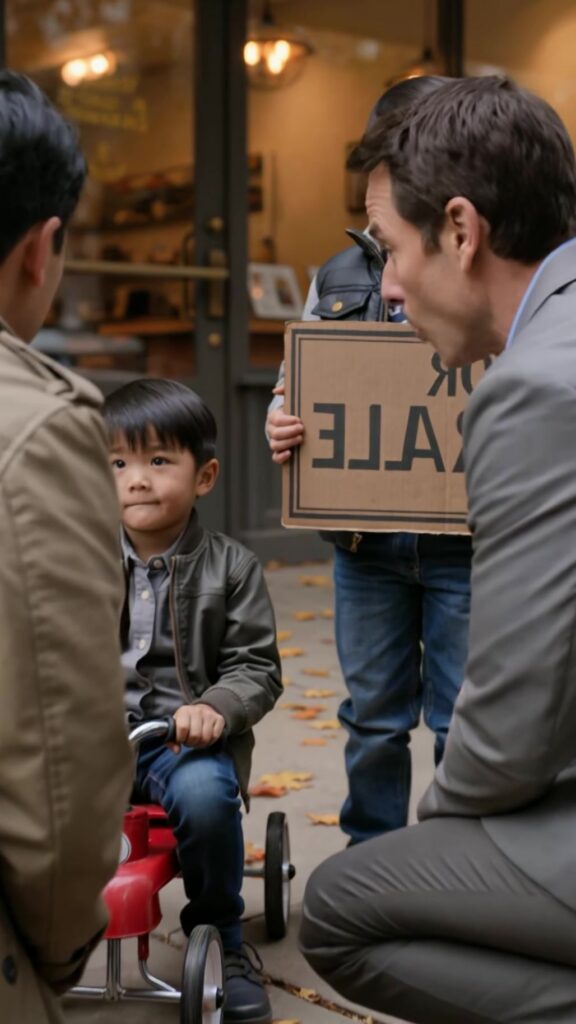
The cardboard sign looked too big for his hands. FOR SALE, it said in block letters that trembled as the wind worked its way under the flaps of his coat. Elias held it up anyway, like the words were a shield he could hide behind, like if he kept the sign high enough the cold wouldn’t notice the thinness of his gloves.
Beside him sat the pedal car—red once, now a tired shade like dried blood. Its paint had peeled into scales, and the chrome steering wheel had a dull bruise of rust. Still, it had a dignity that made passersby slow down and smile before remembering their errands. It was the kind of toy that belonged in a yard full of summer, not on a gray sidewalk in February.
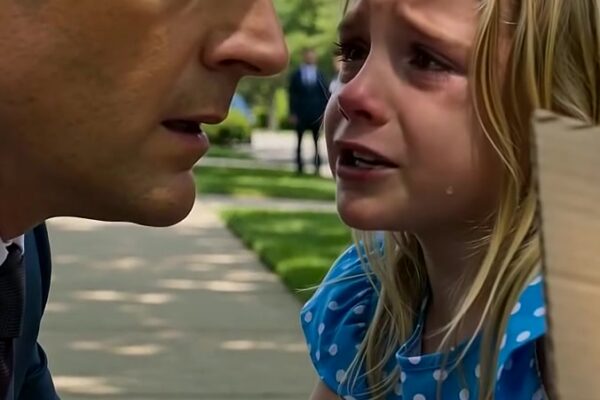
Jonah stood just behind the front wheel, small shoulders bunched up, his fingers twisted in the hem of his sleeve. Every few seconds his gaze skittered to the street, to the stream of boots and coats and hurried faces. Tears kept rising, stubborn and bright, and he kept pushing them down with the back of his wrist as if he could erase what he felt.
“Hold the sign straight,” Elias murmured. He tried to sound older than twelve. He tried to sound like someone who could make a plan and make it work.
Jonah nodded without speaking. The silence was his way of not breaking. If he talked, he feared he would say something that would turn the day into a sob. If he cried, he feared he would never stop.
Cars hissed over slush. Breath smoked in the air. The storefront behind them glowed with warm light they couldn’t afford. The pharmacy was two blocks away, and every time Elias looked at its green cross he felt as if it were watching him, waiting for money he didn’t have.
The red pedal car had lived in their mother’s stories longer than it had lived in their garage. It was how she spoke about a father without naming him—how she told them about the summer she was young and reckless, about a ribbon tied to a wheel because someone had once believed in little ridiculous gestures. When she spoke of that ribbon her voice went soft, then guarded, like a door quietly closing.
A black car eased into the curb lane and stopped with the confidence of something that owned the street. It was too polished for this neighborhood, a sleek animal among tired sedans. The engine went quiet. For a moment, nothing happened.
Elias pretended not to notice. He fixed his stare on the sidewalk, on the cracks where last week’s snow had melted and refrozen. Jonah noticed anyway. He always noticed. He stiffened, and his breathing sped up.
The back door opened. A man stepped out. His coat was charcoal and expensive; the air itself seemed to move differently around him. He didn’t hurry. He didn’t have to.
He stood at the edge of the sidewalk, watching the boys and the toy. He didn’t smile, but his face softened the way a face does when it sees something it recognizes and wishes it didn’t.
Then he approached. His shoes made no sound on the slush, only a muted crunch. Elias lifted the sign higher.
“You’re selling this?” the man asked.
His voice was even, controlled, but it carried a thread of something else—an uneasy curiosity.
“Yes, sir.” Elias cleared his throat as if the word sir could build a bridge between their worlds. “It works. The left pedal sticks sometimes, but you can fix it.”
Jonah kept his eyes on the ground. He stared at the wheel as if staring could hold it in place, keep it from leaving them.
“Why sell it?” the man asked.
Elias hesitated. He had rehearsed answers. For food. For rent. For school. He had picked the simplest one, the one that felt least like begging. But the man’s eyes were on him in a way that made lying feel impossible. They weren’t casual eyes. They were the eyes of someone who measured details and remembered them.
“Our mom needs medicine,” Elias said. The words came out small, not dramatic the way they sounded in his head. “The kind the clinic won’t give without… without paying.”
Something shifted in the man’s expression, like a lock turning. He looked closer—not at the sign, not at the toy, but at the boys. At their faces. At the shape of Elias’s cheekbones, at Jonah’s eyes. The longer he looked, the more his composure thinned, as if a memory had leaned too close to the present.
Then his gaze dropped to the front wheel.
A blue ribbon was tied there in a neat bow, frayed at the ends. It fluttered faintly in the wind as if it were trying to wave.
The man went very still. All at once, the city noise felt distant. He took one step closer, then another, not touching anything, as if afraid the ribbon would vanish if he did.
His breath caught. “That ribbon…” he said, and stopped, as if finishing the thought would cost him something he wasn’t ready to pay.
Elias swallowed. “It’s been there a long time,” he said. “Mom wouldn’t let us take it off. She said it was—” He almost said important. He almost said proof. “She said it belonged.”
The man’s jaw tightened. His eyes went wet in a way he fought hard to hide. “I tied one like that,” he said quietly, and the words sounded like confession. “Years ago.”
Jonah looked up then, startled by the crack in the man’s voice. Elias watched the man’s face and saw not pity, exactly, but pain that had been waiting for a door to open.
“Who is your mother?” the man asked. He tried to keep his tone steady, but it slipped on the last word.
Elias reached into his pocket and pulled out the folded paper he had been carrying like a fragile secret. It wasn’t just a prescription. It was their reason for standing out here in the cold. It smelled faintly of antiseptic and their mother’s perfume, because she had held it with shaking hands before telling Elias, voice too calm, that he was the man of the house.
He handed it over.
The man took it carefully, as if paper could cut. His fingers were pale against the white fold. He opened it, eyes scanning quickly—medication names, dosage, a doctor’s signature. Then his gaze snagged on the patient’s name.
The color drained from his face so fast it was almost frightening. His lips parted. For a second he looked as though the sidewalk had tilted beneath him.
Jonah edged closer to Elias, instinctively seeking shelter. Elias didn’t move, but he felt his own heartbeat hammering. If the man was angry, if he was disgusted, if he decided they were lying—
“This…” the man whispered. He didn’t say the name aloud. He didn’t have to. Elias saw it in the way his eyes changed, in the way the man’s whole body seemed to recognize a person he thought he’d lost.
Below the name, there was a line that had never stopped hurting to see. It was supposed to be blank or filled with a man’s name. Instead, it was a cold phrase printed without emotion.
Unknown father.
The man stared at that line as if it were a wound that had been covered and uncovered again. His throat worked. He looked up at Elias, then at Jonah, and something unguarded broke through his careful mask—fear, hope, regret, all braided together.
“Where is she?” he asked. “Your mother. Where is she right now?”
Elias held the sign tighter, the cardboard bending. “At home,” he said, and his voice cracked despite his effort. “She’s… she’s trying to sleep because it hurts less when she sleeps.”
The man’s gaze flicked to the red pedal car, to the blue ribbon, to the boys’ thin coats. When he spoke again, his voice had changed. It was still controlled, but it carried a decision in it like a hammer coming down.
“Put the sign down,” he said softly. “You’re not selling this today.”
Elias blinked, unsure he’d heard right. “But—”
“Listen to me.” The man crouched then, lowering himself to their level, and in that motion he looked less like a stranger from a black car and more like someone who had once knelt in summer grass tying a ribbon, believing in the permanence of simple joys. “You shouldn’t have to trade your childhood for medicine.”
Jonah’s lower lip trembled hard. “We don’t have enough,” he whispered, the first words he’d spoken all morning.
The man’s eyes closed briefly, as if Jonah’s voice struck a place he’d kept sealed. When he opened them, they shone with a fierce, exhausted tenderness.
“You do now,” he said. He stood, pulled out his phone with a hand that shook just slightly, and glanced toward the black car as if it were suddenly too small to contain what he was about to do. “Get the pedal car. Both of you. We’re going to see her.”
Elias hesitated only a heartbeat, then folded the sign and tucked it under his arm. The cardboard felt lighter than it had an hour ago, as if its words had lost their weight. He grabbed the pedal car by its side, feeling the familiar roughness under his fingers, and Jonah held the front wheel, careful not to crush the ribbon.
As they moved toward the waiting car, the man looked once more at the prescription in his hand, at the name that had survived in ink when so much else had vanished. His mouth formed a silent apology to the wind, to the years, to the boys who had been growing up without him.
Then he opened the door for them, and the city’s cold air rushed around the moment like an audience holding its breath, waiting to see whether the past would finally stop running.
Behind them, on the sidewalk, the place where they had stood selling their joy was empty except for a pale rectangle of slush where the pedal car had been. The space looked strangely like a scar that might, at last, begin to heal.
And in the man’s pocket, the prescription paper crackled softly as the car pulled away—an ordinary sound that felt, to all three of them, like fate turning a page.