The sun was already setting when the boy walked into the bank, turning the glass doors into sheets of copper. Inside, the air smelled like paper, polish, and the sort of fear that wore a tie. It was the kind of place where people lowered their voices instinctively, where even laughter sounded like a mistake.
He was too young to belong to that hush. Fourteen, maybe. Thin jacket too big for his shoulders, hair still damp from the cold outside. No parent at his back, no phone in his hand, no nervous glance toward the security guard. He stepped over the dark line of the entrance mat as if he’d crossed it a hundred times.
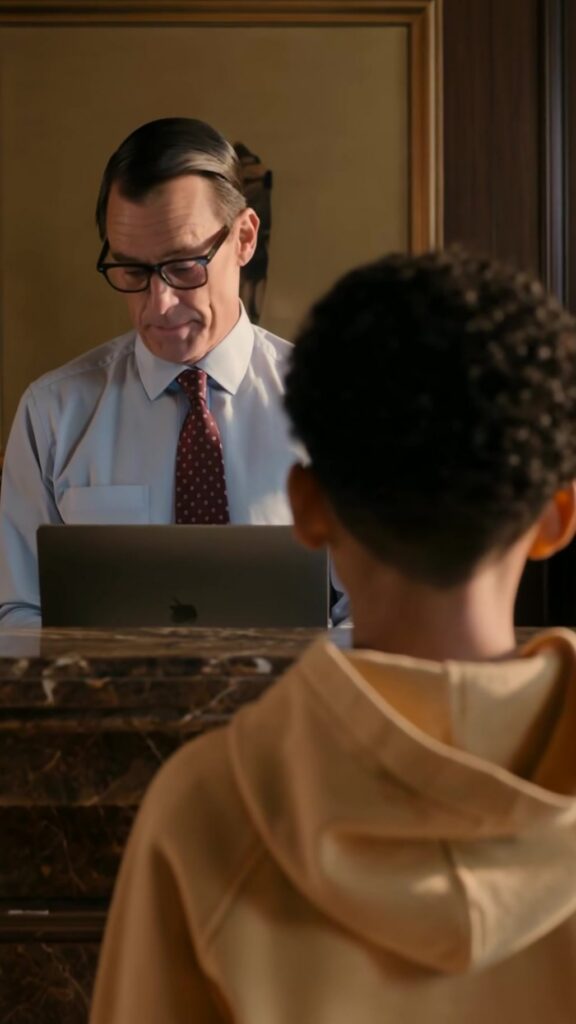
The guard watched him for a beat, deciding whether to intercept, then looked away. The boy didn’t drift toward the brochures or the waiting chairs. He didn’t pretend to browse. He moved straight through the rows of quiet customers and stopped at the main counter, where the marble edge met a pane of glass. He slid something forward with two fingers.
It wasn’t a debit card. It wasn’t even plastic anymore, not really. It looked like a laminated rectangle that had survived decades in a wallet: corners rounded, surface scuffed milky, the printed name faded into a whisper. A few patrons glanced up, curiosity flashing and then vanishing under the discipline of public etiquette. Kids like him came here to cash birthday checks if they came at all, and even then they came with adults.
Behind the counter, the teller—new, young, too bright—paused as if expecting a joke. But the boy’s face held no invitation to laugh. His eyes were steady, old in a way that made the teller’s smile evaporate. The teller, uncomfortable, pressed a button under the desk and glanced toward the office behind the frosted glass where the branch manager worked.
Moments later, the manager appeared with practiced calm. His suit fit like authority, his hair was combed into submission, and his expression said he had seen every kind of desperation money could shape. He approached with the easy confidence of someone who believed he could read a person from the way they held their shoulders.
“Can I help you?” he asked, voice smooth as the counter.
The boy didn’t step back or lean in. He didn’t search for words. “I’d like to check my balance,” he said. The sentence landed softly, but it didn’t drift. It stayed. “My grandfather opened the account. He died last week.”
The manager’s expression didn’t change immediately, but something tightened around his eyes. Death was not unusual in banking, but it arrived in paperwork—certificates, letters, legal language. It did not usually arrive in the form of a boy who walked in alone at sunset holding a card like a relic.
“All right,” the manager said, and he took the card with care that looked like politeness until it didn’t. He signaled the teller to pull up the relevant system. The teller typed. The manager watched the screen, then leaned closer. A faint click in the room seemed to amplify—the sort of sound that made everyone momentarily aware of their own breathing.
At first he wore the mild impatience of routine. Then his gaze sharpened. His fingers, which had been tapping the counter, stilled. He asked for the card again, turned it over, checked the signature strip as if the ink might rearrange itself. He frowned at the date, then at the account number, then at a second field on the screen the teller hadn’t noticed.
“That can’t be correct,” he muttered before he could stop himself.
The teller looked up, confused. The customers, sensing tension, returned to their own silences but listened anyway; a bank’s quiet is never empty. It is full of attention pretending to be elsewhere.
The manager’s breathing shifted, subtle but unmistakable. His jaw moved as if he were chewing something hard and bitter. On the screen, the balance displayed more digits than most people saw in a lifetime. But it wasn’t the number that drained color from his face. It was the status line, the note buried in the account’s history: IN TRUST. CONDITIONS UNMET. DO NOT DISCLOSE WITHOUT CONFIRMATION.
“Who are you?” the manager asked, and he didn’t bother to dress the question in courtesy. His eyes were no longer measuring the boy’s clothes or age. They were searching for something behind them, as if the boy were a door and the manager feared what might open.
The boy didn’t flinch. “My name is Eli Carrow,” he said, clearly, as if reciting a fact he’d learned long ago. “My grandfather was Martin Carrow.”
The manager went still. He looked down at the screen again. His thumb hovered over the keyboard, then pressed a key that brought up an internal alert panel—one most employees never saw. A small red icon pulsed like a heartbeat. The teller’s eyes widened, and she drew her hands back from the keyboard as if it had turned hot.
“Mr. Carrow…” the manager began, but his voice cracked around the name. “There hasn’t been—” He swallowed, and the swallow was loud in the stillness. “There hasn’t been activity on this account in thirty years.”
Eli’s gaze didn’t move from the manager’s face. “I know,” he said. “He said it was waiting.”
“Waiting for what?” The manager’s tone sharpened. The question was too personal, too raw for the polished air of the lobby, and it made a woman near the pen chain shift uneasily. The security guard’s head turned a fraction, alerted by the change in rhythm.
“For me,” Eli said. Then, after a pause that felt measured, he added, “For today.”
The manager’s hand trembled once. He covered it by reaching for the desk phone and dialing an internal extension. He didn’t speak into it right away; he listened, eyes fixed on the boy as though he expected Eli to vanish.
“This is Daniel Mercer,” he said finally, voice low. “Pull the archive file on Carrow. The one we were told to forget.”
The word forget landed like a dropped coin. The teller stared at the manager, not understanding. The customers pretended not to hear, their faces turned toward forms and flyers, their ears turned toward the counter. Eli’s eyes flicked once, to the frosted door behind the manager—toward the back offices where the bank’s true work happened.
A chair scraped somewhere out of sight, sharp as a knife on porcelain. The sound came from behind the frosted glass, from the area marked AUTHORIZED PERSONNEL ONLY. Someone had been sitting in there all along, quiet enough to be mistaken for a coat rack or a shadow. Now, whoever it was stood.
The manager froze mid-breath. The phone receiver trembled slightly in his hand. He didn’t look back, as if turning his head would summon whatever waited there. Instead, his eyes clung to Eli, and in them lived a recognition that had nothing to do with customer service.
The frosted door didn’t open, but a shape approached it, darkening the glass. A silhouette paused, shoulder and head distorted by the frosting, and for a moment the bank’s lobby seemed to shrink around that blurred outline. Eli’s face remained calm, but his fingers curled once against the counter’s edge.
“Your grandfather,” the manager whispered, not into the phone now but into the space between them, “he made us promise. He said if the card ever came back in the hands of a boy—”
“He said you’d know who I was,” Eli interrupted, voice soft but certain. “And you’d have a choice. Just like he did.”
Daniel Mercer’s eyes flicked, at last, toward the frosted door. The silhouette shifted as if listening. The manager’s throat worked. He lowered the receiver slowly, like setting down something that might explode.
Eli reached into his jacket and drew out an envelope, creased, sealed with an old wax imprint cracked down the middle. He didn’t slide it forward yet. He held it where the manager could see the broken seal, the emblem—an unfamiliar mark, half sunburst, half keyhole.
“He left you a letter,” Eli said. “He told me to give it to you only if you asked who I was.”
The manager’s face tightened as though struck. “What did he tell you?”
Eli’s eyes met his, unblinking in the copper light. “He told me the account wasn’t money,” he said. “It was a lock.”
Behind the frosted door, the shadow lifted an arm. The outline of a hand pressed against the glass, fingers splayed. The lobby’s lights buzzed faintly, like insects trapped in a jar. Somewhere, a printer whirred and stopped, the sound absurdly normal against the weight pressing down on the room.
Mercer’s voice dropped to something almost reverent, almost terrified. “And he gave you the key.”
Eli placed the envelope beside the worn card. He didn’t push it, didn’t insist. He simply set it there, an offering and a challenge. “I didn’t come for the balance,” he said. “I came to see if you’d still keep your promise.”
The manager stared at the envelope as if it were a snake. Then he looked at Eli again, and whatever certainty he’d carried into the lobby—whatever belief that he understood people—fell away. He saw, for the first time, that the boy was not here to ask permission. He was here because the bank, the account, the promises buried in its ledgers, all belonged to the past that had finally decided to collect.
The silhouette behind the frosted glass shifted closer. The hand withdrew. The doorknob turned, slow, deliberate, a metallic whisper that made every person in the lobby go still without knowing why.
Eli did not look back. He watched the manager, waiting.
And as the door began to open, the last slice of sunset outside the glass doors faded, and the bank’s careful, adult quiet broke under the sound of something old returning.