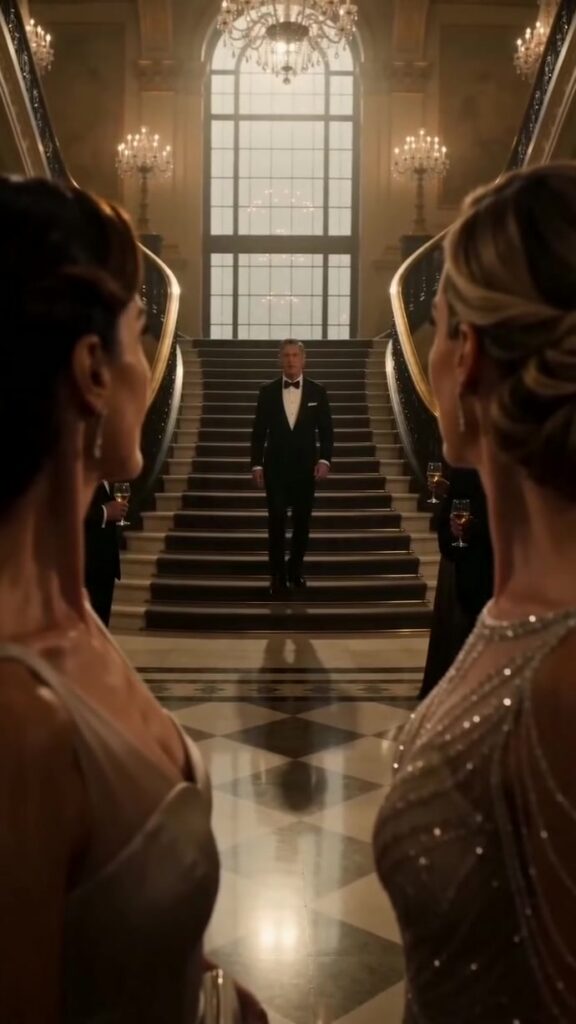
The ballroom glowed in gold—chandeliers blazing like captive suns overhead, their light splintering across a hundred champagne flutes and pooling on the polished marble floor. Violin music drifted through the air in soft, obedient ribbons, the kind of melody that smoothed sharp edges and made strangers feel like friends. Behind every smile was a calculation, behind every compliment a bargain. The city’s finest had come to applaud a new era for Valenor Industries, to be seen within its orbit, to touch its gravity without being pulled too close.
Rosa stood near a column veined with green stone, her hands loose at her sides, a black satin dress falling cleanly to the floor as if it had been poured. She wore no diamonds. She needed no armor that glittered. Her hair was pinned back with a simplicity that felt almost insolent in a room built to worship extravagance. She watched the dancers, the servers, the laughter—untouched by it. The night had a script, and she had read it long ago.
Elena arrived the way a blade enters a sheath: smoothly, with a faint scrape that only the closest ears notice. Her gown was a pale, expensive color meant to imply innocence while promising appetite. She moved toward Rosa with the confidence of someone used to rooms making space for her. The collision was sharp—shoulder to shoulder, champagne sloshing, a violin note stuttering before recovering. Around them, a few heads turned, delighted by the prospect of conflict in a place designed to hide it.
“Move,” Elena said, voice low but engineered to carry. “You don’t belong here.”
The words cut clean, cold and precise, like a scalpel used for something other than healing. Rosa’s gaze did not flicker. The slightest curve of her mouth suggested she found Elena’s certainty familiar—an heirloom passed down through generations of people who had never been told no.
Elena leaned closer, perfume blooming sharp as crushed petals. Her smirk tightened. “Step aside before you embarrass yourself.”
Whispers began—soft at first, then multiplying, the room’s attention shifting like a tide. Rosa could feel it without looking: the weight of eyes, the hope of spectacle. In a ballroom full of power, humiliation was entertainment. She heard her own name, mispronounced and sharpened. She heard Elena’s surname spoken like a shield.
Rosa did not move. She did not speak. Her stillness was not fear. It was patience.
The violin music began to fade—not abruptly, not in a way that would draw blame. It thinned as if the air had changed density, as if the instruments themselves had grown cautious. Dancers slowed, then stopped with awkward smiles, as though the pause were intentional. Silence spread with the quiet inevitability of ink in water.
A single cough sounded too loud. A laugh died halfway out of someone’s throat.
Then the camera of attention—every gaze, every thought—whipped toward the grand staircase.
A figure appeared at the top, framed by gold railings and the cascading light of chandeliers. Victor Valen stood there as if he had been carved into the building the night it was erected. A tailored suit, dark and severe, held his posture like discipline. His expression was controlled, but the kind of control that implied what it cost to keep anger contained.
He began to descend. Measured steps. Commanding presence. The room shifted around him as iron filings shift around a magnet. Guests parted instinctively. Conversations evaporated. Even Elena’s friends, clustered like well-fed predators, straightened as if someone had cracked a whip.
Victor did not look at anyone else. His gaze found Rosa and stayed there, unblinking.
“Welcome home,” he said, each syllable weighted. “Rosa.”
The words landed heavy and immediate, like a verdict. Elena froze. Her expression—so carefully assembled—cracked down the middle, revealing confusion first, then a flash of fear that made her eyes look suddenly young.
The whispers returned, sharper now, the room’s mind trying to catch up. Welcome home. Not welcome here. Home was ownership. Home was inheritance. Home was the kind of word you didn’t offer a stranger in a place like this.
Victor reached the final step. He crossed the marble with the deliberate calm of someone who had already decided the outcome. He stopped beside Rosa, not in front of her. Not shielding her like a fragile thing, but aligning with her, making it clear where he stood.
Elena forced a laugh that came out brittle. “Victor—this is—” She glanced at Rosa as if trying to identify the correct role to assign her. Guest. Employee. Mistake. “I didn’t realize she was with you.”
Rosa turned her head slightly, just enough to look at Elena. Her eyes were steady, calm, unshaken. She had the kind of composure that did not need approval to exist.
Victor’s attention remained on Elena only long enough to make her feel the full weight of it. Then he turned to the room. He raised his voice—not loud, but precise, a tone that assumed obedience and received it.
“Ladies and gentlemen,” he said, and silence tightened in response, “allow me to correct a misunderstanding before it becomes tradition.”
In the front row of onlookers, board members stood rigid, their smiles locked in place like porcelain masks. A senator’s wife clutched her husband’s sleeve. A journalist lifted a phone, then lowered it again, sensing the danger in capturing the wrong second.
Victor extended his hand—not to Rosa’s arm, not to her waist, but open, offering. Rosa placed her fingers in his, and the gesture was simple enough to be mistaken for politeness by anyone who didn’t understand signals in rooms like this. It was not protection. It was acknowledgment.
“The owner of this company,” Victor continued, “the person whose name is on the founding documents and whose signature holds the majority stake—”
Elena’s breath hitched. Her lips parted as if she could interrupt fate itself. One of her friends touched her elbow, then thought better of it and withdrew, suddenly eager to be uninvolved.
Victor’s eyes returned to Rosa, and for a moment the hardness in his face eased, as if he were allowing himself a single honest emotion in public. “—is Rosa Maren.”
The name moved through the crowd like a shockwave. Heads turned, then bowed. Calculations rearranged. Alliances rewrote themselves in real time. A man who had ignored Rosa minutes earlier began to smile too widely, as though his teeth could purchase forgiveness. Someone murmured, “Maren,” with recognition that came too late to be useful.
Elena swayed as if the marble had shifted under her heels. “That’s impossible,” she whispered, the word small in a room built for grand declarations. “She’s… she’s nobody.”
Rosa finally spoke. Her voice was quiet, but it carried because the room was starving for it. “Nobody,” she repeated, tasting the insult as if it were wine, evaluating its quality. “That’s what you needed me to be.”
Victor released Rosa’s hand and stepped half a pace back, giving her the center without pushing her into it. The gesture told the room what to do: look at her. Listen. Understand.
Rosa took a slow breath, as if drawing strength not from the chandelier light but from something deeper—memory, perhaps, or the long practice of endurance. “I was told,” she said, eyes sweeping the faces that had weighed her worth like a coin, “that I should stay away tonight. That it would be kinder. Cleaner. Less complicated.”
Her gaze returned to Elena. “But you don’t get to decide where I belong.”
Elena’s throat worked, searching for words that would restore the world to the shape she preferred. None came. The room had already chosen its new story, and it did not include her at the top.
Rosa turned to Victor. “Will you let them play again?” she asked softly.
Victor nodded toward the musicians. The first violinist lifted his bow with trembling hands, then drew it across the strings. The music returned—hesitant at first, then fuller, as if relieved to have permission. It was the same melody as before, but now it sounded different. Less like decoration. More like consequence.
Rosa stepped forward into the open space between the dancers and the watchers. The chandeliers still glowed. The marble still shone. Champagne still caught light. But the ballroom had changed, as ballrooms do when the wrong person is revealed to be the right one.
Elena stood stranded near the column, her smirk gone, her confidence collapsed into something thin and frightened. She watched Rosa the way people watch a door closing. And as the music swelled, Rosa’s calm remained—a quiet, devastating proof that she had always belonged, even when no one dared to say it out loud.
The night resumed its motion, but the script had been rewritten. And every guest, smiling again with newly practiced ease, understood that a single sentence—welcome home—had turned gold light into a spotlight, and a stranger into an owner.