The radio had only one volume in Mack Dwyer’s garage: low enough to ignore until you couldn’t. It sat on a shelf between a row of dented oil cans and a coffee mug that had long ago become a cup for stray bolts. A weary blues station bled through the speaker’s static, the kind of sound that made time feel slower. Late afternoon sun spilled in from the open door, turning drifting dust into something almost holy. Every so often a tool chimed—metal on concrete, a wrench nudging a socket—and the men’s voices stayed scarce, as if too much talking might wake a problem.
Mack leaned into the engine bay of a faded pickup, forearms stained with grease, hair tied back with the same strip of cloth he’d once used to bandage his own knuckles. He wasn’t old, not really, but the lines at the corners of his eyes had been etched by things that didn’t wash off. Tino worked at the bench behind him, sorting screws by feel, and Landry hovered near the vice, smoking without lighting the cigarette—an old habit for nerves that never got the message that the war was over.
Outside, the street lay quiet. It was one of those hours when the neighborhood held its breath, when dogs didn’t bark and even the passing cars seemed to roll softer, as if the asphalt asked them to. Mack was tightening the last bolt when a sound threaded into the radio hum. It was not music, not speech, not anything the men expected from the peaceful afternoon.
Drag. Pause. Drag.
The noise was faint at first, like something heavy being pulled across tile. Then it came again, closer, sharper, wrong. The radio’s bluesline faltered under it, not in volume, but in attention—the way a conversation dies when someone says the name of a dead friend.
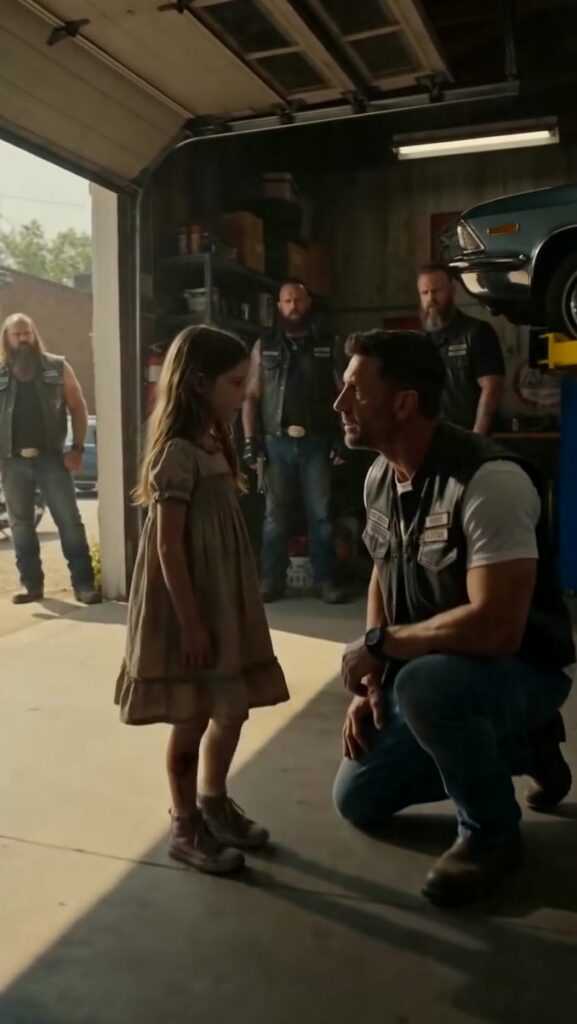
All three men turned toward the doorway at once. The open garage door framed the world outside like a stage, bright with sun, and in the center of that brightness stood a child. She was no more than seven, maybe eight, her outline dark against the light. For a moment she didn’t move, and Mack had the odd thought that she might be a trick of his eyes, a shadow shaped like a person.
Then she stepped forward.
She did not walk so much as argue with the floor. One foot came down flat; the other arrived late, reluctant, angled as if it had forgotten its job. Drag. Pause. Drag. The sound scraped along Mack’s spine. The girl’s hair was unbrushed, her dress a thin cotton thing that had seen too many washes. When she reached the threshold she stopped, blinking as if the garage light was a different kind of daylight altogether.
“My leg,” she said, and her voice was small but strained, as if she’d been saving it for the right person. “It feels wrong.”
Silence spread like oil. The ratchet in Tino’s hand froze mid-click. Landry’s unlit cigarette slipped from his fingers and hit the floor without anyone watching it fall.
Mack wiped his hands on a rag and took a step, keeping his movements gentle. He’d seen dogs flinch under a raised hand; he’d seen grown men flinch under kindness. He knelt in front of her, lowering himself to her height the way you did for something fragile.
“Hey,” he said, and he hated how calm his own voice sounded, like a mask he’d learned to put on. “You’re alright. What’s your name?”
The girl stared at him as if she was searching his face for a lie. Her eyes were tired in a way that didn’t belong to childhood. Not sleepy tired—spent tired, like a candle that had burned too long in a room with no air.
She didn’t answer. She looked past him into the garage, at the rows of tools that could fix nearly anything made of metal. Then she looked down at her own legs, and her mouth tightened, as if making a decision hurt.
Slowly, she pinched the hem of her dress between thumb and finger and lifted it just enough to show what she meant. The skin above her knee was mottled with bruises in old colors: yellowing green, dark purple, the sickly brown of healing done wrong. There were marks that weren’t bruises, too—small crescents, finger-shaped shadows. Her knee itself looked slightly swollen, her shin scraped raw in places where the dragging had taken its toll. The way she held herself was careful, like someone guarding pain so it wouldn’t spill and make her seem troublesome.
Mack felt something inside him misfire. Concern did not grow into anger; it snapped into it. He kept his face steady because children watched faces like they were weather reports, but his heart began to beat like it was trying to kick down a door.
“Who did that?” he asked, and the words came out low, scraped by something rough in his throat.
Her gaze dropped to the concrete. The garage smelled suddenly sharper—gasoline, rubber, the metallic bite of blood that wasn’t there but might as well have been. When she looked up again, she did it slowly, as if she was lifting something heavy inside her.
“No one,” she said.
That answer should have been too easy. It landed wrong, like a part that didn’t fit but had been forced in anyway. Mack didn’t speak. Behind him, he could feel the men holding still, as if movement might shatter whatever this moment was becoming.
The girl’s voice thinned. “They said it’s normal.”
The sentence hung in the air, heavier than any engine block Mack had ever lifted. Normal. The word belonged to scraped knees from playgrounds, to the sting of a bee, to a fall from a bicycle. It did not belong to that bruising, that careful way she kept her weight off one side, that tiredness behind her eyes.
Mack wanted to ask who “they” were, but something warned him not to. Not yet. He had learned that questions could be weapons if you swung them too fast. He forced his hands to stay open, palms visible, empty. “Does it hurt right now?” he asked instead.
She nodded once. A restrained motion, like even agreement cost her.
Mack reached for the rag again and used it to cushion his touch as he examined her leg without pulling or twisting. The joint felt warmer than it should. He imagined ligaments stretched, tendons bruised, maybe worse. He imagined the kind of home where a child learned to call pain normal because the alternative—calling it wrong—would invite something worse than pain.
“Alright,” Mack said, though he didn’t feel alright. “We’re going to help you.” He looked over his shoulder at Tino and Landry, and the look said everything he didn’t trust his voice to say.
Tino swallowed. “We call an ambulance?”
Landry’s jaw tightened. “Or the police.” He said it like a curse.
Mack’s gaze returned to the girl. A siren could be salvation or it could be a signal flare to whoever had taught her that this was normal. He thought of the houses on this block with curtains always drawn, of the way some children never played outside. He thought of whispers that traveled through a neighborhood like smoke: don’t get involved, you don’t know what people are capable of.
He thought, too, of the shape of her silence. It wasn’t stubbornness; it was training.
“What’s your name?” he asked her again, softer. “You can tell me. You’re safe here.”
For the first time, something flickered across her face—an emotion so quick it might have been a trick of light. Hope, maybe. Or fear of hope. She opened her mouth, closed it, then whispered, “Mara.”
Mack repeated it like a promise. “Mara.” He stood carefully, as if rising too fast might scare her, and shrugged off his jacket. He laid it over her shoulders, the fabric swallowing her small frame. “We’re going to get you looked at,” he said. “And we’re going to make sure nobody tells you ‘normal’ ever again when they mean ‘quiet.’”
At that, Mara’s eyes widened—not at the words, but at the certainty behind them. The radio continued its low murmur, oblivious. Dust floated through sunlight. Tools waited on their hooks.
But the garage was no longer just a place for repairs. It had become a threshold. Mack could feel it: one step, and everything in his life would either break or finally become useful. He lifted Mara gently into his arms, and she didn’t resist. In the quiet, the sound of her uneven dragging was gone, replaced by the hard, steady rhythm of Mack’s heartbeat as he carried her out of the light and into whatever came next.