The engines were quiet, and that was the first wrong thing.
At the edge of the county fairgrounds, where the cracked asphalt met a line of pines, hundreds of motorcycles sat in rows like sentries awaiting an order that would never come. Chrome dulled under a slate sky. Leather vests, patched and weathered, formed a dark sea around a single open space in the middle, where an oil-stained coffin rested on a low stand. Somebody had draped a banner over it—not the bright, ceremonial kind you saw on televised parades, but a faded piece of cloth that looked like it had ridden in rain and sun and road grit for years. It might have been a flag once. It might have been a promise.
The crowd didn’t shuffle. They didn’t whisper. They didn’t do what crowds did. They held still like men and women trying not to startle a memory.
Cal Mercer stood at the front of them with his hands folded together because he didn’t know what else to do with them. They were hands that had twisted throttles and tightened bolts and pushed broken machines over miles of empty road. Today they felt too big, too clumsy, as if grief had made them belong to someone else.
He’d been the one to insist on silence. “No revving,” he’d told the club the night before. “Not this time.”
Some had stared at him like he’d spoken a foreign language. Engines were how they mourned. Engines were how they spoke when words failed. But Cal had looked at the coffin, at the nameplate—RAY “RATCHET” GARNER—and the idea of thunder seemed like an insult. Ratchet had hated noise for noise’s sake. Ratchet had liked a clean line, a clean fix, a clean end.
Yet the quiet had turned sharp. It pressed on ears and made every breath sound loud. It made the day feel staged, like the world was waiting for an actor to hit his mark.
Then the actor arrived.
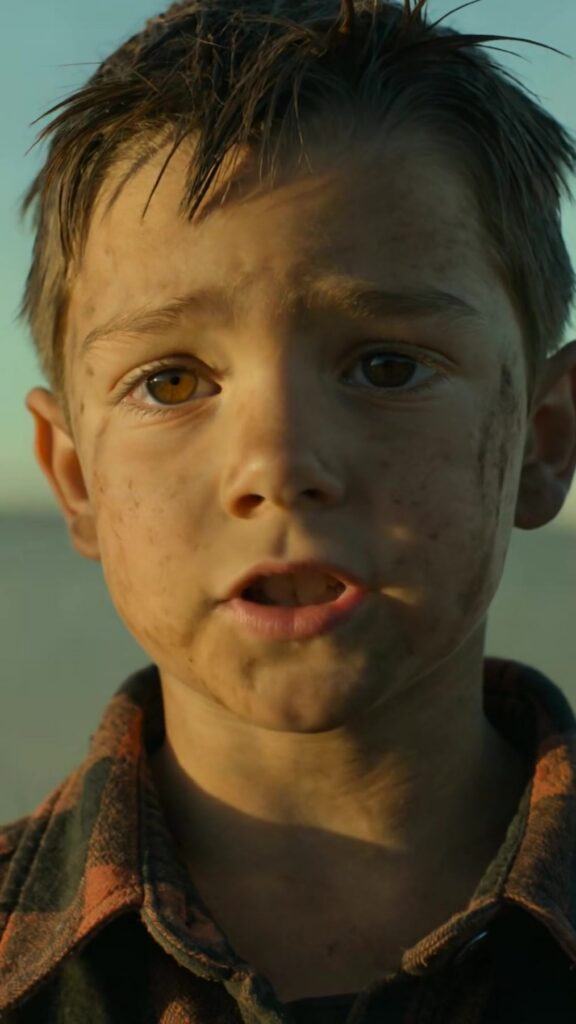
He came from the road with no bike, no car, no adult hand guiding him. A boy—maybe ten, maybe twelve—walking straight toward the fairgrounds gate. He wore sneakers too thin for the gravel and a black hoodie that swallowed his shoulders. His hair was dark and wind-mussed, and his face had the set, closed look of someone who’d practiced not crying until he could do it on command.
A ripple moved through the bikers. Heads turned. A few hands drifted toward belts out of habit. Cal felt his chest tighten. Outsiders didn’t stroll into club gatherings like this, not now, not with law and rivals always hunting for a reason.
“Whose kid is that?” someone muttered behind him.
No one answered, because no one knew. Yet, as the boy walked forward, a strange thing happened: nobody stopped him. A man stepped sideways without thinking. A woman shifted her boots back to clear his path. The corridor opened as if the crowd had been instructed.
Cal watched the boy pass between patched backs: red serpent, silver skull, the names of towns and dead friends stitched in thread. The boy didn’t look at the patches like they meant danger. He didn’t look at the coffin like it scared him. He walked as if he’d been here before, as if there was one specific place he needed to reach and nothing else mattered.
He stopped in front of Cal.
Up close, Cal could see dust on the boy’s lashes and a thin scab on his knuckle. He held his arms folded to his chest. For a second Cal thought he was hugging himself.
Then the boy unfolded his hands.
He was holding a bundle wrapped in cloth. The cloth was folded with care, corners tucked, edges pressed flat. Cal recognized the pattern even before the boy lifted it higher: red and white stripes, a field of blue. A flag, but not new—creased and worn in a way that meant it had traveled, had been clutched, had been carried in a pack and pulled out again and again like a talisman.
Someone whispered, “A flag,” with a disbelief that sounded almost like anger, as if the world had no right to bring the military into their private mourning.
The boy’s eyes stayed on Cal’s face. “This is for you,” he said. His voice was soft but steady, like he’d rehearsed it.
Cal hesitated. His throat tightened. “Where’d you get that?” he asked, and it came out harsher than he meant.
The boy didn’t flinch. He opened the cloth just enough to show what sat inside, tucked carefully into the folds.
Dog tags. A chain looped twice around them, metal dull from age. The tags themselves were scarred, letters stamped deep. Cal’s breath left him.
Because there were only a handful of reasons a boy would be carrying those.
Because Cal recognized the shape of that chain, the way it kinked at the clasp. He’d seen it dangling from a rearview mirror once, swinging with the road, catching the light.
His hands, those useless hands, reached out anyway. He took the bundle as if it might burn him.
The boy watched him like a witness.
Cal unfolded the last corner and read the name.
HAWK DONOVAN.
His mouth opened, but sound failed. The name hit like a fist. The fairgrounds blurred. A noise rose in his ears, a phantom of engines that weren’t there.
“No,” he breathed, and then he swallowed the word because it wasn’t a protest so much as a prayer. Hawk Donovan had been missing for fifteen years. Hawk Donovan had vanished in a sandstorm half a world away, and the official letters had been polite and final. No remains. No closure. A ghost with a serial number.
Cal heard himself say the name again, the way you say something you know will break if you speak it too loud. “Hawk Donovan…”
His voice cracked on the last syllable. Around them, the bikers leaned in. Even Ratchet’s widow, Janelle, took a step forward, her eyes bright with questions she didn’t dare voice.
Cal stared at the tags until the letters became grooves, until his vision sharpened on the smallest detail: a nick along the edge, right where Hawk used to worry it with his thumb.
“He made it home,” Cal said, and the words sounded wrong in the open air, like they didn’t belong to the laws of time.
Silence landed heavier than the coffin. The kind of silence that didn’t just fill space—it erased it. The wind stopped. Even the distant highway seemed to hold its breath.
The boy spoke again. “He said you’d understand.”
Cal looked up, and in that moment he saw what he’d missed before. The boy’s chin had Hawk’s stubborn angle. The eyes were darker, but the shape—wide-set, watchful—was a mirror. The boy’s gaze didn’t beg. It demanded, as if a debt was about to be collected.
Cal’s mind ran, stumbling. Hawk hadn’t had kids. Hawk had been a man who lived like tomorrow wasn’t promised. Hawk had been the one who rode too fast into storms and laughed when the sky tried to scare him. Hawk had left behind a jacket in Cal’s garage, a dog-eared photo, a half-finished letter with coffee stains on the corner.
“What’s your name?” Cal asked, though he already felt the answer in his bones.
The boy’s throat moved as he swallowed. “Eli,” he said. “Eli Donovan.”
A few people exhaled sharply. Someone swore under their breath. Ratchet’s widow made a sound like she’d been punched, one hand flying to her mouth.
Cal held the tags so tight the chain pressed into his palm. He searched the boy’s face for a lie and found only the exhaustion of truth.
“Where is he?” Cal asked. “Where’s Hawk?”
Eli glanced at the coffin, then at the bikes, then back to Cal as if measuring how much pain these people could carry on one day. “Not here,” he said. “Not like that.”
“Then how?” Cal demanded, and he hated the edge in his voice, hated that grief made him sharp. “You don’t just—”
Eli lifted a hand. In it was something else, small and plain: a key. Not a bike key with a fancy fob, but an old brass key with teeth worn smooth. A strip of tape was wrapped around the top, and on the tape, in blocky handwriting, was a name: MERCER.
Cal’s chest tightened until it hurt to breathe.
“He told me to find you when the engines went quiet,” Eli said. “He said the quiet would mean someone important was gone, and that you’d be there trying to hold it all together like you always do.”
Cal couldn’t speak. He didn’t know which part of the sentence to grab first. The engines. The quiet. Someone important gone. Ratchet. Hawk. A key with his name.
Eli leaned closer. His voice dropped so only Cal could hear. “He said Ratchet didn’t die the way everyone thinks. He said it was the last loose bolt.”
The world narrowed to a pinprick. Cal saw Ratchet’s coffin and, behind it, the faces of his club—people who’d bled together, fought together, buried too many. He saw the bikes lined like a barricade against the past. He saw the boy standing alone in front of them all, carrying a war’s worth of metal and a promise folded into cloth.
“Where did you come from?” Cal whispered.
Eli’s eyes flicked toward the pines, where the shadows thickened. “From where he’s been,” he said. “From where he couldn’t come back until you were ready to listen.”
Cal looked down at the key again. His own name stared back at him, ink faded but stubborn. A key meant a lock. A lock meant a door. A door meant something hidden, something saved.
He closed his fingers around the key and felt the jagged edge of possibility.
Behind him, Janelle let out a slow, shaky breath. “Cal,” she said, her voice trembling. “What is this?”
Cal didn’t answer her. Not yet. He couldn’t. Because the boy was right: something about this wasn’t finished.
He lifted his head and looked out over the crowd. Hundreds of faces watched him, waiting for the ritual to resume, waiting for him to speak the words that would let them go home and turn the noise back on. But the engines were quiet, and now Cal understood that the quiet wasn’t only mourning.
It was a signal.
Cal stepped aside from the coffin and made space for the boy beside him. The gesture felt like opening a gate. Eli didn’t hesitate. He stood at Cal’s shoulder as if he belonged there, as if he’d been walking toward this moment for years.
Cal raised the flag-wrapped tags in both hands, letting everyone see the name stamped into metal. The gasp that followed was not the loud kind. It was a collective intake, a roomful of lungs discovering they could still be shocked.
“This isn’t just a funeral,” Cal said, his voice carrying without him forcing it. “It’s a message.”
He looked down at Eli, and Eli nodded once, solemn and certain.
In the distance, a single engine turned over on the highway—far away, not theirs. It sounded like thunder remembered.
Cal tightened his grip on the key. “After we lay Ratchet down,” he said, “we’re going to find out why Hawk Donovan sent his son to walk through our ranks without a single person stopping him.”
He paused, and when he spoke again, the words cut through the fairgrounds like a blade. “And we’re going to find out who made the engines go quiet.”
Not one bike revved in reply.
But every hand in the crowd flexed, every jaw set, every eye sharpened on the same thought: the road had called them back to unfinished business, and this time, the silence would not be polite.
Eli stood straight beside Cal, small in a world of giants, holding his grief like a compass.
And Cal Mercer, who had buried too many friends and sworn too many oaths, finally understood what Hawk meant.
The quiet wasn’t the end.
It was the start.