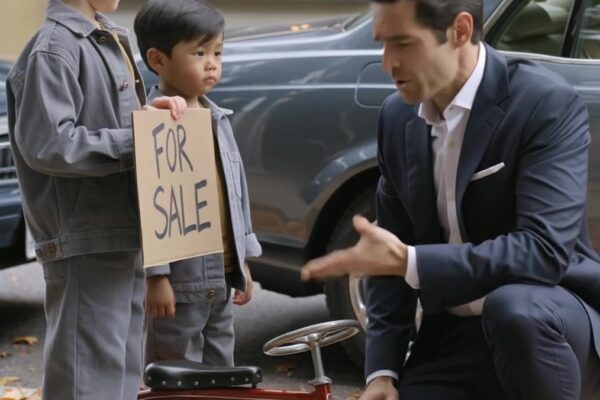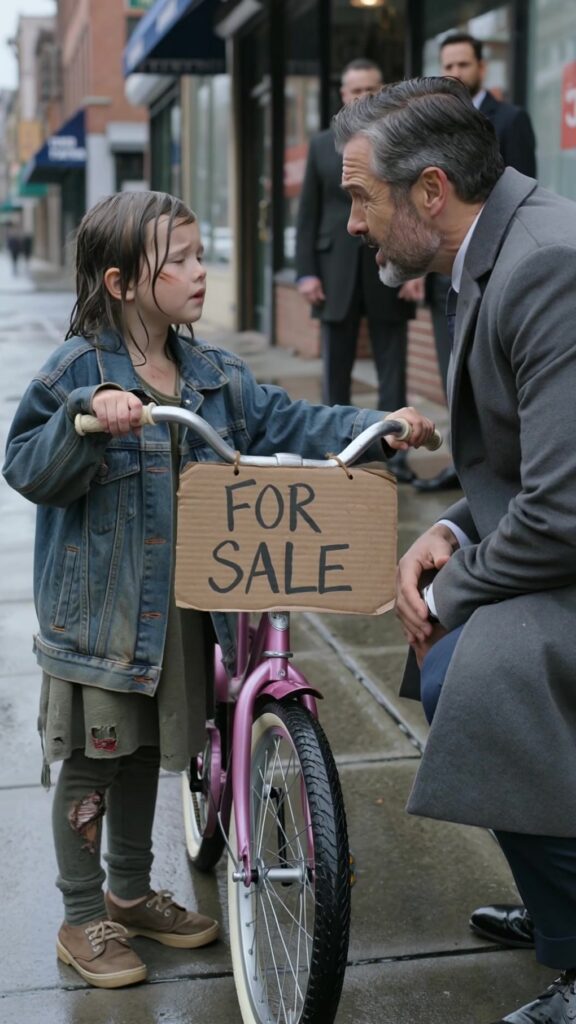
The little girl was not trying to sell the bicycle. That was only what her soaked cardboard claimed in thick marker, the letters bleeding at the edges like bruises. She stood in the narrow strip between curb and storefronts, the rain turning the afternoon into a single gray smear, and she held the small pink bike as if it were a door she could keep shut by force alone. Cars hissed over the wet street. A bus sighed past. People moved around her like water around a stone, quick glances, no stopping.
Across the sidewalk, just under the awning of a closed jewelry shop, four men waited. They were dressed too neatly for this weather—dark suits, dark shoes that didn’t seem to pick up grit, hands hidden in coat pockets. They didn’t talk. They didn’t need to. Their attention kept returning to the girl, to the bicycle, to anyone who slowed down. The girl didn’t look at them. She stared at the ground in front of her feet, like the pavement could be persuaded to open and swallow her whole.
When the man in the gray overcoat approached, he didn’t do it with the cautious gait of someone buying a used bike. He walked like someone who had been summoned by a sound he couldn’t quite identify. He stopped at the edge of her space and, before he could speak, she lifted her chin and delivered words that sounded practiced and borrowed.
“Excuse me, sir,” she said, voice thin as thread. “Would you buy my bicycle?”
He looked at her more than the bike. She was ten, maybe eleven, but the way she kept her shoulders braced made her seem older and smaller at once. Wet hair clung to her cheeks. One sleeve was darker where it had been rubbed against her face. He saw a faint purple mark on her wrist where a hand had squeezed too hard, too recently.
“Where’s your mother?” he asked.
The girl’s mouth opened as if to release a lie. What came out instead was the truth, and it shook on the way into the air. “At home. She’s… she can’t get up.”
He lowered himself slightly, not quite a crouch, to hear her over the rain and to keep his own voice from carrying. “Are you hungry?”
Her eyes flicked, briefly, to the men beneath the awning. It was the quickest betrayal—an instinctive check of a threat—then back to the man’s face. “My mom hasn’t eaten,” she said. “In days.” She swallowed hard. “I sold the toaster. I sold the lamp. I tried—” Her words snagged. “This is the last thing.”
Concern crossed his face, but it wasn’t the sentimental kind she’d seen from strangers who dropped coins and continued walking. It was alert, sharp, the expression of someone who had heard a child say something no child should be carrying. The man’s gaze lowered to the sign taped to the bike’s frame. FOR SALE, it read. But underneath, the cardboard was chewed up, as if someone had scraped at it with a key until the surface broke.
He leaned a fraction closer, shielding the sign with his shoulder from the rain, and made out a second layer of lettering beneath the smeared marker. It wasn’t fully erased—just wounded. Two words remained clear enough to sting: FOR HER.
The girl’s fingers tightened on the rubber grips. The knuckles went pale. She didn’t speak at first; only her breathing changed, shorter, careful. Then, without letting her lips move much, she pushed sound through her teeth like a secret being smuggled out.
“Please,” she whispered, “buy it before they ask for the key.”
The man froze. “What key?” he murmured, barely audible.
Her gaze stayed on his coat buttons, not on his eyes. “The key to the pink one,” she said. “They said… if I couldn’t sell it, I had to give it. And then…” The rest threatened to spill and she bit it back, jaw trembling. “They said I’d have to come with them. To pay.”
He didn’t look over his shoulder. He didn’t need to. He could feel the four men’s patience, that practiced stillness predators learn. He took a breath that tasted like cold metal and wet wool, then made a decision that felt older than his own life.
“All right,” he said, loud enough now to sound ordinary. A buyer’s voice. “How much?”
The girl’s eyes widened, just a hair. She hesitated, as if the number had been chosen for her. “Fifty,” she said.
He nodded as though fifty dollars were the most reasonable price for a child’s rain-warped bicycle. He reached into his coat slowly, making a show of rummaging, and pulled out his wallet. While his fingers moved, he watched the men in the window’s reflection: one straightened, another turned his head, a small shift of attention like a knife drawn slightly from its sheath.
He peeled bills out—more than fifty, all he had in cash—then folded them so they looked like a single stack. “Take this,” he said. “And listen to me. Do you have a phone?”
She shook her head once.
“Do you know where the police station is?”
She made the smallest no, a motion that barely disturbed the water clinging to her lashes.
He held the money out as if concluding a simple transaction. “Then you’re going to do exactly what I say,” he continued, voice calm. “You’re going to walk into that bakery.” He nodded toward the lit storefront two doors down, where the smell of bread fought bravely against the rain. “You’re going to tell the woman behind the counter your name. You’re going to tell her you’re with me. And you’re going to ask her to call the number I’m about to give her.”
“They won’t let me,” the girl breathed. “They’ll—”
“They’ll have to,” he said, and for the first time his tone sharpened. “Because you will be inside, with witnesses. And I will be outside, with them.”
The girl stared at him, trying to understand why a stranger would volunteer for the outside. Her hands slackened on the grips, not in relief, but in bewilderment.
He set his wallet back into his pocket and, with his other hand, took hold of the bicycle’s seat. He didn’t pull it from her; he shared the weight. “Give me the key,” he said quietly.
Her eyes filled, and he saw the moment she chose to trust him. From the cuff of her wet sleeve, she produced a tiny metal key on a thin string—so small it looked like it belonged to a diary, not a bike lock. She pressed it into his palm like it was a heartbeat.
The men under the awning began to move. Not fast. Not yet. They stepped off their island of shelter and onto the sidewalk, their shoes darkening in the rain. Their pace was a practiced intimidation: slow enough to suggest confidence, steady enough to promise inevitability.
The man in gray did not step back. He raised his voice again, bright and public. “Fifty dollars for this? You drive a hard bargain,” he said, smiling as if the world were simple. Then, quieter, he added, “Go. Now.”
The girl gathered the money to her chest and, for the first time, released the handlebars. She turned and walked—one step, then another—toward the bakery’s warm window. She did not run; running would confirm a chase. She moved like someone trying to look like a child on an errand.
Behind her, the man rolled the bicycle forward a few inches and positioned it between himself and the approaching suits, as if the toy-sized frame could be a barricade. He watched the nearest man’s eyes flick down to the key still visible in his fingers, then back up, expression hardening.
“That’s not yours,” the nearest man said, voice smooth as oil.
The man in gray held the key up, letting it catch what little light the day offered. “It is now,” he replied, just as smoothly. “I paid for it.”
Rain struck the sidewalk in furious, delicate needles. Through the bakery window, the girl’s silhouette appeared at the counter, small hands gesturing urgently. The woman behind the counter leaned in, her posture changing from polite to alarmed.
The four men spread slightly, as if to surround him without making it obvious. The man in gray felt his pulse hammer, but he kept his voice even. “I’m sure we can all pretend this is a misunderstanding,” he said, and allowed his eyes to move, at last, over their faces. “But if you try to take her, there will be witnesses. Cameras. Phone calls. And I will make it loud.”
The nearest man’s mouth tightened. “You don’t know what you’re stepping into.”
“No,” the man in gray said. “But I know what I’m stepping between.”
Across the street, a siren rose—not close yet, but approaching, its wail threading through the rain like a promise. In the bakery, the girl turned her head and looked back through the glass. Their eyes met for an instant, and he saw something flicker inside her fear: a fragile, astonished hope, like a candle finding air.
He wrapped his fingers fully around the little key and stood his ground, holding the bicycle as if it were not a thing for sale, but a line that could not be crossed.