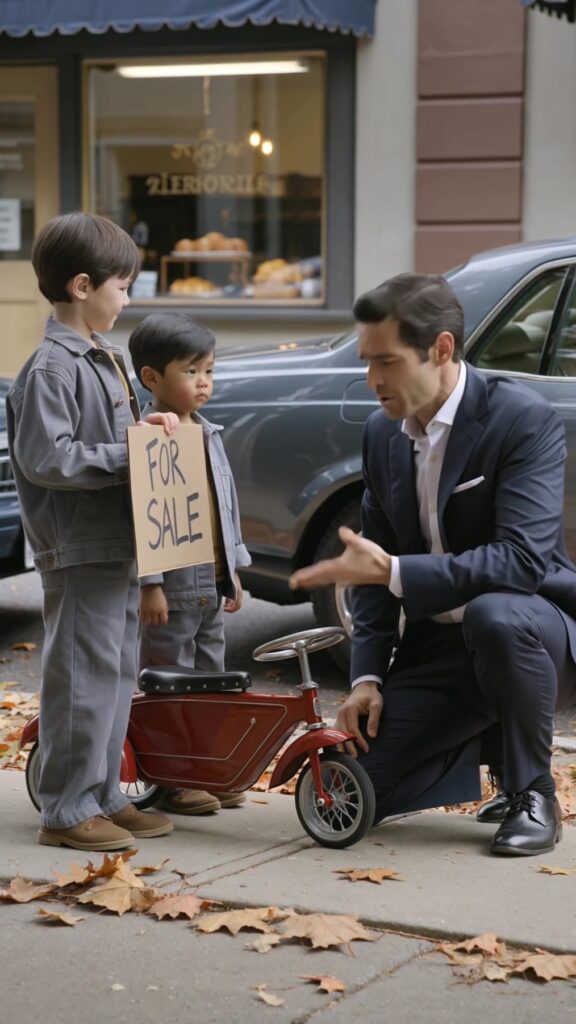
The little red pedal car was worth almost nothing, the kind of thing people left on curbs with a sign that said FREE, the kind of thing a man in a blue suit might not even see if he was thinking about quarterly reports and the weight of his own name. Its paint was rubbed down to a dull cherry in places. One headlight was missing. A strip of tape held the seat together like a bandage.
Yet on the autumn sidewalk, where orange leaves skittered like nervous hands across the concrete, the car sat as if it had been placed on an altar.
Behind it stood two boys with the posture of people waiting for bad news. The older one held a piece of cardboard with block letters drawn in a thick marker: FOR SALE. His knuckles were white. His little brother was pressed so close to his side that their sleeves touched, and he stared at the bakery window as if the warm glow inside could heat him through the glass.
The man in the blue suit stepped out of his dark sedan and paused, irritated at first by the thought of being delayed. He was late for a meeting across town and early for his own loneliness. He had been rehearsing phrases in his head—merger, restructuring, consensus—when the sight of the boys cut through his practiced language.
They did not look eager. They looked as if the street had demanded something from them and they were surrendering it. The older boy kept licking his lips and swallowing. The younger boy’s eyes shone too brightly, the way eyes do when a child has been told not to cry.
The man, Elias Harrow, took one step closer and noticed the blue ribbon tied around the toy’s small steering wheel. The ribbon was faded, but its knot was careful. It was not the kind of detail a child added by accident. It was ceremonial.
Elias’s irritation slipped and something else took its place—an old habit of attention, like a muscle remembering how to do its work. He lowered himself to a crouch. The car smelled faintly of dust and apples.
“You’re selling this?” he asked, keeping his voice soft so it wouldn’t frighten the boys into disappearing.
The older boy nodded quickly. “Yes, sir. It’s mine.” He tried to stand taller as he spoke, as if height could turn fear into courage.
Elias touched the cracked edge of the steering wheel. It was warm from the sun and from hands that had held it hard. “It looks like you’ve had it a long time.”
“Since I was three,” the boy said. His gaze flickered to his brother and then away again.
“Why would you sell your favorite toy?” Elias asked, and the question came out harsher than he meant, because he couldn’t find the logic. Children did not trade joy for coins unless the world had cornered them.
The older boy’s throat worked. “Because our mommy needs medicine.”
The younger boy turned his face toward the bakery window and pressed the heel of his hand to his eye, quick and furious, like he was angry at the tears for arriving.
The sentence landed on Elias as if someone had shoved him. He saw, all at once, the boys’ cuffs fraying, the cheap thinness of their shoes, the way the older one kept shifting his weight as though he had learned to be ready to bolt. He imagined a kitchen without enough food, a dark bedroom with a woman trying not to cough too loudly so her children could sleep. He imagined a bottle of pills measured out like treasure.
“How much are you asking?” Elias said. He hated that he asked it; it sounded like bargaining with a fire.
The older boy held up two fingers. “Twenty.” Then, as if fearing that number might anger this stranger, he added quickly, “Or… whatever you can do.”
Elias’s eyes went back to the ribbon. A memory rose, sharp and bright as broken glass.
Years ago, he had stood in a small flower shop with a spool of ribbon exactly that shade of blue. He had wrapped a box with ridiculous care, because the woman it was for—Marin Vale—had laughed at the way he treated gifts like contracts. Inside the box had been a tiny pair of socks. She had placed them in his palm and said, trembling, “I think it’s real this time.”
He had tied the ribbon into a knot that he promised himself would never be undone.
Marin had vanished three weeks later with nothing but a duffel bag and a letter that said she was sorry, and then silence that stretched for years. Elias had tried to find her in ways that embarrassed him now: private investigators, late-night drives past addresses he didn’t fully believe, calls that went straight to dead numbers. Eventually, he had had to let the silence win, because he was drowning in it.
Now the ribbon sat on a child’s toy like a ghost wearing familiar clothes.
Elias found he was holding his breath. “Who is your mother?” he asked, and heard the faint tremor he could not control.
The older boy blinked as if he hadn’t expected the question to matter. He glanced at his brother, who stared down at his own shoes and said nothing. Then the older boy reached into his pocket and pulled out a folded paper, creased and softened by being opened many times.
“She said if anyone asked, I should show this,” the boy murmured. There was a complicated pride in his voice, pride at having remembered and fear of what the paper might cause.
Elias took it with fingers that suddenly felt too big for his hands. It was a pharmacy receipt—ordinary thermal paper with fading ink. The top had a printed name: Marin Vale. Underneath were medication codes and prices that looked like insults. Toward the bottom, in the section labeled emergency contact, there were two words that made Elias’s stomach fall away from his body.
Father unknown.
The world seemed to tilt. The bakery’s warmth became distant, a stage light behind glass. The traffic noise thinned to a hum. Elias stared at the line as if the ink might rearrange itself into something kinder if he watched hard enough.
“That’s… her,” he said, and the sentence tasted like ash. He looked up at the older boy. The child’s face was narrow, his eyes a stormy gray, and his expression—a stubborn attempt at bravery—hit Elias in a place he hadn’t known was still tender. “Her name is Marin?”
“Yes, sir,” the boy said. “But she tells people it’s Mary now.”
Mary. Elias remembered Marin saying once that she could live with another name if it bought her peace. Elias had thought it was a joke.
“Where is she?” he asked. His voice went too loud, then he forced it down again. “Where do you live?”
The older boy hesitated. He’d been taught not to give strangers directions to his home. Elias saw the warning in his eyes, saw the battle between desperation and caution. The younger boy finally looked at Elias, and for a second the child’s face held the raw question that adults were always too proud to ask: Are you danger or rescue?
Elias folded the receipt carefully and handed it back as if it were a fragile relic. “I’m not going to hurt you,” he said, and then realized how useless those words were. Everyone dangerous said them.
He pulled his wallet out anyway, but stopped. Money suddenly felt obscene, a flimsy tool for a wound that had been open for years.
“What are your names?” he asked instead, because he needed something solid.
“I’m Cal,” the older boy said. “He’s Owen.”
Cal. Owen. Elias repeated the names silently and felt something in his chest answer, as if a locked room had heard its key turning in the hall.
“Cal,” Elias said slowly, “I think I knew your mother a long time ago.”
The older boy’s grip tightened on the cardboard sign, the letters trembling. “You did?”
Elias stood, because he needed the air higher up, and looked down at the little red pedal car again. It sat patiently, battered and brave, as if it had carried these boys through a thousand games and now was being asked to carry them through something far worse.
He reached into his suit jacket and pulled out his phone. His hand shook, but his voice did not. “I’m going to take you to her,” he said. “And I’m going to pay for the medicine. All of it. But first I need you to trust me enough to show me where she is.”
Cal’s eyes filled but he did not let the tears fall. He looked at Owen, who gave a small, terrified nod. Then Cal nodded too, once, as if signing his name at the bottom of a contract he didn’t fully understand.
Elias glanced at the bakery window, the glow that had seemed warm now feeling like a witness. He bent down, lifted the pedal car by its cracked body, and felt its surprising weight in his arms. The ribbon brushed his wrist.
Almost nothing, the world would say.
But he carried it like it was proof—proof that what he’d lost was not entirely gone, proof that the past had been waiting in plain sight on a leaf-strewn sidewalk for him to finally look down and see it.
“Come on,” he told the boys, and heard the plea in his own words. “Let’s go home.”