The bell over the diner door didn’t jingle so much as complain, a tired little sound swallowed by the steady hush of plate clatter and the hum of old heaters. Warmth sat in the corners like dust. Everything in the place—vinyl booths, chipped mugs, a neon sign that had been glowing since someone’s childhood—pretended it could keep the world outside at a respectful distance.
That illusion lasted until a chair legscreamed across the floor.
Every face turned. Forks hovered. A waitress midway through refilling coffee froze with the pot angled wrong.
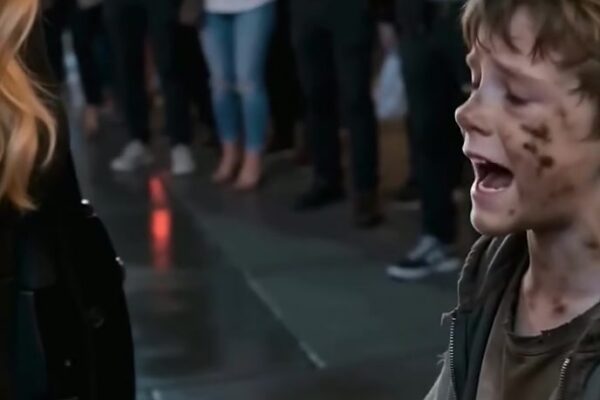
A boy in a red hoodie stumbled between tables, crying hard enough his ribs hitched like he was trying to outrun his own lungs. He wasn’t looking for comfort. He was looking for cover. He barreled straight into the back of a man seated alone at the counter and clamped both hands into the sleeve of the man’s battered leather jacket, twisting fabric and flesh together like rope.
The man rose immediately.
Not startled. Not irritated. No, he moved like he’d been standing up to trouble his whole life, like his body had learned the timing before his mind needed to understand. He didn’t peel the boy away. He didn’t even glance down at the small fingers whitening around his sleeve. He stared at the glass front of the diner as if he could see through daylight and brick and years.
The scars across his face—thin and jagged, older than the dark stubble on his jaw—pulled when he tightened his mouth. People had the sense not to ask how he’d gotten them. Scars like that belonged to stories that ended with someone not coming home.
The boy pressed himself behind the man’s leg, trembling so violently his hood bobbed with each breath. “Please,” he rasped, though it didn’t sound like he was begging the man. It sounded like he was begging the room not to become what he knew it could become.
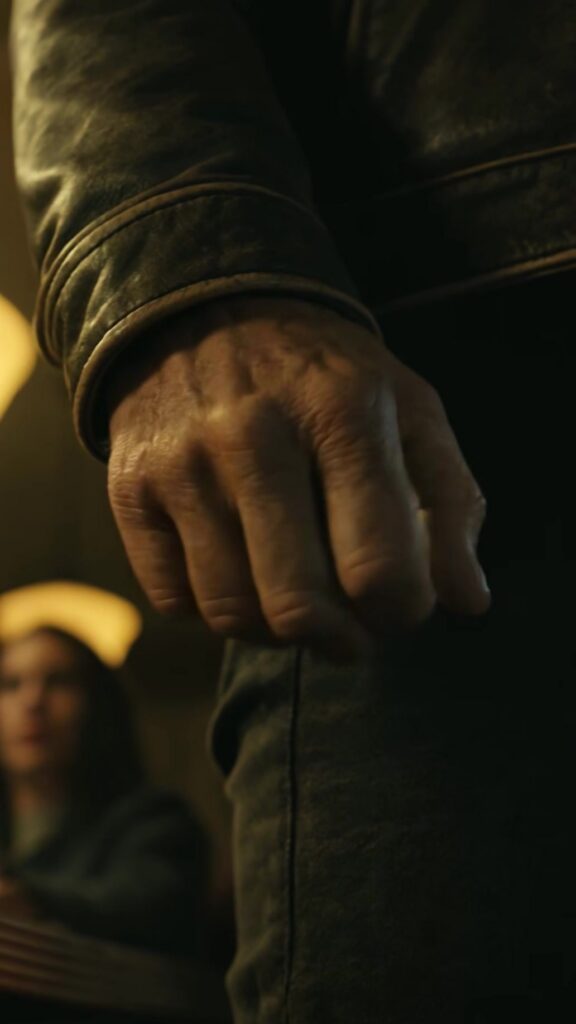
The scarred man’s hand closed slowly at his side. Not theatrical. Deliberate, like a door being locked.
Outside, through the pale smear of winter light on the window, two figures approached across the parking lot. They wore dark hooded coats, heads down against the wind—ordinary shapes, ordinary enough that a person could talk themselves into looking away. But the way they walked didn’t belong to ordinary people. They moved in a straight line, no hesitation, as if the world had been measured and decided and they had been sent to correct it.
When they reached the door, the man’s face shifted—not into fear, but into recognition that carried weight. Something old returned to his eyes, something that didn’t like to be reminded it was still alive.
The boy’s fingers tightened until the leather creaked. He whispered, barely loud enough to be heard over the soft sizzle from the kitchen. “They found me where you said they would.”
The man finally looked down. His gaze met the boy’s—wide, wet, and furious with terror. In that moment there was no tenderness on the man’s scarred face, only a hard kind of decision. “Stay behind me,” he murmured. “No matter what.”
The bell complained again as the door swung inward. Cold air spilled in, carrying the scent of gasoline and salt from the road. The two hooded figures stepped into the diner as if they owned it. One of them scanned the booths. The other’s eyes went straight to the man with the scars, as if they’d been following him across seasons, not streets.
“Evening, Calder,” the nearer one said. His voice was calm. Too calm. The kind of calm that made violence feel inevitable.
Calder didn’t answer. He shifted a fraction, angling his body so the boy vanished behind him. A few customers lowered their gaze. Someone at the back slid off a booth seat and headed quietly for the restroom, not wanting to be in the open when whatever was about to happen happened.
The hooded man took a step forward. “We’re not here for your audience. Just the kid.”
The boy made a small sound, a breath snagging on a sob. Calder felt it through his pant leg. Fear traveled like electricity. It reminded him of other nights: asphalt wet with rain, a siren far away, the taste of blood in his mouth while someone else’s footsteps closed in.
Calder spoke then, voice low, pitched to carry without rising. “You picked the wrong place.”
The second figure, taller, shoved his hood back. The fluorescent lights caught a sharp cheekbone and a smile that didn’t touch the eyes. “We picked the place where you’d be. That’s the point.” His gaze flicked to Calder’s scars with a familiarity that made the air feel thinner. “Always hiding in plain sight, Calder. Always thinking you can pull someone out of the fire without getting burned.”
The waitress near the counter swallowed. Her hand trembled around the coffee pot. Calder’s eyes didn’t leave the men, but he spoke to her anyway. “Call nine-one-one. Tell them there’s trouble. Don’t tell them what kind.”
She hesitated. The taller man smiled wider, turning slightly so she could see a bulge beneath his coat. “Sit down,” he said gently, as if he were offering her a chair at a party.
Calder’s fist flexed, then relaxed. The motion looked small, but the boy behind him felt it and clung harder, like he could anchor himself to that restraint.
“Why him?” Calder asked, nodding once toward the boy without looking away. “He’s a child.”
“He’s a witness,” the nearer one replied. “He saw something he shouldn’t have. He got told to forget. He didn’t.”
The boy’s voice burst out, raw and shaking. “They did it. I saw the car. I saw the man in the suit. He had a ring with a black stone and he—”
“Enough,” Calder said, sharp but not cruel. He lowered his chin a fraction. “Not here.”
It was too late. The taller man’s expression tightened. “He talks too much,” he said, as if discussing a noisy appliance. He reached inside his coat.
Calder moved.
He didn’t lunge like a hero in a movie. He stepped—one small step that placed him between the hand and the world, between the gun and every fragile thing in the diner. His left arm snapped out, knocking the door of the man’s coat aside, redirecting the draw. The right hand came up with something that had been hidden all along: a worn, dark object that fit his palm the way a memory fit a scar.
There was a split second where time seemed to forget which way it was supposed to go. Plates stopped clinking. The radio behind the counter babbled on about road conditions as if nothing had changed. The boy’s tears paused mid-breath.
Then the taller man grunted, staggering back as Calder drove him into the counter edge with a brutal economy that suggested practice. The gun clattered, skidding under a stool. A customer shouted. Someone else screamed. The nearer hooded man grabbed for his own weapon, but Calder’s voice cut through the chaos like a blade.
“Don’t,” he said, and there was something in that single word—something absolute—that made the man hesitate.
Calder’s eyes were bright now, not with rage but with clarity. “You came for him,” he told them. “You found him where I said you would because I needed you to come somewhere you couldn’t vanish him in the dark.” He glanced quickly toward the windows. Across the lot, a pair of headlights had appeared. Not police—too quiet, too purposeful. Another car rolled in behind it.
The nearer man’s gaze followed Calder’s for the briefest moment, and suspicion sharpened into anger. “You set a trap.”
Calder’s mouth didn’t smile, but something close to it hardened his face. “I bought time.”
The boy clung to him, not because he believed Calder was kind, not because he trusted the scars or the hard hands or the way the man’s eyes held too many endings. He clung because he had seen the men outside first—because he’d recognized the walk of people who didn’t knock before taking what they wanted. Because in a world that had taught him to measure danger faster than comfort, he had chosen the closest wall that looked like it might stand.
Sirens rose in the distance at last, wailing closer as if the night itself had finally decided to pay attention. Calder leaned back just enough to speak to the boy without exposing him. “When they ask,” he said, his voice steady amid the shouting and the scraping of chairs, “you tell them everything you saw. All of it. You understand?”
The boy nodded wildly, tears streaking down his cheeks. “What about you?” he choked out.
Calder looked at the two men—one bent over, clutching his side, the other tense as a wire, weighing whether to run before the law arrived or to gamble on finishing the job. Recognition flared again in Calder’s eyes, and beneath it, something like exhaustion.
“Me?” Calder murmured, almost to himself. “I’m just the part of the story that reminds them consequences exist.”
Then he squared his shoulders and held his ground as the diner’s warm, tired light shook with approaching sirens, and the boy in the red hoodie—still trembling, still terrified—stayed behind the scarred man because, in that moment, there was nowhere else left that even resembled safe.