At midnight the laundromat looked like it had forgotten what purpose it served. Rows of machines churned and sighed behind cloudy doors, their spinning guts throwing pale green light across the puddled tile. The air smelled of detergent and old rain. The buzzing fluorescents made everything feel unreal, like a set built for a crime that hadn’t happened yet.
Cal Marris stepped inside with water still clinging to his boots. His leather vest was darkened by drizzle; the ink on his forearms looked alive under the hard light. He hadn’t come for laundry. He’d come because one of his crew swore they’d seen a child stumbling along the service road with something cinched around her wrists. In their world, you didn’t leave children to the night. Not if you could help it.
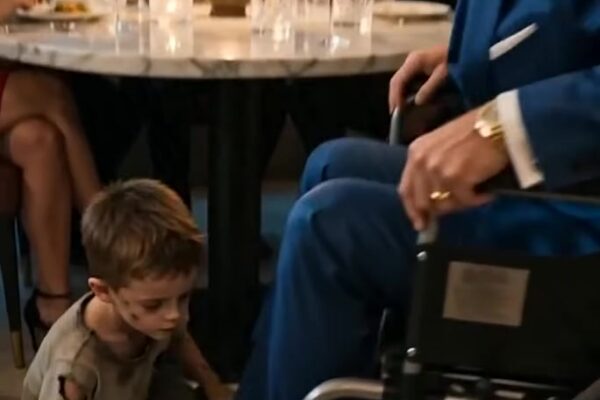
In the back corner, half-hidden by vending machines, sat the girl. Too small for the chair, wrapped in a coat that swallowed her like a costume. Torn striped pajamas peeked out at the cuffs. Her socks were soaked through, and one sleeve hung in threads. A paper cup on the table sent up a thin ribbon of steam, as if someone had tried to make her feel normal with the simplest kindness they could buy.
Cal lowered himself to one knee the way you approached a stray dog—slow, hands visible, voice kept low. A narrow plastic tie bit into the girl’s wrist. Whoever had put it there had yanked tight, not caring about skin. Cal brought out his pocketknife and, with a gentleness that looked wrong on him, slid the blade under the strip and snipped it free. “Does anything hurt?” he asked. “Can you stand?”
The girl stared at him with eyes that were too old for her face. She didn’t answer. Instead, she fished inside the coat pocket with the urgency of someone reaching for a life jacket. Her small fingers brought out a note, crumpled and damp. She pressed it into Cal’s hand like it was a key. “They found me,” she whispered, each word scraped raw.
He unfolded the paper carefully. The message wasn’t a message so much as a scar. Two words, printed in block letters, as if the writer had wanted no trace of themselves in the curve of a pen: SHE KNOWS.
Cal’s breath caught. Not because he didn’t understand it—but because he did. Those two words had a history. They were a warning he’d heard once before, murmured through a busted phone line on a night when his brother Tate went missing and the woman Cal loved disappeared with him. The woman had gone by Lena then. She’d never used Cal’s name, never asked for forgiveness. She’d only said, She knows, and the line had gone dead.
Light swept across the front windows, sharp and moving. Outside, tires hissed on wet pavement. Engines followed—low, hungry, multiplying. Not cars. Motorcycles. Cal’s crew at the entrance snapped to attention, their silhouettes catching and breaking in the chrome of washer doors. Cal didn’t hesitate. He pulled the girl off the chair and guided her down behind a machine. “Stay low. No sound,” he said. His hand, huge on her shoulder, trembled once before it steadied.
The front door opened without a jingle, as if someone had removed the bell long ago. Boots crossed the threshold. The smell of rain came with them, but also oil and cigarettes. A voice drifted through the humming room—pleasant in the way poison could be pleasant. “You’re in there, Cal. Don’t make me tear this place apart.”
Cal recognized the voice before his mind let him say the name. Briggs. Not a biker in truth—an errand man with a patch he didn’t earn, a collector for people who stayed clean by making others dirty. Cal tightened his grip on the note until the paper creased like thin bone. In his pocket, his phone buzzed with a text from one of his guys out back: Three bikes. One van. They’re blocking the alley.
Behind the washer, the girl’s breathing came fast. Cal leaned closer. “What’s your name?” he murmured. “Who brought you here?”
She swallowed. “Mara,” she said. “A lady did. She had a scar on her lip. She said… she said you’d understand the note. She said you’d know what to do when they came.”
Scar on her lip. Cal’s throat tightened. Lena had gotten that scar the summer after Tate taught Cal to ride. She’d laughed about it, called it her exclamation point. Cal had seen it in his dreams for ten years, a small mark on a face that wouldn’t stay still in memory.
Briggs’s boots stopped near the row of dryers. “Last chance,” he called. “Give us the kid. No one gets hurt. You can go back to pretending you’re a hero in a vest.” The machines kept turning, steady as heartbeats, indifferent witnesses.
Cal knew what they wanted wasn’t Mara. Mara was leverage. What they wanted was what Mara carried in her head, or what she had seen—something Lena had risked a child’s life to move. Cal looked at the girl’s wrists, at the raw red line where the tie had been. “What did you see?” he asked, barely moving his lips.
Mara’s eyes flicked toward the ceiling as if the answer might be written there. “A room with screens,” she whispered. “A man with a badge talking to the lady. They said a name. Tate. And then they said, ‘If Cal ever finds out—’ and the lady said, ‘He will.’ She told me to remember where the papers were. She told me the numbers.”
Before Cal could ask which numbers, a dryer door slammed open with a metallic crash. Someone had started searching in earnest. Cal took a slow breath and made a decision that felt like stepping off a cliff. He slid his knife into his sleeve and pulled out his old service pistol, the one he swore he’d never carry again. He pressed it into the palm of the nearest crew member, a lanky kid named Roach who was shaking too hard to hide it. “If I don’t come back in two minutes,” Cal said softly, “you run with her. Out the back. Over the fence. Don’t look for me.”
“Cal—” Roach started.
“Do it,” Cal said, and there was no arguing with whatever had hardened in his voice.
He rose from behind the washer, straightening to his full height in the center aisle, hands raised just enough to look like he wasn’t reaching. The room seemed to shrink around him, the hum of machines turning into the roar of blood in his ears. Briggs turned, grinning like he’d won.
“There you are,” Briggs said. “Hand her over.”
Cal held up the note instead, pinched between two fingers. “You tell whoever sent you,” Cal said, each word measured, “that Lena’s alive. That she used to say these words when she needed me to listen. And I’m listening now.”
Briggs’s grin slipped for a fraction of a second. That fraction was enough. Cal saw it—the confirmation. Lena wasn’t a ghost. Tate wasn’t just a missing man. Someone in a badge had been involved, and someone had been paying Briggs to clean up loose ends. Mara wasn’t a hostage. She was evidence.
Cal let the note fall. It fluttered to the wet tile like a wounded moth. “You can have me,” he said, stepping forward, drawing their attention away from the machines. “But you’re not taking her.”
Briggs’s eyes narrowed. “You really think you can stop this?”
Cal pictured Tate’s smile, Lena’s scar, the way Mara’s hands shook when she tried to be brave. He pictured a decade of silence that suddenly had a crack in it wide enough for truth to bleed through. “No,” Cal said. “I think I can start it.”
Behind him, he heard a washer door creak—the smallest sound—and then the soft patter of quick feet, guided toward the back. Cal didn’t turn to watch. He kept his gaze locked on Briggs as if staring hard enough could set the man on fire. Outside, engines idled like predators. Inside, Cal stood in the brightest light the laundromat had, ready to burn in it if that’s what it took to keep the note’s promise alive.