The street had learned the art of pretending. At midday, it wore sunlight like a clean shirt—bright, pressed, unwrinkled by urgency. Shop signs blinked without meaning, a bus sighed at the curb, and the rhythm of footsteps kept time with nothing in particular. It was the kind of calm that felt rehearsed, as if someone had shouted “Places!” and the whole neighborhood had taken its mark.
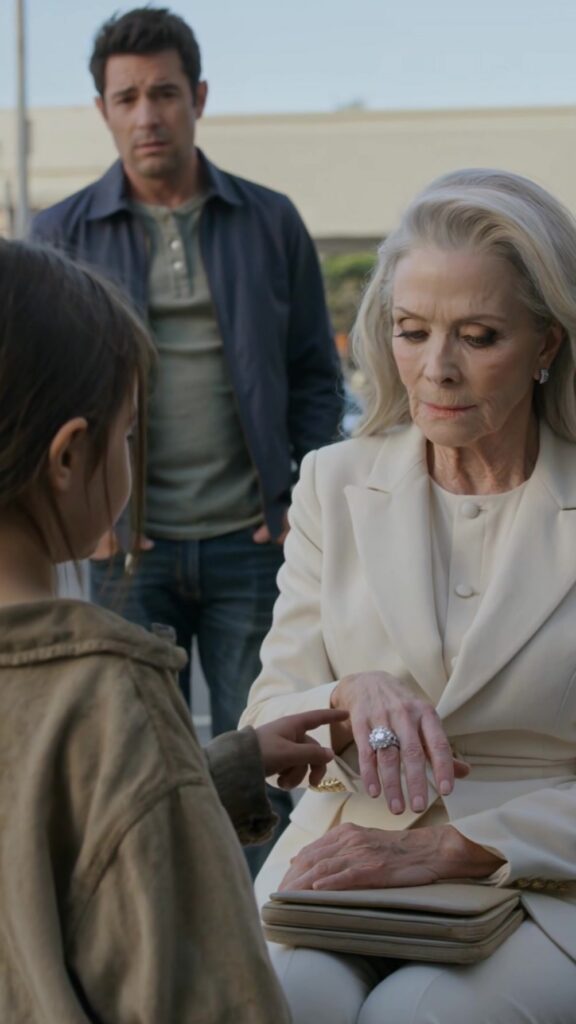
On the bench beneath the plane trees sat a woman who looked as though she’d been carved for public view and then forgotten. Her hair was a soft silver coil at the nape of her neck, pinned so precisely it seemed to obey geometry. Her coat was too elegant for a street that sold used phones and cheap flowers. She held her hands together in her lap, fingers interlaced, posture unwavering. She might have been waiting for a carriage that would never arrive.
Sun fell across her knuckles and snagged on a gemstone. The ring was not ostentatious—no gaudy crown of diamonds—yet it commanded attention the way ice commands attention: quiet, dangerous, impossible to ignore once seen. A deep blue stone, oval and smooth, caught a sliver of light and returned it colder, as if the day itself had turned and looked away.
People passed her as they passed everything: with the practiced blindness of the busy. A man with a paper cup and a tie that had given up on its own symmetry. Two women laughing too loudly. A teenager dragging a skateboard. None of them spared the elderly woman a glance long enough to register that she was alone, that she hadn’t moved in a while, that her gaze was fixed not on the street but somewhere behind it, as though she were watching another time run in front of her eyes.
Then the smallest sound changed the air—a scuff of bare skin on pavement, a soft catch of breath too careful to be accidental. A girl stepped from the shadow of a doorway as if she had been standing there for hours and only now decided she existed. Her clothes were the remnants of something once bright. The hem of her shirt had been ripped clean, as if a hand had grabbed her and she’d slipped out of it. Dirt had settled into the lines of her ankles, her knees. Her hair was a dark tangle that made her face look even thinner.
She didn’t look at the woman’s face. Her eyes went straight to the ring, and it was like watching a magnet discover iron.
She crossed the sidewalk slowly, as if the distance were made of glass that might shatter under her weight. One step, then another. She paused when a cyclist passed between them, and her shoulders hunched instinctively, bracing for impact that didn’t come. When the street opened again, she continued, drawn by something that wasn’t simply desire.
She stopped so close to the bench that the toe of her bare foot nearly touched the woman’s polished shoe. For a moment she only stood there, silent, breathing through her mouth as though the words inside her were too large for her throat.
The elderly woman noticed at last. Her gaze shifted down, then up, and settled on the girl with the same careful precision with which she arranged herself—an evaluation without expression. But as the girl’s stare remained fixed on the gemstone, the woman’s composure faltered in a way that was almost imperceptible: a minute tightening at the corner of her mouth, a blink that lingered a fraction too long.
Across the street, a man who had been walking with a bundle of envelopes slowed, then stopped. He was neither young nor old, merely worn by routine. He watched them with the reflexive curiosity people reserve for small disturbances in otherwise orderly days. At first he meant to move on. Then the girl lifted a trembling hand.
Her finger hovered in the air, inches from the ring, not touching, just pointing as though touching might hurt. When she spoke, her voice was thin but steady, a whisper that carried because the street, for a breath, seemed to hold still.
“My mommy… had a ring like that.”
The words didn’t fall; they hung. They did not ask a question. They were a statement with a wound in it.
The elderly woman’s eyes widened, and something behind them—something distant and sealed—cracked open. Her perfect posture bent forward slightly, a small break in a lifetime of discipline. “What?” she asked, but the sound was not strong. It was the voice of someone discovering that the room they have lived in for years has a door they never knew about.
The man with the envelopes stepped closer, driven by a discomfort he couldn’t name. He looked from the girl to the ring and back again, as if his gaze might arrange the scene into something sensible. The quiet around them thickened. The bus at the curb closed its doors and pulled away. A sparrow hopped once, then flew off. Everything ordinary kept moving, but it felt far away, muffled.
The girl did not look away. Tears gathered, not spilling, just shining at the edge of her lashes like a threat. “She said…” The girl swallowed, and the sound was too loud in the hush. “She said it was the only thing she had left.”
The woman’s fingers tightened over the ring. Not in pride. Not in vanity. In protection—or defense. Her thumb rubbed the underside of the band, searching for something invisible, a groove, a memory. The blue stone caught the sun again and flashed, and for an instant the woman’s face seemed older than her years, as though a long-held breath had finally been released.
“Where is your mother?” the woman asked. It was the sensible question, the one any passerby might ask. But it came out stained with fear.
The girl’s mouth opened, closed. Her eyes flicked briefly to the side, toward the mouth of an alley two doors down, where shadows clung stubbornly despite the day. “She told me to wait,” the girl said. “She said she’d come back. She always said that.” The last sentence was flat, practiced, worn thin from being repeated to herself.
The woman’s gaze darted toward the alley as if she recognized it, or what it meant. Her hand went to the ring again, and this time she turned it slightly, rotating the stone. On the underside, a tiny engraving caught the light—two letters, close together, almost hidden by years of wear. The man leaned in without meaning to, as if the world had pulled him by the collar. He could not read it from where he stood, but he saw the woman’s reaction: a flinch, a slow closing of her eyes.
When she opened them, the distance had drained from her expression. In its place was a terrible clarity, the kind that arrives after disaster, when there is no longer room for denial. She studied the girl’s face—her cheekbones, the shape of her mouth, the stubborn set of her chin—and her breath left her in a small, involuntary sound.
“How old are you?” she asked.
“Eight,” the girl said. Then, after a pause, as if she were revealing a secret name, “My mom called me Lina.”
The woman’s lips parted. The name struck like a bell. Her fingers loosened, and for the first time the ring looked less like an ornament and more like a weight. “Lina,” she echoed, tasting it carefully, as though it might cut her tongue. She lowered her gaze to her own hand, to the cold blue stone she had carried through dinners and funerals and years of silence. Then she looked back at the child with the fierce attention of someone who has just been cornered by the past.
The man with the envelopes felt a chill run through his arms in spite of the warm day. He didn’t know why. He only knew that the air around the bench had changed, that they were no longer in the safe territory of casual concern. Something larger had stepped into the street and was standing among them, unseen.
The woman’s voice came softly, stripped of polish. “Who gave your mother that ring?”
Lina’s tears finally spilled, rolling down her cheeks without sound. She lifted her chin, as if refusing to be small. “She said,” the girl whispered, “it came from someone who promised to come back. Someone who never did.”
The woman’s shoulders trembled once, a brief shudder she tried to swallow. Her hand rose, not to touch the girl, but to hover in the air between them as if she were testing whether the child was real. The ring flashed again, cold and beautiful, and now it looked like what it truly was: a piece of a story that had been buried and was clawing its way into the light.
The street continued to pretend at ordinary life. Cars passed. A distant laugh erupted and faded. Yet on the bench, beneath the indifferent trees, three strangers were held in a still frame of truth. The girl stood barefoot on sun-warmed pavement, pointing at a promise turned to metal. The elderly woman stared back, her calm mask broken beyond repair. And the man watched, realizing that some questions did not need to be spoken to be asked—because the answers were already gathering, heavy as thunder, in the quiet space between them.