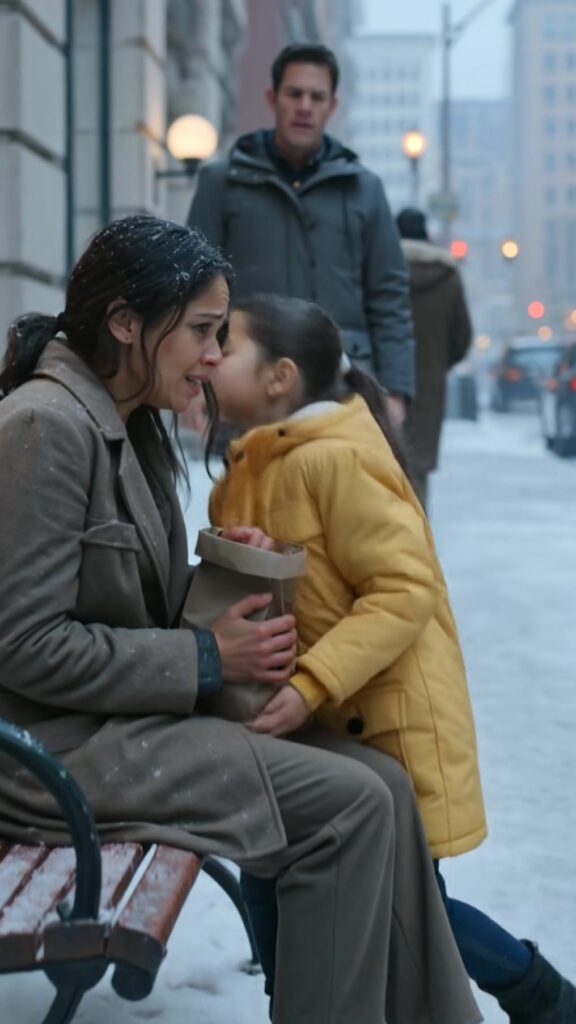
Snow threaded the city like a quiet rumor, settling into the seams of sidewalks and the hems of coats. At the edge of the park, where iron fences held back drifts and the bare trees scratched at the sky, a woman sat on a bench with her shoulders drawn inward. Her scarf was too thin for the weather. A paper bag rested beside her, folded over as if it had learned to conserve its own air.
A little girl in a red hood walked a few steps ahead of her father, boots making a careful music in the powder. She was the kind of child who looked as if she belonged to warmer rooms—gloved hands, a clean coat, a braid tucked into her collar—yet her gaze was fixed on the bench as if it had been waiting for her.
“Are you cold?” she asked, voice small enough to fit between falling flakes.
The woman looked up like someone called from a distant sleep. Her eyes were ringed in windburn, her lashes damp. “A little,” she managed. “But I’m fine, sweetheart.”
Behind the girl, her father paused in his dark coat, his expression soft with the practiced patience of a man indulging a child’s whims. He watched his daughter take a step closer, and his smile lingered—until it began to slip, subtly at first, as though it had met resistance.
The girl knelt in the snow without hesitation. She didn’t look at the woman’s bag, or her shoes, or the faint trembling in her hands. Instead she studied the woman’s face with an unnerving seriousness: the shape of her eyelids, the line of her mouth, the way one eyebrow lifted as if it had once been trained to do so. The child’s eyes moved as if matching pieces in a puzzle no one else could see.
“What’s your name?” the girl asked.
The woman swallowed. “It used to be Elena,” she said, then seemed surprised that she’d offered it. “Now it’s… just what people call me.”
The father’s smile fell away completely. He took a small step forward, then stopped, as if the air had thickened. The girl didn’t notice. She leaned closer to the woman, close enough that their breath mingled in pale clouds, and whispered something into her ear—words the father couldn’t hear, words the passing traffic couldn’t steal.
The effect was immediate. The woman stiffened as if struck. Her inhale caught and refused to let go. Tears filled her eyes in a sudden tide, turning them glassy and wide. She stared past the girl, up at the man in the dark coat, as if he had just walked out of a grave she’d been forced to leave.
“No,” she breathed. “No, it can’t be.”
The father’s face drained of color. He took one slow, unwilling step closer, boots crunching in snow that suddenly sounded too loud. “What did she say?” he asked, and the question came out ragged, as if it scraped his throat on the way.
The girl stood and turned between them, snow landing on the curve of her hood. She looked from the woman to her father with the calm certainty of someone repeating an instruction, not a discovery. “Mommy said you’d recognize her eyes,” she said clearly, as if quoting a bedtime line that had been told again and again.
The paper bag slid from the woman’s fingers and toppled into the snow. An apple rolled out and stopped against the bench leg, bright as a warning. The man’s lips parted. For a moment he looked like a person trying to remember how to stand.
“Elena,” he whispered, and the name sounded like it hurt.
The woman’s tears spilled freely now, tracking down her cheeks into the scarf. “You told them I died,” she said. Her voice was thin, but there was iron in it. “You let them say it. You let her grow up thinking it.”
Pedestrians began to slow, drawn by the gravity in the air: a woman shaking, a man gone pale, a child fixed between them like a hinge. A couple passing with a stroller drifted to the side; an older man paused with a hand half-raised as if to offer help, then thought better of stepping into something so raw.
The father’s eyes shone with panic, not simply sorrow. “I thought you left us,” he said. “I thought you chose—”
“Chose?” The woman gave a broken laugh that became a sob. “They moved me like property. They signed papers I couldn’t read. I woke up in another city with my name replaced and my mouth full of cotton from the hospital. They said I’d been in an accident. They said you didn’t want to see me. They said my baby was better off without me.”
The little girl’s brows knit, confusion cracking her calm. “Daddy?” she whispered, and the word carried a plea, a desperate wish for the world to make sense.
The father flinched at the sound. He looked at his daughter as if she were suddenly a stranger, then back at the woman with fear blooming into something like dread. “I searched,” he insisted, but his voice wavered. “I called. I went to the hospital—there was a fire. They said you were… gone. They gave me ashes in a box.” His hands curled at his sides. “I didn’t know.”
The woman rose, unsteady on feet that had learned to endure cold. Her knees shook, but she moved anyway, stepping through the snow until she stood close enough to the child that their coats brushed. “I’m not Elena,” she said, and the sentence seemed to split her open. “That was the name they gave me when they needed me to disappear.”
She lifted a trembling hand and touched the girl’s cheek with two fingers, reverent and terrified. The girl didn’t pull away. Her eyes widened, as if the touch had struck a bell in her bones. The woman’s voice softened into something raw and ancient. “I’m your mother.”
The father made a sound, half protest, half collapse. “Don’t do this,” he whispered, and it wasn’t clear whether he begged the woman, the child, or the past. “Please.”
“Tell her,” the woman said, not looking at him. “Tell her who I am. Look at her and tell her the truth.”
The girl turned her face up toward her father. Hurt unfurled across it in real time, like ink dropped into water. “Is she?” she asked, voice shaking now, childhood finally showing through the strange certainty. “Is she my mommy?”
The man opened his mouth. Nothing came out at first. His gaze flicked to the woman’s eyes—the same stormy gray as his daughter’s, the same slight tilt at the outer corners that the child had inherited. It was a map he had pretended not to recognize because recognition would demand action.
“I—” he began, and his breath shuddered. The park around them felt suddenly too exposed, too public for the private catastrophe unfolding. Yet the truth didn’t care about witnesses.
He swallowed hard and sank to one knee in the snow beside his daughter, his gloved hands hovering as if he didn’t deserve to touch her. “Yes,” he said finally, the word cracking. “She is.”
The girl stared, as if the sentence rewrote the air. Then she stepped forward and pressed herself into the woman’s coat. The woman folded around her with a sob that sounded like years breaking free, arms tightening as if she could hold the child back from time itself.
The father stood slowly, a man caught between relief and ruin. “Who did this?” he asked, voice hoarse. “Why?”
The woman looked over the child’s hood at him, and her tears did not make her weak; they sharpened her. “Because someone wanted you manageable,” she said. “A grieving husband is easier to steer than a fighting family. Because money moves faster than love. Because papers can say anything if no one is watching.”
Snow continued to fall, indifferent and steady. The woman bent and picked up the apple, brushed it clean against her sleeve, and placed it gently back into the bag as if performing a small ritual of restoration. Then she took the girl’s hand in one of hers and faced the father with the other hand empty, open, demanding.
“You don’t get to hide behind ‘I didn’t know’ anymore,” she said. “Not if you want to keep her.”
The father’s eyes squeezed shut for a moment, as if bracing against a wave. When he opened them, they were wet and clear. He reached out—not to the woman, not yet, but to his daughter—fingers closing around her free hand.
Between them, the child stood small and solid, a bridge made of breath and blood. The park held its silence, and the city kept moving beyond the fence, unaware that in a pocket of snowfall three lives had collided into the truth, and nothing—no name, no lie, no winter—would be able to turn it back.