The ballroom had been designed to make hunger feel like a myth.
It wore gold the way other rooms wore paint. Light spilled from chandeliers heavy as frozen waterfalls, scattering into a thousand obedient sparkles across marble that never knew footprints without polish. The air smelled of lilies and citrus and money, and somewhere beneath it all, the faint bite of champagne—cold, bright, careless. Even the music that usually floated there was curated: strings and laughter, a comfortable rhythm for people who never counted coins in their palms to decide between bread and soap.
Tonight the ballroom belonged to the Harrowgate Foundation’s winter gala, a celebration of philanthropy that felt, to those invited, like triumph. The men’s cuffs flashed; the women’s gowns whispered. No one asked where the oysters had come from or how many hands had touched the silver. They only raised their glasses toward the high ceiling and talked about the future as if it were a thing one could buy and store away.
On the small stage, a black grand piano waited with its lid raised like an elegant jaw. It had been delivered that morning and tuned three separate times. The scheduled pianist—some name printed in the program with a flourish—had not yet arrived. It hardly mattered; the guests were drinking too loudly to notice time.
Then the doors at the far end of the hall opened with a shiver of hinges, and a girl stepped in as if she had been pushed by the wind.
She was barefoot. Her dress was the color of old paper and torn at the hem, one sleeve hanging too loose. Her hair had been tied once and then given up on, strands falling in dark ropes around her face. Dirt made maps on her knees. She looked small enough to be swallowed by the room.
Conversations slowed, not out of kindness but out of shock. The entire ballroom pivoted as one, eyes finding her the way moths find flame. A laugh slipped out of someone near the front—an accidental spark—and then it became a fire. Women brought jeweled fingers to their lips, half-hiding smiles. Men in tuxedos leaned toward each other, amused by the intrusion, as if the staff had arranged a novelty and forgotten to announce it.
The girl walked to the piano with careful steps, toes curling against the cold marble. She stopped beside the bench and lifted her chin. She swallowed, and it was plain how much effort it cost her to keep her voice steady.
“May I play,” she asked, “for food?”
The laughter sharpened. It echoed up into the vaulted ceiling and returned to strike her again. Someone said, too loudly, that there was soup for the servants in the back. Someone else suggested the girl might be part of the entertainment, a charity tableau. A third voice—a woman’s, bright as a snapped ribbon—asked if they were supposed to applaud now or after.
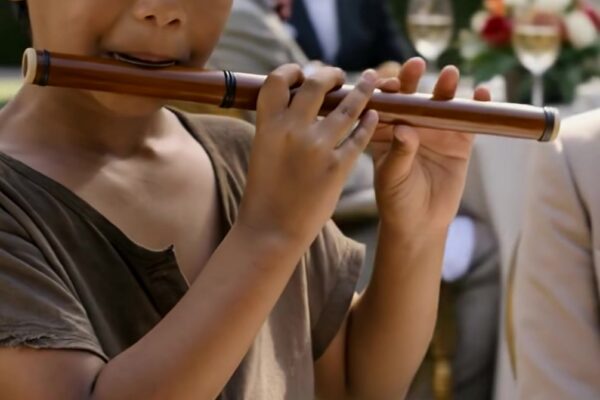
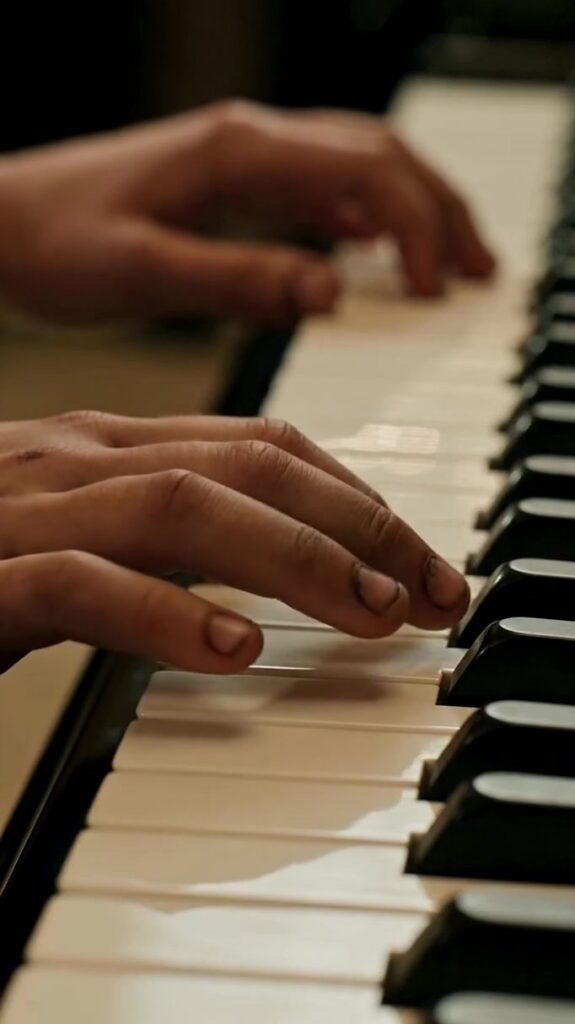
The girl flinched, the sound hitting her like thrown stones, but she did not retreat. She laid one hand on the side of the grand piano, as if anchoring herself to something solid, climbed onto the bench, and set her fingers—dirty, chapped, shaking—above the immaculate keys.
When the first note sounded, the ballroom changed temperature.
It was a soft note, almost uncertain, as though the piano itself had to remember how to speak. Then came another, and another, and the melody began to take shape—delicate and wounded, a thread pulled from some older cloth. It did not match the room’s glittering confidence. It did not flatter anyone. It was the kind of music that did not ask permission.
A woman halfway through a sip froze with the glass hovering near her mouth. A man who had been smirking felt his smile slip, as if someone had reached in and pulled it away. The laughter dwindled into coughs and silence.
The girl’s shoulders relaxed as she played, not because she forgot she was being watched but because the notes became a place to stand. The melody widened, grew teeth. It carried the sound of rain hitting a tin roof in a narrow alley, and the scent of coal smoke, and the bruised sweetness of stolen apples. It contained the ache of waiting for a door to open that never did.
Near the front of the room, an older man in a dark tuxedo turned slowly. His posture had the effortless certainty of someone who owned buildings and opinions. His hair was silver at the temples. A thin scar cut through one eyebrow, pale against his skin. He had been speaking to a senator and not listening to his own words.
Now he listened.
It wasn’t the girl—at first—that held him, but the song itself, as if it had reached up from the keys and seized him by the throat. He took one step forward. Then another. The senator’s sentence died in midair.
“That song…” the man whispered, and his voice did not sound like a host’s. It sounded like someone speaking in a church long abandoned. “Where did you learn that?”
The girl didn’t look up. She kept playing, the melody curling into something darker. Her left hand struck a repeating pattern like footsteps on stairs. Her right hand rose and fell like breath trying to become speech.
The older man moved closer until he stood beside the piano. Guests leaned in, unwillingly drawn. The chandeliers continued to blaze, but their light suddenly felt less important than the shadow in the music.
“Stop,” he said, and it came out more like a plea than a command.
The girl’s hands slowed. The final chord hung in the air, trembling, before fading into the room’s stunned quiet.
She lifted her eyes at last. They were too old for her face—dark, watchful, and tired in a way wealth could not imagine. “I don’t know the name,” she said. “My mother hummed it when she was trying not to cry.”
The man’s throat worked. He stared at her fingers, then at her face as if searching for a resemblance he had forgotten how to recognize. “Your mother,” he said carefully, “what was her name?”
The girl hesitated, as if names were fragile things. “Elara,” she answered. “Elara Vale.”
A ripple went through the guests, not because the name meant anything to them, but because it clearly meant everything to him.
The older man took a half step back, as though the floor had tilted. His hand rose to the edge of the piano lid, gripping it. For a moment the ballroom’s polish could not hold the reality that leaked in.
“Elara Vale died ten years ago,” he said, voice rough. “In a fire at the river tenements.”
The girl’s jaw tightened. “They said she did,” she replied. “People say a lot when it helps them sleep.”
Someone near the back scoffed, uneasy with the new tone, eager to drag the moment back into ridicule. But the sound did not catch. The room had become trapped in its own attention.
The girl’s small hands curled on her lap. “She taught me the song,” she said. “She said if I ever got lost, I should play it where people couldn’t ignore me. She said there’d be someone who would recognize it. Someone who owed her.”
The older man’s eyes glistened, and he blinked hard as if anger were a thing that could be controlled by force. “Owed her,” he repeated. The words seemed to scrape against his teeth. He looked around at the faces—curious, amused, hungry for spectacle. “Of course,” he murmured, and there was bitterness in it, “she was right about that.”
The girl leaned forward slightly. “I’m not asking for money,” she said, and her voice shook now, the brave mask cracking at the edges. “Just something to eat. Bread. Anything. I haven’t—” She stopped, pride swallowing the rest.
The man’s expression changed then, not softening, but hardening into purpose. He straightened, as if the song had pulled a spine into him that the evening had not required. “What is your name?” he asked.
“Mara,” the girl said. “Mara Vale.”
The older man exhaled as though struck. He looked at her for a long moment, and in that silence the ballroom felt the first true discomfort it had known in years: the discomfort of being seen.
“Bring her food,” he said, turning his head without taking his eyes off her. The command landed like a gavel. “Now. And water. Warm. Not wine.”
A waiter, pale with confusion, hurried away.
The man stepped closer to Mara, lowering his voice. “Your mother,” he said, each word weighed, “was my sister.”
The girl’s face did not brighten. It did not collapse into relief. Instead, a slow fury climbed into her eyes, as if the admission was not an answer but an opening of a wound. “Then why,” she whispered, “did we starve?”
The older man’s mouth opened, closed. Around them the ballroom held its breath, caught between scandal and shame. He glanced up at the chandeliers, the marble, the gold walls built to keep need outside, and for the first time that night, his gaze looked like someone who understood the cost of such a room.
“Because,” he said quietly, “I believed the story that made my life easier.”
The food arrived—a plate piled too high, rolls and meat and fruit that smelled like a different world. Mara did not reach for it immediately. She looked at the man as if measuring him, as if deciding whether he was a door or another wall.
“Play again,” he said, his voice hoarse. “Not for them.” He gestured to the guests, suddenly small behind their finery. “For me. So I can’t pretend I didn’t hear you.”
Mara’s fingers hovered over the keys once more. The ballroom, built for people who never wondered where their next meal would come from, waited on the edge of a song that did not care what it had been built for at all.
And when she began to play, the room’s glittering certainty finally cracked—letting in, through the music, the truth that hunger had been outside its doors all along, listening for a way in.