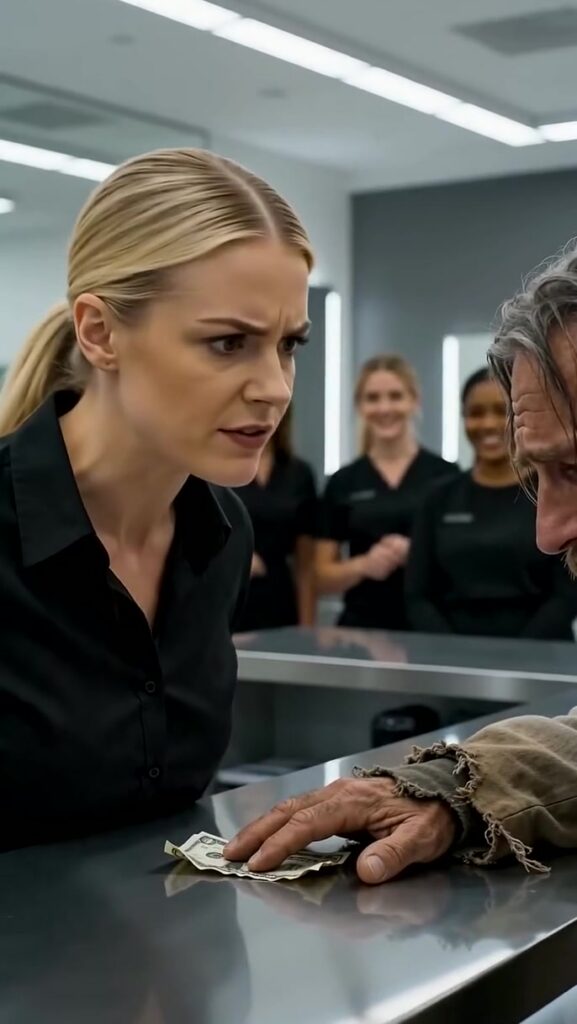
The old man placed one crumpled dollar on the glossy salon counter like it was the last piece of pride he had left. It landed soundlessly on the lacquered surface, a tired green square flattened by the weight of his fingers, as if he feared it might blow away if he let go.
Light poured down from chandeliers shaped like inverted flowers. The salon smelled of citrus shampoo and hot metal. Everything shone—mirrors, chrome chairs, the glass shelves lined with identical bottles—everything except him.
His hands trembled in small, disobedient spasms. A gray beard, long and unkempt, spilled down over a coat that had once been brown and now lived in the color of soot. The mirrors were merciless; they multiplied him into angles: an old man with hollowed cheeks and eyes that kept trying to look brave.
Behind the counter, the receptionist didn’t lift her gaze right away. She wore her blonde hair in a sleek knot and her expression in the practiced neutrality of someone who was paid to keep the world orderly. She looked at the dollar, then at him, and the neutrality curdled into something colder.
“Please,” he said. His voice was soft, weathered thin. “I need a haircut to get a job.”
At the styling stations, a few staff members in dark uniforms were pretending not to listen. Their reflections listened for them. One of them—the one with the sharp eyeliner—let out a breath that could have been a laugh.
The receptionist’s lips lifted just enough to wound. “That’s one dollar. A haircut is fifty.” She tapped the counter beside the bill as if to emphasize the gap between his reality and theirs.
Color rose in the old man’s face, then faded again. He lowered his head. He did not reach for the money. It stayed where it was, stubbornly offering itself.
“I can pay the rest later,” he whispered. It was not bargaining as much as begging the room to allow him to keep believing in tomorrow.
Her eyes narrowed, as though the very idea offended her. “We aren’t a charity. Leave.”
For a moment the salon held its breath. In the back, a hairdryer hummed on, steady as a distant storm. The old man’s shoulders twitched, and he turned slightly, as if making sure there was no other door out of this humiliation.
That was when a man in a white apron stepped forward from near the wash basins. He was younger than the rest—late twenties maybe—with sleeves rolled to the forearm and a faint smell of rosemary clinging to him. His name tag read: LEO.
He came around the counter without asking permission. The receptionist started to protest, but he didn’t look at her. He placed a gentle hand on the old man’s shoulder, the kind of touch that says: you are still a person.
“Ignore them,” Leo said, voice calm but firm. “I’ll cut it myself.”
The receptionist’s jaw tightened. “Leo—”
He finally met her eyes. “I’ll take my break,” he said. “Put it on me. Or fire me. Your choice.”
In the mirror behind them, the smirks evaporated. Even the air seemed to rearrange itself around the sentence.
The old man blinked rapidly. Tears filled his eyes as if they had been waiting for permission. He reached out, and his fingers closed around Leo’s hand with surprising strength, like a drowning man catching a rope.
“Thank you,” he whispered, and then, as if it were too dangerous to say out loud, “I have a surprise for you.”
Leo smiled gently, assuming it was gratitude speaking nonsense, and guided him to a chair at the far station—one that faced a window where the city moved in bright, indifferent currents. The old man sat as though the chair were sacred. He kept his hands folded in his lap, trembling only a little less now that someone had chosen him.
Leo draped a cape over his shoulders and combed through the beard with careful fingers. It was tangled with the grit of sleeping outdoors, knotted with the stubbornness of days that didn’t end kindly. Up close, the old man’s face carried a map of lived things: scars that had healed wrong, sunburn, and a faint crease at the corner of his mouth that hinted he once smiled often.
“What kind of job?” Leo asked as he snipped the first lock. The scissors made a crisp sound, clean as decision.
“Maintenance,” the old man said. “A building. They told me to come in tomorrow. Said I looked… not ready.” He swallowed. “I used to be ready.”
Leo worked slowly, as if the work was not simply grooming but returning something stolen. Hair fell in soft gray spirals to the black floor. Leo trimmed the beard into shape, revealing a jawline that had been hidden for months, perhaps years. Beneath the wildness was not ugliness—just neglect.
As he cut, Leo noticed the old man’s hands. The nails were clean, despite everything. The knuckles were scarred in a particular way—burn marks, faint and old. Leo had seen those on his father’s friends, men who worked with heat and metal.
“You were a welder?” Leo asked.
The old man’s throat bobbed. “Used to be.”
Leo turned the chair slightly to catch better light. In the mirror, the old man began to change, hairline by hairline. His eyes looked larger. His cheeks seemed less hollow. It was frightening how close dignity was—how it waited just under the surface, stubborn as bone.
When Leo finished, he removed the cape and brushed stray hairs from the old man’s collar. He handed him a small mirror to see the back, a gesture of professional courtesy as much as respect.
The old man stared, not at his haircut but at the person inside it. His lips parted. He pressed a shaking hand to his cheek as if to make sure he was real.
“It’s… me,” he said, almost offended by the rediscovery.
Leo chuckled softly. “Yeah,” he said. “It is.”
The receptionist watched from behind the counter with arms crossed, her expression guarded. The others pretended to be busy, though their eyes kept sliding over. A silence sat between them like judgment.
The old man stood, and for the first time since he entered, he stood straighter. He reached into the torn inner pocket of his coat, pushing past the lining as if searching for something that might not be there.
Leo expected a second crumpled dollar, maybe a linty thank-you note. Instead, the old man’s fingers drew out a small object that caught the salon lights and threw them back: a business card, heavy, metallic, and gold, the edges sharp and precise as a promise.
He held it between thumb and forefinger, letting it gleam for a beat too long.
“I said I had a surprise,” the old man murmured. He did not smile. He looked tired, and in that tiredness was something else—an authority that didn’t ask permission.
Leo’s brow furrowed. “Sir… what is that?”
The old man extended the card. On it, embossed letters spelled a name: HENRY CALDWELL. Beneath it, a title: CALDWELL PROPERTIES — FOUNDER.
Leo’s breath caught. Across town, Caldwell Properties owned half the buildings people dreamed about: the downtown glass towers, the renovated theaters, the newly painted apartments with rents that made the city ache. There were rumors about Mr. Caldwell—about his disappearing, about a family lawsuit, about a man who couldn’t be found even by those who wanted his money.
The old man—Henry—looked past Leo to the rest of the salon, his gaze settling on the receptionist like a slow blade.
“I needed to know,” Henry said quietly, “what my city does when it sees someone who can’t pay.” He shifted his eyes back to Leo. “And I needed to know if there was still anyone in it who could look at a person and not just a price.”
Leo didn’t take the card right away. His hand hovered, uncertain, as if touching it would change the rules of the world. “Are you… you’re him?”
Henry nodded once. “I am.” He looked down at the crumpled dollar still on the counter. “And today, I was also what your receptionist assumed.”
The receptionist’s face drained of color. “Mr. Caldwell, I didn’t— I mean—”
Henry lifted a hand, stopping her without raising his voice. “No. You did exactly what you meant to do.”
He turned to Leo again. “You,” he said, the single word thick with consequence. “You cut my hair when you thought you’d get nothing.”
Leo swallowed. His mind raced—rent, student loans, the owner’s temper, the way kindness could be punished in places built on image.
Henry pressed the gold card into Leo’s palm. It was warm, as if it had been held close to the heart. “Tomorrow morning,” Henry said, “come to the address on the back. There’s a building manager position opening at one of my properties. It pays well. Benefits. Real hours.”
Leo stared at him. “I’m a stylist,” he whispered, as if the word was a boundary line.
Henry’s eyes held his, steady and severe. “So was my wife,” he said. “She used to tell me a person’s hands reveal their soul. Your hands were gentle when they could have been indifferent.” His voice softened, just enough to make the next words land harder. “People like you should be in charge of doors.”
The salon felt suddenly smaller. Even the chandeliers seemed too bright for the shame blooming under them.
Henry took a slow breath. “And as for this place,” he added, turning his gaze to the glossy counter, the mirrors, the curated perfection. “I happen to own the building your landlord leases.”
A sound escaped the receptionist—half gasp, half prayer.
Henry’s expression didn’t change. “I won’t destroy you,” he said, and that mercy sounded sharper than cruelty. “I’m just going to stop rewarding you.”
He glanced at Leo one last time. “Keep the dollar,” he said. “It’s worth more than the fifty today.”
Then Henry Caldwell walked out of the salon with a clean cut and a trimmed beard, looking less like a stranger in a bright room and more like someone returning to claim what was his—starting with his name. Behind him, the crumpled dollar remained on the counter, a small, stubborn square of pride that no longer looked pathetic at all.