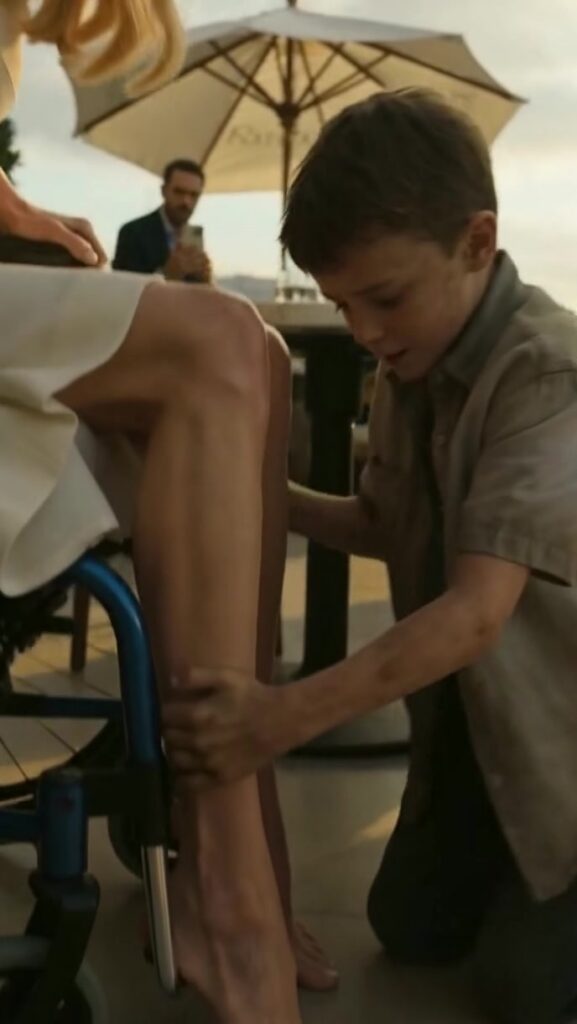
The terrace of Café Argenté shimmered like a jewelry case left open to the sun. White awnings softened the light into honey, and the marble underfoot kept the heat away from the ankles of women who never walked anywhere they didn’t want to. A string quartet played something polite and expensive. Waiters carried flutes of champagne as if they were carrying secrets.
Odette Morel sat near the railing, positioned to be seen. Her wheelchair—custom leather, discreet gold trim—was less a necessity than a throne. It declared tragedy without explaining it. Men greeted her with sympathy and investors greeted her with reverence. The papers had called her a survivor, a philanthropist, a woman who built an empire despite the accident that “took her legs.” She had learned to keep her smile steady even when her spine ached from sitting straight for too long.
She was halfway through a conversation about a new foundation wing when the air changed. Not a gust—something colder, like a door opening onto a corridor no one had known existed. The quartet faltered. A few guests looked up, irritated, as if a fly had landed on their tablecloth.
The boy appeared between tables like a torn shadow. Eight, maybe nine. Too thin, too light for the world to make room for him. His shirt hung off him in surrender, and his knees were stippled with old bruises. A waiter took one step toward him, then stopped, instinctively gauging the boy’s desperation and deciding he didn’t want it anywhere near his hands.
Odette did not see him until he was already at her side. He dropped to his knees with a strange precision, as though he’d practiced. Then his hands shot forward and clamped around her calves—hard enough that the wheelchair jolted. The sound of rubber tires scraping marble sliced through the polite music like a knife. Glasses trembled. A woman at the next table hissed, “Security!”
Odette’s shout rang out first, bright with outrage. “Get off me!” Her bracelets chimed as she grabbed the armrests. A man half rose, napkin still in his lap, ready to perform heroism with minimal inconvenience.
The boy didn’t plead. He didn’t look at the diners. He stared at Odette as if she were the only person in the universe who might still know what the truth tasted like. “Don’t pull away,” he said, voice hoarse but steady. “Just—let me.” His fingers trembled, not from fear but from hunger and strain. He pressed one of her shoes down against the stone floor, anchoring it.
Odette’s face twisted in disbelief, then in something else. The muscles along her jaw tightened. She felt pressure—actual pressure—travel through her foot and up her shin. It was impossible, she told herself, the way all lies begin: calmly, confidently, with the certainty of repetition. Then her toes made the smallest movement, a quick involuntary curl like a waking animal testing a limb.
Odette’s breath caught. Her eyes dropped, pinned to her own shoe as if it had betrayed her. “No,” she whispered, not as denial but as a plea to the laws of her carefully staged life. Around her, the terrace fell into a stunned hush. Phones lifted, not yet filming but preparing to. Every wealthy face looked suddenly eager, as if a miracle might be a form of entertainment.
The boy tightened his grip, gentler now, not dragging but guiding. “Again,” he said. He pushed her heel down and shifted her weight forward. The wheelchair creaked. Odette’s hands white-knuckled the armrests. Her upper body pitched as if pulled by a force she couldn’t name. Something in her legs answered—another twitch, bigger this time, and then a tremor that made her stockinged knee quiver.
A strangled sound escaped her throat. It wasn’t triumph. It was terror. If her legs could move, then everything that had been built on their stillness—sympathy, donations, interviews, the empire with her face on it—became a tower of glass.
“Stop,” she hissed at the boy, and for the first time her anger held panic. “What do you want? Money? Food?”
He shook his head without taking his eyes off her. “I want you to remember,” he said. Then he leaned close enough that only she could hear. “My mother said you could stand. She said you did, the day you left.”
Color drained from Odette’s face so fast it looked like a trick of lighting. Her lips parted, searching for a name she’d sealed away like a crime. The boy’s eyes were unmistakable now—same storm-gray as hers, framed by lashes too long to belong to a stranger. In that instant she saw, behind him, a cramped room with peeling paint, a woman coughing into a towel, a suitcase by the door. She saw herself in a cheap coat, walking out while her sister begged, while a child cried, while the future clawed at her ankles.
“Eli…” Odette whispered. The name came out like blood.
The terrace inhaled as one. A woman at the next table murmured, “Did she say—?” A man’s phone finally began recording, the small red dot a new kind of spotlight.
Odette tried to sit back, to retreat into the chair, into the role. But her legs betrayed her again. Another movement, and this time she felt the ground under her sole in a way she hadn’t allowed herself to feel in years. She had told doctors she was numb. She had told journalists the accident stole everything. She had told donors their money helped her fight. The truth was uglier: she’d learned, slowly, that she could feel. Then she’d learned, slowly, that if she admitted it, the pity would evaporate and the questions would come.
The boy’s hands slid to her ankles, steadying her as she shook. “You didn’t just leave,” he said, louder now, because the world had already begun listening. “You took her settlement. You took the papers. You told her it was for the hospital, and then you bought this life.” He swallowed hard, and the hunger in his throat made the words scrape. “She died waiting for you to come back.”
Odette’s vision narrowed. The quartet had stopped entirely. Somewhere a fork clattered to the ground, ignored. She tasted metal. She could already see tomorrow’s headlines forming like bruises. She could already hear the board members calling their lawyers, the donors demanding refunds, the interviews turning from admiration to prosecution.
“It’s not—” she began, but the sentence collapsed. It collapsed because she saw, past the railing, two uniformed officers stepping onto the terrace, guided by the café manager’s frantic gestures and a woman in a crisp blazer holding a folder. The folder bore the crest of her own foundation.
Odette recognized the blazer woman: internal audit. The one she’d delayed, redirected, charmed. The one she’d underestimated.
The auditor’s gaze flicked from the boy’s hands on Odette’s ankles to Odette’s trembling legs, then to the phones recording everything. She didn’t look shocked; she looked vindicated. “Ms. Morel,” she called, voice slicing through the silence. “We need to discuss the missing accounts. And the medical fraud.”
Odette’s world did not end with a gunshot or an explosion. It ended with her own body answering in public, and her past crawling out of a starving child’s mouth. She tried to lift herself in protest, in denial, in anything—but the movement only proved what everyone had just seen.
The boy stepped back as the officers approached, as if he had completed a task he’d carried like a stone for years. Odette reached for him instinctively, not to stop him, but to anchor herself to something real. Her fingers caught air.
Eli’s voice softened, almost kind. “You can stand,” he said. “So stand. And tell them.”
Odette looked down at her legs—at the legs she had built a kingdom upon by pretending they were ruins. Then she looked up at the sea of polished faces now hungry for her downfall. Her mouth opened, but the only sound that came out was the thin, cracking noise of a life collapsing under the weight of its own lie.