“Don’t sell it.”
The words left Mara Keene’s mouth like a blade thrown on instinct, faster than thought, sharper than the chandeliered air. They seemed to strike the room with an audible crack. The auctioneer—silver-haired, voice polished for command—paused mid-bid as if someone had pulled a plug from his spine. A few patrons turned. Most didn’t, not at first. Their attention was trained on the canvas propped under velvet drapery, the spotlight bleaching it into importance.
“Excuse me?” the auctioneer said, irritation quickly searching for a reason to become something else. His gaze ran over Mara’s black gloves, her staff lanyard, the small case in her hand. “Miss, you’re not—”
From the front row, Gideon Voss didn’t bother to look surprised. He looked bored, the way a man looks when a lock clicks exactly as expected. The billionaire’s suit was the color of wet stone; his wedding band—newer than his smile—caught the light when he raised a hand.
“She’s staff,” he said, voice even, almost gentle. “Remove her.”
Two security guards shifted toward Mara. She didn’t step back. She didn’t step forward. She simply opened her case, drew out a penlike UV lamp, and held it up the way someone might lift a match in a darkened cellar.
“If you sell this,” she said, louder now, “you’ll be selling a lie.”
A ripple traveled through the room—phones appearing like fish breaking the surface of water. The guards hesitated because the people watching were expensive, and expensive people are dangerous in different ways. The auctioneer’s mouth tightened. “Miss, what do you think you’re doing?”
Mara clicked the UV light on.
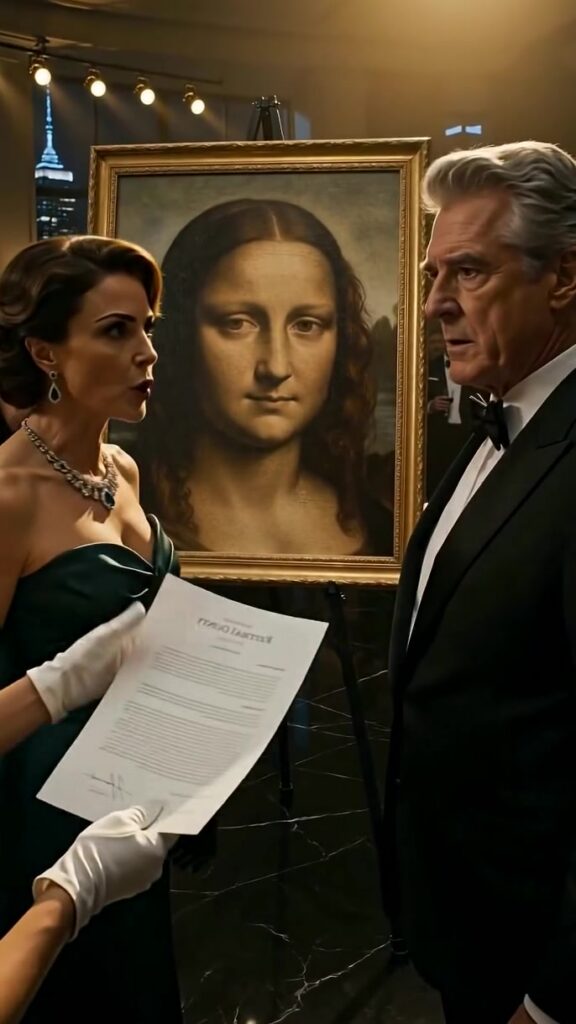
The beam cut across the portrait’s lower edge, where the canvas had been “accidentally” torn years ago and repaired with meticulous care. At first, nothing changed. The painting showed what the catalog promised: a stylish woman in a blue gown, gaze poised, lips set in a practiced calm. Beneath the varnish she looked flawless enough to be owned.
Then the ultraviolet caught a seam. A faint geometry appeared—brushwork that didn’t match the visible hand. Mara moved the light slowly, like a surgeon tracing a fracture. Under the top layer, another face began to form, pale as a memory, coaxed into visibility by fluorescence.
A woman’s eyes emerged first: not the blue-gown subject, not the society portrait everyone had come to bid on, but someone older in style, softer around the mouth, painted with tenderness rather than commission. The room made a collective sound that wasn’t a gasp and wasn’t silence but something between, the breath being held before an accident.
Isla Voss—Gideon’s current wife—rose from her seat without seeming to decide to. Her pearls pressed into her throat as she leaned closer, brows knitting, voice a tight wire. “What am I looking at?”
Mara’s fingers trembled around the lamp, but her voice had steadied into something that felt like inevitability. “An overpaint,” she said. “A burial. Someone was painted out and replaced.”
Gideon finally stood. Not hurried. Controlled. The kind of control that assumes it will be obeyed. “Turn it off,” he said, softly enough that the nearest people had to listen harder. “You’re embarrassing yourself.”
Mara didn’t lower the light. She shifted it higher.
Details sharpened beneath the upper layer: the curve of a shoulder, the ghost of lace, and at the throat—an unmistakable necklace, its pendant shaped like a teardrop with a small star set inside. Isla’s hand lifted to her own neck as if her skin had been tugged by a string. The same teardrop star lay against her collarbone.
Her voice cracked. “That’s mine.”
Mara’s eyes flicked to Isla’s throat, then back to Isla’s face. “No,” she said. “It belonged to her.”
She reached into her folder and unfolded a report—photos, pigment analysis, dates, signatures from conservators who had been paid not to ask questions. The paper made a small, almost indecent noise in the hushed room.
“This portrait,” Mara continued, “was altered. The original subject was removed. The work was done by an in-house restorer with access to the studio and to Mr. Voss’s private collection.” Her breath came shallow, but she kept going. “The authorization came from Mr. Voss. Timing: seven days before your wedding, Mrs. Voss.”
Isla turned her head toward Gideon as if slow movement might prevent the truth from shattering. “You told me your first wife died before we met.”
Gideon’s jaw tightened. His eyes did not. “Isla,” he said, as though her name were a door he could close. “Sit down.”
“Answer me,” she whispered.
Mara lifted the report higher, letting the overhead lights strike the embossed seal near the bottom. “She didn’t die,” she said. “She vanished.”
A murmur rose. The auctioneer looked like a man who had lost the thread of his own voice. Patrons leaned in, hungry now for scandal more than art. Somewhere a camera’s autofocus chirped.
Isla swallowed hard. “Who are you?” she asked Mara, and it came out not as accusation but as plea, as if Mara’s identity might make the story less true.
Mara’s throat worked. The word she’d carried for years rose like bile. “My name is Mara Keene,” she said. “But on my birth certificate, the mother’s line is blank. It was always blank.” She took a step forward, feet finally moving, drawn by the portrait’s hidden eyes. “In the conservation notes, there’s a name the studio thought they’d scrubbed away. Evelyn Voss.”
Gideon’s composure faltered for the first time—just a flicker, a crack in stone. “This is not the place,” he said, sharper now. “Security.”
“It’s the only place,” Mara replied. “Because this room is full of witnesses.”
Isla’s fingers curled around her pendant as if to keep it from falling into someone else’s history. “The night you said you met me,” she said to Gideon, voice rising, “you told me you’d already lost everything once. That you’d never—” She stopped, breath trembling. “Was she afraid of you?”
Gideon’s smile returned, thin and practiced. “This is theater,” he said, and spread his hands to the crowd. “A disgruntled employee chasing attention. An invented tragedy.” He looked at Mara. “Tell them why you really came.”
Mara felt the old fear—the one she’d inherited without explanation—press its cold palm against her spine. She pushed back with the only thing stronger: the need to name what had been unnamed.
“I came,” she said, “because you can’t auction a person twice. Not in paint. Not in life.”
She moved the UV beam to the lower right corner, where the visible portrait’s signature sat like a stamp of ownership. Under the fluorescence, a different signature surfaced beneath it, angled, defiant—E. Voss, written in a hand that looked like it had been done quickly, as if the painter knew time was running out.
Isla’s face drained, then hardened. “You changed her name,” she said to Gideon, understanding arriving like a slap. “You changed everything. And you gave me her necklace like it was… like it was nothing.”
Gideon’s eyes sharpened. “It was a gift,” he said. “A beautiful thing, wasted on the dead.”
The word dead thudded through the room, and Mara saw Isla flinch as if struck. Isla took a step away from Gideon, then another, creating a space between them that felt suddenly vast.
“Where is she?” Isla asked, each syllable precise. “Where is Evelyn?”
Gideon leaned closer, voice low, meant for her alone—but microphones and money have made rooms porous. “You don’t want to know,” he said.
Mara’s hands tightened around the report. “I do,” she said, surprising herself with the force of it. “Because the night she disappeared is the night I appeared. And people don’t vanish without leaving a shadow.”
For a moment, Gideon looked at Mara not as staff, not as nuisance, but as an equation he hadn’t expected to face in public. His gaze darted to the exits, to the guards, to the phones. He made a calculation.
Then Isla spoke again, and the room leaned toward her voice the way it had leaned toward the painting. “Don’t sell it,” she told the auctioneer, steady now. “Not until the truth is sold with it.” She turned to the crowd, pearls shining like teeth. “Call the police. Call every reporter you can.”
The auctioneer’s hands shook as he lowered his gavel without striking. Somewhere, someone finally exhaled. And in the pool of UV light, the hidden woman’s eyes seemed to meet Mara’s—an unfinished goodbye, a warning, or perhaps a recognition that made Mara’s chest ache.
Security advanced again, but this time they hesitated for a different reason: Isla Voss had stepped between them and Mara. Gideon’s face lost its softness.
“Isla,” he said, voice edged with steel. “Move.”
She did—one step to the side, not to obey, but to reveal the painting to the cameras, to the world. “I am moving,” she said. “Away from you.”
Mara clicked the UV lamp off, not because she was finished, but because she’d lit what mattered. In the returning warm light, the top portrait looked intact again, innocent. But the room was not.
Outside, sirens began to gather like an approaching storm, and Mara understood with a sudden, fierce clarity: he could erase paint. He could erase women from rooms, from records, from stories. But he could not erase the moment the hidden face finally surfaced—when someone said the forbidden words, and the lie cracked open for everyone to see.