The sound was wrong for a place like this—too raw, too human. A chair dragged across pale stone with a shriek that cut through the terrace’s velvet chatter, through the clink of spoons and the lazy confidence of people who believed nothing could reach them here. Heads turned as if pulled by invisible strings. Conversations snapped shut. Even the fountain at the center of the courtyard seemed to hush its rhythm.
At the front table, beneath a striped awning that shaded the brightest money in the city, sat Livia Ardent. Her sunglasses were a dark mirror, her dress severe as a judge’s robe, her jewelry so restrained it announced wealth without needing to sparkle. The waiters orbiting her moved like moons—silent, attentive, terrified of making a ripple.
The ripple came anyway.
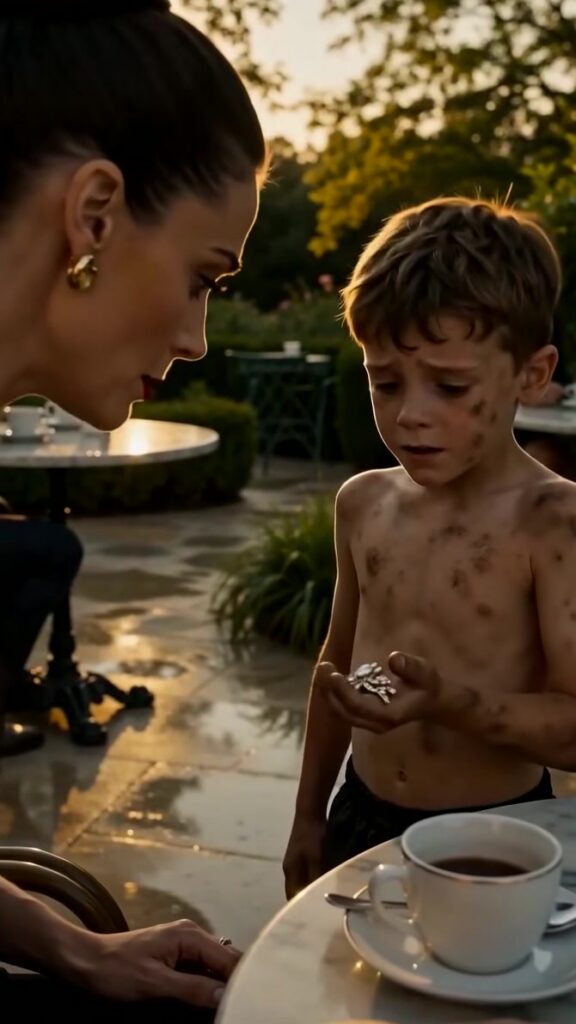
A child had stepped into the terrace from the hedge walkway, small and unsteady as a candle flame in wind. He was barefoot, shirtless, his ribs faintly visible under skin browned by sun and neglect. Dirt streaked his collarbones and the delicate bones of his wrists. No one could decide whether he was lost or bold, whether the security had failed or something darker had slipped through the iron gates.
Before anyone stood, before anyone called for help, the boy reached up on his toes and laid his fingers in Livia’s hair.
Gasps crackled around the tables. A woman dropped her napkin like it had burned her. Livia recoiled so sharply her espresso trembled, a dark wave nearly spilling over porcelain. “Don’t,” she snapped, the word clean and cruel. Her hand rose as if to strike the air between them away. “Don’t touch me.”
The boy yanked his hand back. His entire body shuddered as though the terrace itself had slapped him. Tears welled, but he did not sob. He simply stared at Livia with the fixed, desperate focus of someone trying to remember a face they’ve only seen in dreams.
His voice came out thin, broken at the edges. “It’s the same,” he whispered. “The same hair.”
A few people laughed, reflexive and nervous, the way people laugh when they want to reassert control over the unpredictable. But the laughter faltered as the boy did not smile, did not blink, did not look away from Livia. He studied her as if the answer to a question was hidden in the shine of her black curls.
Livia leaned forward, removing her sunglasses with slow precision. Her eyes were a bright, wintery gray. Anger sharpened them—but underneath, something else flickered. Recognition, or fear. “What are you talking about?” she asked, her voice quieter now, the tone of someone stepping toward a cliff edge.
The boy swallowed, Adam’s apple bobbing. “My mama said I’d find you here.” He said it the way a child repeats a promise the world has taught him not to trust.
Livia’s posture stiffened. Color drained from her face so quickly it looked as if the sunlight had abandoned her. “Your mother?” The words stumbled out of her, stripped of contempt. She glanced, fast and involuntary, to the jeweled clasp holding a small section of her hair back—an ornament she had worn for years without thinking of the day it first touched her skin.
The child nodded once. Then he opened his fist, uncurling his fingers with solemn care. Resting in his palm was a hair clip: silver filigree set with deep green stones that caught the afternoon and scattered it into fragments. It was old-fashioned, too ornate for modern taste. Yet it gleamed as though it had never known dust.
Livia’s hand began to tremble. The clip was not merely familiar. It was impossible. She had watched it disappear into dark water seventeen years ago, on a night her memory refused to enter without breaking. Her lips parted. No sound came. Her fingers hovered over the boy’s palm but did not touch, as if the object might vanish if acknowledged.
“Where is she?” Livia finally managed. Her voice cracked on the final syllable.
The boy’s gaze drifted away from her, as though a string had pulled his chin toward the hedge walkway. Every head followed. Even the waiters stopped, trays frozen midair.
There, framed by clipped greenery and a narrow path of gravel, stood a woman in a beige suit. She looked polished in the way stones look polished—hard, deliberate, shaped by pressure. Her hair was the same black as Livia’s, but worn in a severe knot. Her face was composed into a mask so controlled it bordered on inhuman.
Livia’s chair scraped again, softer this time but still full of violence. She rose, slow and unsteady, as if her legs had forgotten what weight was. Her mouth formed a single word, and it sounded like confession. “Sera.”
The woman in beige did not smile. She stepped forward, and the terrace seemed to inhale as one body. The child moved to her side automatically, like a satellite finding its orbit. Sera’s hand rested lightly on his shoulder; the gesture was both protective and possessive.
“You came,” Sera said. Her voice was low, with an accent that hinted at distances, at years spent somewhere Livia’s money could not buy access to. “I wasn’t sure you still kept your rituals. Same table. Same time. Same performance.”
Livia’s eyes glistened but did not spill. “You’re dead,” she whispered. “I buried you.”
“You buried a story,” Sera replied, and her gaze flicked to the hair clip in the boy’s hand. “And you bought witnesses to keep it in the ground.”
As if on cue, one of the older men at a nearby table shifted uncomfortably. Another man’s gold watch flashed as he lifted his hand, half as if to call a waiter, half as if to signal security. But no guards appeared. The air itself seemed to forbid movement.
Livia’s throat worked. “Why bring him here?”
“Because he is the part you couldn’t erase,” Sera said. She looked down at the boy, her expression softening by a fraction. “His mother told him the truth. And she told him you would pretend you don’t know it.”
“His mother?” Livia repeated, dread thickening the words. “Who is she?”
Sera’s eyes held Livia’s, unblinking. “Mara,” she said. The name landed like a stone dropped into glass. “She lived when you needed her silent. She ran when you tried to keep her. She raised him while you kept your hands clean.”
Livia staggered, gripping the edge of the table. The espresso cup finally tipped and spilled, dark liquid bleeding across white linen like an accusation. Her perfect composure fractured, and something old and terrified looked out through her face. “Mara is… she can’t be—”
“Alive?” Sera finished, almost gently. “Of course she’s alive. People like us don’t die when it’s convenient. They only vanish when they’re forced.”
The boy looked up at Livia, tears finally sliding down his cheeks. “She said you’d know,” he whispered. “She said you’d remember the clip. She said you’d remember what you did.”
Silence pressed in from all sides. The terrace—so used to gossip and carefully curated cruelty—suddenly felt like a courtroom with no judge, only witnesses.
Sera reached into her jacket and drew out a folded envelope, worn at the edges. She placed it on the stone table with a deliberate tap. “There are copies,” she said. “Records. Names. Payments. That night by the river, when you chose your future over mine.”
Livia’s gaze dropped to the envelope as if it were a blade. Her fingers hovered, trembling, then stopped. She did not touch it. Pride fought with panic behind her eyes.
“What do you want?” she asked, and the question carried the ruin of someone who has always bought answers.
Sera’s expression remained almost blank, but her voice turned suddenly sharp, full of a restrained fury that had been forged slowly. “I want you to stand,” she said, “in front of them, and say my name. Say Mara’s name. Say what you did, and why you did it. I want you to look at him”—she nodded at the boy—“and understand that wealth does not make you untouchable. It only delays the moment someone drags a chair across stone and the world finally listens.”
Livia stared at the child, at the clip glittering like a relic in his dirty palm. The terrace waited, suspended between comfort and consequence. For the first time in her life, Livia Ardent could not decide which would destroy her faster—confession, or silence.
And then, very softly, as if the city itself leaned closer, Livia spoke. “Sera,” she said, and the name broke something open in the air. “Mara.” Her voice shook, but it did not stop. “Tell me what you want me to say… and I will say it.”
Sera’s hand tightened on the boy’s shoulder. “Good,” she replied. “Because this time, everyone is watching.”