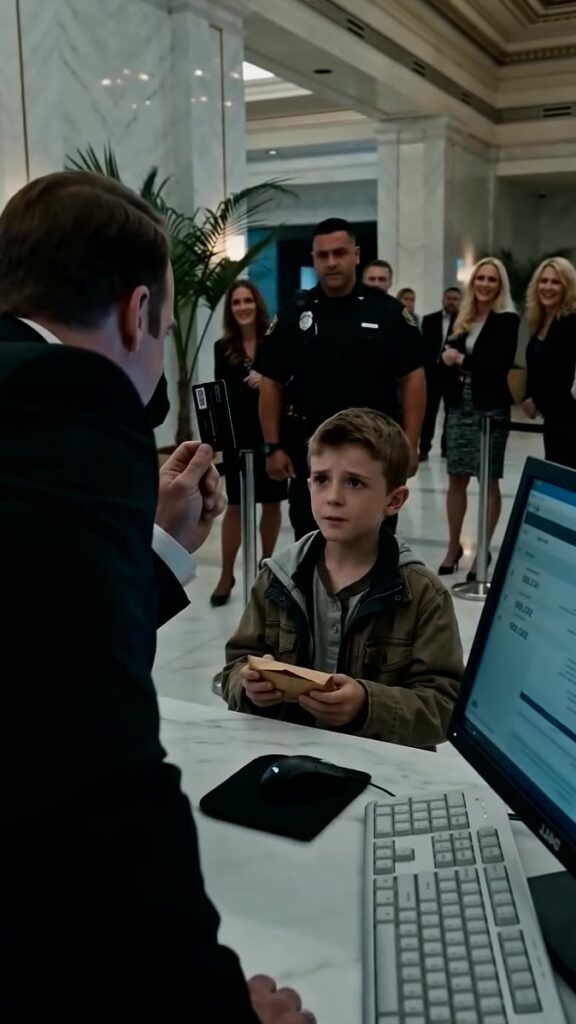
The bell above the bank’s glass doors chimed like it always did—bright, indifferent—when the boy stepped inside. Rainwater slid off his sleeves and dotted the marble floor in small, dark coins. He paused just long enough to wipe his shoes on the mat, as if he could rub away the evidence of where he’d come from.
He couldn’t have been more than sixteen. His jacket was too thin for the season and too big for his shoulders, the elbows shiny with wear. He carried a paper envelope pressed flat against his chest, clutched with the seriousness of someone holding a fragile promise. The lobby smelled of polished wood and expensive cologne. It smelled like people who had never measured their hunger in days.
At the reception desk, a woman with immaculate nails glanced up and down him in a single practiced motion. Her smile did not reach her eyes.
“Can I help you?” she asked, already halfway to saying no.
“I need to make a deposit,” the boy said. His voice was quiet but steady.
Two men in tailored coats sat near the brochure rack, waiting for a private banker. One of them leaned toward the other and murmured something with a smirk. The other laughed—soft at first, then louder, as if he wanted the sound to travel and do its work.
“A deposit,” the first one repeated under his breath. “In that envelope? What is it, his lunch money?”
The boy’s ears flushed. He kept his gaze on the receptionist.
She slid a clipboard toward him. “Do you have an account with us?”
“Yes,” he said. “My mother opened it.”
“Name?”
He gave it. The receptionist typed, eyes narrowing. The bank’s system spun for a moment, and her expression changed—not to kindness, not to respect, but to a guarded caution, as if she’d just touched a wire she didn’t know was live.
“One moment,” she said, and picked up the phone without looking at him again.
The boy waited, holding his envelope. His fingers were raw, the cuticles split. Under the fluorescent lights, his knuckles looked bruised.
A tall man emerged from the frosted-glass corridor behind the lobby—Mr. Hargrove, branch manager, a man with a silver tie clip and a reputation for never being surprised. He walked with the measured confidence of someone who believed the world was arranged to accommodate him. Yet as he approached, his eyes flicked to the boy with something like discomfort.
“You asked for me?” Hargrove said to the receptionist.
She covered the mouthpiece with her hand, lowered her voice, then gestured toward the boy. Hargrove’s gaze tightened. He stepped behind the desk and looked at the screen.
At first, nothing changed. He simply stared. Then his mouth parted slightly. The color drained from his face as if someone had pulled a plug. His hand went to the desk edge, gripping it.
The laughter from the two men faltered. One of them shifted, as if the air had grown colder.
Hargrove blinked once, hard, and leaned closer to the monitor. His pupils seemed to contract. Whatever he saw there wasn’t a number alone. It was something that rearranged assumptions—something that made the floor feel less solid.
He straightened too quickly, smoothing his suit as if trying to reassemble himself. “May I speak with you, young man?” he asked.
The boy swallowed. “I just… I just need to deposit this.” He lifted the envelope a little. “And I need a statement.”
Hargrove’s voice came out gentler than anyone in the lobby had ever heard it. “Of course. Please. Come with me.”
“He can do it right there,” one of the waiting men said, not quite joking now. “Isn’t that what the counter is for?”
Hargrove turned his head. For the first time, his politeness fell away and something sharp looked out from behind it. “This client will be assisted privately,” he said. “And I would appreciate it if you kept your comments to yourself while on our premises.”
The men fell silent, eyes following as Hargrove guided the boy down the corridor, past doors labeled WEALTH MANAGEMENT and INVESTMENTS. The boy walked as if he expected someone to grab his collar and drag him back out into the rain.
Inside Hargrove’s office, the air smelled of leather and old paper. A framed photograph of the bank’s founders hung behind the desk. Their stern faces seemed to watch, waiting to see who would be admitted and who would be refused.
“Please sit,” Hargrove said, and then, as if the command might have sounded too ordinary, he added, “Would you like something warm? Tea? Hot chocolate?”
The boy stared at him, suspicious. “No, sir. I just need the deposit. My mom said it has to be today.”
“Your mother,” Hargrove repeated carefully, and clicked his mouse. “Ms. Elara Grey.”
The boy stiffened at the sound of her name spoken aloud in this room.
Hargrove’s eyes returned to the screen. “Your account is not… typical.”
“I know,” the boy said quietly. “She said I shouldn’t talk about it.”
Hargrove nodded once, as if confirming something. “I can see there have been no withdrawals. Minimal activity for years. And then…” He stopped. The word that wanted to come out was transfer, but it seemed too small for what he was seeing.
“Then what?” the boy asked, though he already looked like he knew the answer would hurt.
Hargrove folded his hands, knuckles whitening. “There was an update this morning. A legal instrument was executed.”
The boy’s grip tightened on the envelope. “Is my mother…”
Hargrove inhaled slowly. “Your mother filed something with us a long time ago. A contingency. Instructions to be followed if she didn’t return.”
The boy’s face went blank, as if his mind refused to allow the rest of the sentence in.
Hargrove continued, voice lower. “She named you as sole beneficiary. She also included a letter. It arrived with the verification this morning.”
He reached into a drawer and pulled out a sealed envelope, thick and cream-colored, the bank’s watermark pressed into it. The boy recognized his mother’s handwriting on the front and made a sound that wasn’t quite a breath.
“Before you read it,” Hargrove said, “there is… something you should understand about the account.”
The boy’s eyes flicked to the computer. “Is it… is it bad?”
Hargrove’s throat moved. “No. It is the opposite of bad.” He turned the monitor slightly so the boy could see. Numbers lined up in neat, impossible columns. A balance that looked like a printing error. A list of holdings with names that carried weight in boardrooms and government offices.
“This isn’t a savings account,” Hargrove said. “It’s a trust. With controlling interests. With restrictions that were just lifted.”
The boy stared until his eyes watered. “That can’t be mine.”
“It is yours,” Hargrove said, and now his composure began to crack, not from fear but from the realization that he’d been standing, all morning, on the edge of a cliff without knowing it. “Your mother—Elara Grey—was not who this town thought she was. She was listed under a different name in our historical ledgers. The original family name. The one on the wall behind you.”
The boy turned and looked at the founders’ photograph. Their stern faces had never seemed familiar before. Now, in the angle of a cheekbone, the shape of an eyebrow, he saw a resemblance that made his stomach drop.
“Why did she never tell me?” he whispered.
Hargrove watched him with something like regret. “Perhaps she wanted you to grow up free of it. Or perhaps she was running from it.”
The boy’s hands shook as he set his paper envelope on the desk. It was stained and wrinkled, the kind of envelope used for rent payments and overdue notices. “I brought this,” he said, voice small. “It’s cash. I did odd jobs. I thought… if I had enough, maybe she wouldn’t be so tired. Maybe we could—”
He stopped, because the words were too painful to finish.
Hargrove’s eyes softened. “How much is in there?”
“Two hundred and fourteen dollars,” the boy said, as if confessing to something criminal.
Hargrove didn’t laugh. He didn’t even smile. He looked at the envelope like it was sacred. “Then we will deposit every cent,” he said. “And we will print your statement.” He hesitated. “And if you allow it, we will also arrange a meeting with our legal counsel today. Not because you need to be convinced this is real. Because you need protection.”
The boy blinked. “From who?”
Hargrove’s gaze shifted toward the office window, toward the lobby beyond the corridor, toward the world outside the bank’s thick walls. “From everyone,” he said softly. “People will smell this the way wolves smell blood.”
In the silence that followed, the boy tore open his mother’s letter with trembling fingers. He read the first line, and his expression cracked—not into joy, but into grief.
Hargrove looked away, giving him the dignity of privacy while still standing guard like a man who suddenly understood his role had changed. The boy’s shoulders moved with silent sobs as he read, the paper wavering like a candle flame.
Outside, the bank’s bell chimed again as another customer entered, unaware that in a back office, a life had been split into before and after. The people in the lobby still sat in their expensive coats, still believing the world belonged to them.
But the screen’s glow had already rewritten the room’s hierarchy, and the boy—who had walked in smelling of rain and poverty—sat with his mother’s final words in his hands, heir to a legacy no one had suspected, and a future that would demand more courage than money could ever buy.