The rodeo boiled under a white-hot sky, a circle of dirt hammered flat by hooves and history. Heat rose in visible shimmers from the arena floor, turning the air into something you could almost drink—thick, bitter, and laced with sweat. The grandstands trembled with stamping boots and clapping hands. Somewhere behind the chutes, a band fought to be heard over the roar, brass notes breaking apart in the wind like sparks.
At the south gate, the main event waited in the shadow of rusted steel. Ranger—an enormous bull so black he seemed carved out of midnight—stood packed tight in the chute, his shoulder muscles bunching and relaxing in slow waves. Every exhale came out as a blast, dusty and impatient. The gate chain rattled as he nudged it again, a warning that he was done waiting for men and ropes and rules.
Len Hartley, the announcer, leaned into his microphone and forced his voice to sound like celebration instead of dread. “Ladies and gentlemen,” he bellowed, “we got ourselves the kind of ride you tell your grandkids about!” The words bounced off metal and sunburned faces, but the cheer that answered him was uneven, like the crowd could feel something sharp hiding beneath the spectacle. Along the fence line, hands in straw hats exchanged quick looks. Everyone knew Ranger. He wasn’t just a bull; he was a story people told to make themselves feel alive.
The gate clanged. The chain jerked. A flash of movement cut across the edge of the ring—too small, too fast. For a heartbeat, it looked like a tossed rag. Then the rag became a child, airborne, arms pinwheeling. The boy cleared the top rail and hit the ground with a sound that made the nearest rows flinch as one. Dust puffed up around him like smoke.
Noise shattered into panic. Chairs scraped. Someone screamed a name. Len’s voice cracked through the speakers, sharp enough to slice: “Hey! Hey—get the kid out! Somebody get him out!” The bull turned his head slowly, as if the commotion amused him. Ranger’s eyes—dark, unreadable—locked onto the small figure in the dirt. His nostrils flared. He took one step, and the ground seemed to accept the weight like a reluctant promise.
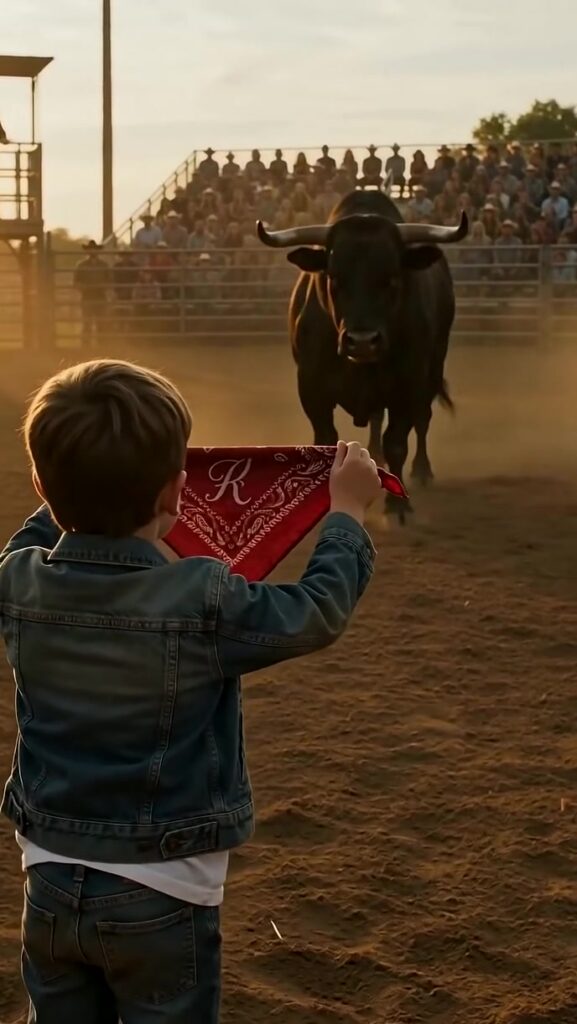
The boy pushed himself up on shaking hands. Eight years old, maybe, with a face too pale for the sun and hair stuck to his forehead in damp strands. His knees trembled, but he didn’t run. He looked around once, not for an exit, but for something beyond the ring—beyond the people. Then he unclenched his fist. A red bandana, washed and rewashed until it had softened into a faded ember, dangled from his fingers. In one corner, the stitching was still visible: two initials, careful and crooked, like they’d been sewn in a hurry.
He lifted the cloth as high as his small arm could manage. His voice barely carried at first, swallowed by the chaos, but it gathered strength as fear sharpened it. “Ranger,” he said, and the bull’s name sounded different coming from a child—less like a challenge, more like a prayer. “Please… look at me.”
Ranger scraped the dirt with a front hoof, sending grit flying. The movement drew a collective gasp from the stands. People shouted for the boy to move, to dive, to do anything but stand there like a target. Yet the child stepped forward, until he was close enough that everyone could see the bandana’s stitching. “My dad said you’d know this,” he called, and the words fell into the arena like stones into a well. One section of the crowd went silent, then another, until only the band’s last note hung in the air and died.
The bull’s head lowered, not in attack but in focus. He stopped watching the boy’s trembling legs and stared instead at the cloth. It was a strange thing to witness—an animal built for force suddenly arrested by something as delicate as fabric. Ranger began to walk toward the child with slow, deliberate steps. His hooves pressed crescents into the dirt. Each step was a countdown. People in the front rows stood with hands over mouths, their faces twisted with helplessness.
The boy didn’t retreat. Tears cut clean lines down his dusty cheeks. “If you remember him,” he said, voice breaking, “then you remember what happened.” He swallowed hard and aimed his gaze past the bull, past the fence, toward the far corner where an old ranch hand leaned on the rail. The man was wiry and sun-leathered, a cigarette tucked behind one ear. His name—spoken in murmurs around town—was Wade Morrow, the kind of person who never smiled with his eyes. As Ranger drew near, Wade’s posture changed. He straightened, stiff as a fence post, as if the bull’s shadow had reached him too.
Ranger suddenly lunged. The world seemed to tilt. Dust erupted beneath his hooves. A woman screamed, long and raw. The boy shut his eyes for a fraction of a second, then forced them open and lifted the bandana higher, as if it could stop a storm. Ranger halted so close that the child’s shirt fluttered in the bull’s breath. A silence clamped down, absolute and suffocating. Ranger’s massive head lowered until his forehead rested against the boy’s chest—gentle, almost careful. The boy’s hands slid to the bull’s face without thinking, fingers splayed over warm hide. He sobbed once, a sound of relief that didn’t belong in an arena built for violence.
From the fence line, Wade Morrow’s face drained of color. He stared at the initials on the bandana like they were a verdict. The boy turned, still pressed to Ranger, and pointed across the ring with a shaking arm. His voice rang out clearer than any loudspeaker. “You lied to my dad,” he shouted. “You told him Ranger was sold—told him the bull was gone. And then you sent Dad out anyway.” The murmurs in the stands congealed into a single, stunned breath. Wade’s mouth opened and closed once, like a man trying to swallow a confession.
Len Hartley lowered his microphone, forgetting he was supposed to narrate. He watched as the boy—small, brave, and trembling—stood sheltered under the shadow of a living battering ram. “My dad thought he was riding a different bull,” the child continued, voice cracking on each word. “He thought you kept your promise. He died out there because you wanted the prize money and you didn’t want anyone backing out.”
Wade gripped the rail so hard his knuckles whitened. Around him, other ranch hands exchanged looks that were part anger, part recognition. A story everyone had half-known suddenly found its missing piece. The boy pressed his cheek against Ranger’s head, as if drawing strength from the animal’s steady heat. “He told me,” the boy whispered, but the arena heard him anyway. “He said Ranger remembers. He said Ranger always knows who’s telling the truth.”
Ranger lifted his head slowly and turned one dark eye toward Wade Morrow. It wasn’t rage exactly—more like a calm, ancient judgment. The bull stamped once, not at the boy, but toward the fence, a single punctuation mark in dirt. Wade took a step back without meaning to. And in that shifting, fragile moment—between spectacle and consequence, between cheering and reckoning—the rodeo stopped being entertainment. It became a courtroom, and the only witness who couldn’t be bought was the one with horns and a heart that still remembered a red bandana in a man’s pocket.