I told nobody I was coming home. Not because I wanted applause, but because I wanted truth—what my life looked like when my name wasn’t announced first. Five years in Dubai had taught me the value of silence. Silence in the heat that pressed down like a hand on the back of your neck. Silence in the worker dorms where men snored through pain and dreamed in languages they could no longer afford to speak. Silence in the video calls where my mother’s voice always arrived too bright, too assured, as if money itself had smoothed every wrinkle in our lives.
I had been a welder on a high-rise project near the marina, twelve hours a day, sometimes more, earning a wage that sounded enormous back home and felt like sand in my mouth there. Every month I wired what I could—nearly everything—to the account my mother controlled. Ava hadn’t had her own at the beginning, and I told myself it was practical. My mother was organized, my mother was responsible, my mother had raised me on the gospel of sacrifice. “I’ll take care of them,” she promised. “Your wife and your boy will live better than we ever did.” And because I needed to believe that my suffering was building something sturdy, I believed her.
The contract ended early when a foreman changed, and suddenly I had a flight in my hands, a real ticket with a real date. I bought gifts the way desperate men buy forgiveness: chocolate, a thin gold bracelet I imagined on Ava’s wrist, a toy dinosaur bigger than Noah’s torso, and a model rocket that promised a clean launch and a safe return. On the plane I rehearsed their faces, the way Noah would shout my name wrong because he’d grown while I was gone, and the way Ava’s eyes would look at me like I’d stepped out of a story she still believed in. I had paid for the house—every stone and nail in it—by counting days like coins. I wanted to walk through those rooms and finally feel rich in the only way that mattered.
The mansion stood outside Houston behind ironwork and motion lights, white and gleaming, as if it had never known the cost of itself. Yet the moment I turned onto the drive, the air felt wrong. Music thumped against the windows. Cars lined the curb like a parade. Through the front glass I saw movement—silhouettes of raised arms, shimmering dresses, men holding glasses in a way that made the liquid look more precious than water. Laughter spilled out in bright bursts. My hands tightened on my suitcase handle. A party. In my house. Again, I thought—because my mother had always liked an audience.
I didn’t go to the front door. Some instinct guided me toward the side path, toward the part of the property guests never saw. The backyard was damp with late-summer humidity, and the smell near the trash bins was sour, like fruit left too long in a bowl. I followed the fence line and heard a sound that did not belong to celebration: a child’s thin, careful sob, as though he didn’t want to be noticed by the world. Then a woman’s voice—hoarse, rushed, trying to make comfort out of nothing. “It’s okay,” she whispered. “Chew slowly. Don’t cough. Don’t let them hear.”
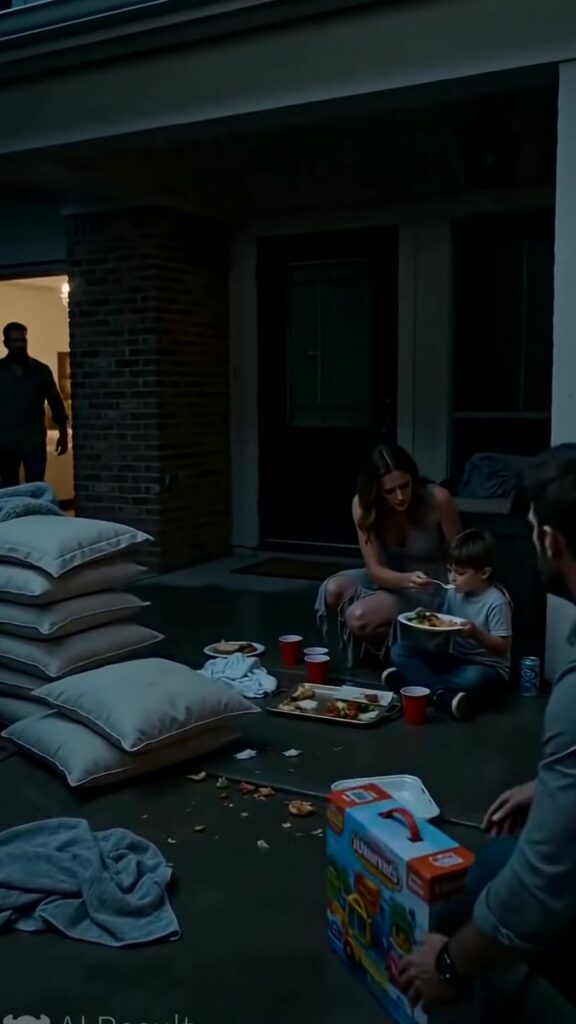
I stepped into the shadow behind the pool house and my lungs forgot how to work. Ava was there, crouched on a flattened piece of cardboard. She was smaller than my memory, her hair pulled back with a strip of cloth instead of a clip, her collarbones sharp under fabric that looked washed too many times. Noah sat beside her with his knees drawn up, holding a plastic fork like it was a tool for survival. A paper plate lay between them with a few pale scraps of food—something scooped from a pan after others had finished. Behind them were signs of living that didn’t count as living: a bucket, a rolled blanket, a half-crushed backpack, a tiny pile of clothes folded as neatly as an apology. My son ate with a focus that broke me—no complaining, no questions, just the grim patience of a child trained not to hope.
My suitcase slipped from my fingers and hit the concrete with a hollow thud. Ava’s head snapped up. Her eyes widened, then filled, then narrowed like she didn’t trust what she was seeing. “Rami?” she breathed—my name thin as paper. Noah looked up too, and for a second his face held no recognition at all. He studied me the way children study strangers, gathering evidence. Then something clicked—something Ava must have pointed out in pictures, some angle of cheekbone or shape of brow—and he rose slowly as if standing might undo the moment. “Dad?” he asked, not as a celebration but as a test.
The back door banged open and a stripe of light carved the darkness. My sister Brooke stepped out with a tray in her hands, her dress glittering, her lipstick perfect, her expression already prepared to scold. She didn’t see me at first. She saw Ava and Noah. “Not yet,” she said in a flat voice, as if she were managing a pet. “That’s for the guests. You can have what’s left after. If there’s anything left.” Ava lowered her head instantly, shoulders curling inward. Noah clutched his fork, frozen. Brooke finally lifted her gaze—and the tray tilted as if gravity had changed. Her mouth opened, but no sound came.
Behind her, my mother appeared, framed by warm light and music, holding a champagne flute. Her jewelry caught the glow. She looked like a woman who believed she had won. When her eyes landed on me, the flute trembled, and the liquid trembled with it. “Rami,” she said, as if my return was a problem to be solved rather than a son to be embraced. In that pause, I saw the whole arrangement as clearly as a blueprint: my money routed through her hands, the story told to friends about her hardworking boy overseas, the expensive parties justified as “networking,” the careful hiding of Ava and Noah where guests wouldn’t ask questions. I saw how hunger could exist behind marble. How cruelty could wear perfume.
I didn’t shout. The rage in me was too old for that; it had been forged in the same furnace as my endurance. I walked to Noah first. I knelt and opened my arms, and he stepped into them cautiously, then suddenly, like a dam breaking. He smelled like dust and cheap soap. His ribs pressed against my forearm. Ava’s hands covered her mouth as she shook, silent tears streaking down her face. I looked up at my mother and sister, and my voice came out steady in a way that surprised even me. “You’ve been feeding strangers in my home,” I said, “while my child eats scraps in the dark.” My mother’s lips tightened, already assembling excuses. Brooke’s chin lifted, already searching for blame. But the music still thumped inside, oblivious. And I understood, in that moment, that the real party had always been my absence.
I stood, taking Noah’s hand, and felt something settle in my chest—not peace, but decision. The house behind us glittered like a monument built on theft. My wife’s eyes held a question that had waited years for an answer: what now? I squeezed her fingers and turned toward the door, toward the light, toward the people laughing in a place they thought belonged to them. “You’re coming inside,” I told Ava, loud enough that my mother flinched. “Both of you. Tonight.” Then I looked straight at the woman who had raised me and at the sister who had enjoyed the spoils. “And you,” I said quietly, “are going to tell everyone exactly where my family has been living.”