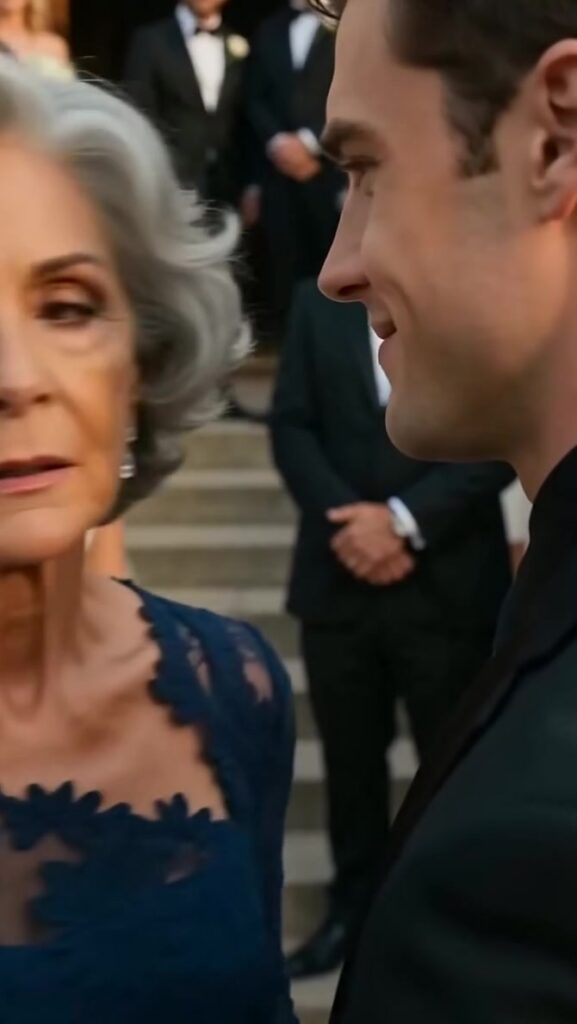
Soft wedding strings drifted out through the open archway of Saint Elowen’s, thin as breath and bright as the afternoon sun. The entrance had been dressed like a promise: white lilies spilling from tall urns, ribbons tied to pew ends, a pale runner waiting like a road into a new life. Guests gathered in their best clothes, laughing with the easy certainty that nothing bad could happen on a day made for vows. On the wide stone steps, polished shoes flashed as people moved aside for the arriving family.
Daniel Hale stood at the top step, just beneath the carved saints. His tuxedo fit as if it had been stitched onto him, the bow tie straight, the boutonnière pinned with care. He should have looked like a man about to be married. Instead he looked like a man about to pronounce a sentence. The string quartet continued, unaware of how his shoulders had set, how his jaw had locked into a line that refused softness.
When his mother appeared at the bottom of the steps, a few guests turned with polite smiles ready. Maren Hale wore navy silk and pearls that caught the sun. She carried a small clutch, her fingers white on its edge, and her face held the practiced calm of a woman who had learned to survive without showing her wounds. Some people murmured her name like it was a rumor. Some didn’t say it at all. Maren climbed steadily, heel to stone, each step measured.
Daniel moved, one clean stride, and set himself squarely in front of the doors. It was not dramatic in the way people expected drama—no raised voice, no wild gestures. The simplicity of it made the air go thin. The quartet kept playing for two more measures before someone faltered, a bow dragging across strings, then silence. Conversations snapped shut. A few phones lowered as if the sight had embarrassed their owners.
“You shouldn’t be here,” Daniel said, loud enough for the first rows to hear. His tone held no question. “This is not your invitation.” The words landed like stones. Maren didn’t flinch, but something moved behind her eyes—a flicker of pain that existed for half a heartbeat before she sealed it away. She looked at the flowers, the ribboned railings, the waiting doorway, as if she were remembering how many times she had brought him to this place as a boy. Then she looked back up at him.
“I understand,” she replied, voice level. It would have been easier if she had shouted. It would have been easier if she had cried. Instead she leaned in just enough that only Daniel could hear her next words. “Then look at your phone.” She didn’t wait for his reaction. She stepped to the side, turned, and began walking down the steps again, the sound of her heels tapping like a judge’s gavel in an empty courtroom.
Daniel’s hand went to his jacket pocket out of reflex, irritation, and something else he refused to name. His phone buzzed against his palm—once, then again, then a third time in quick succession, too loud in the hush. Vanessa, framed inside the church by the open doors, had been wearing her pre-ceremony smile like a crown. It faltered when she saw Daniel’s face sharpen, watched his thumb hesitate over the screen as if the device were suddenly dangerous.
The first message was from Maren. No greeting. Just an attachment. Daniel opened it, and the image filled the display: Vanessa in a pale rehearsal dress from the night before, her body angled toward a man beside a hotel elevator. Her hand was on his collar. Her mouth was on his. The hallway lighting gave their skin a sickly glow, making the moment look like something caught in a crime-scene flash. The sound that rose from the guests was not a single gasp but a spreading fracture—small exhalations turning into whispers that ricocheted between stone and stained glass.
Daniel lifted his eyes slowly, as if the effort cost him. Vanessa stepped forward, bouquet trembling in her grip. “Daniel, please—” she began, reaching for him, her voice thin and hurried, trying to outrun what everyone had already seen reflected on his face. “It’s not—”
His phone buzzed again. Another message. Another file. This time it was a video. Daniel pressed play. In the moving footage, the same elevator doors opened, and the man—tall, smiling, too familiar—wrapped an arm around Vanessa as if he belonged there. A glint flashed at his wrist. Daniel paused the clip and stared at the frozen frame until his breathing changed. His voice came out almost quiet. “Why is he wearing my watch?”
Vanessa’s hand shot toward the phone. “Stop. Don’t—” She was crying now, the tears quick and bright, her makeup beginning to betray her. Daniel pulled the device back as if it were evidence. The bridesmaids, lined behind her in matching dresses, shifted away a step at a time, their bodies instinctively creating distance from contagion. Somewhere inside the church, the priest lowered his program slowly, his expression turning from confusion into resignation, as if he recognized the shape of disaster and knew better than to argue with it.
A third buzz. Daniel’s eyes dropped. This time it was a screenshot—numbers, dates, a bank header he recognized because it belonged to his company. A transfer amount that made his throat tighten. The destination account was not a shared household account. It was not a vendor. It was not anything that belonged in a wedding budget. It was Vanessa’s name, spelled cleanly, linked to a number Daniel had never seen. Vanessa’s knees bent slightly, her bouquet dipping. She didn’t faint, but she looked like she might, like her body could no longer hold up the story she had been telling.
“I was going to explain,” she said, the words cracking apart. Her father, standing near the front pew with a proud boutonnière, staggered backward as if struck. His elbow clipped a tall arrangement; white petals rained down in a slow, obscene snowfall, landing on the aisle runner meant for Vanessa’s entrance. Daniel didn’t seem to notice the flowers. His gaze had traveled past the church doors, down the sunlit steps, to the empty sidewalk where his mother had already vanished into the afternoon.
“How long?” he asked—not to Vanessa, not to the guests, but to the air itself, as if the building might answer. His phone buzzed once more. The final message was plain text. Daniel read it, and whatever had been holding him upright shifted. His shoulders dropped, the first sign of a human being beneath the posture of a groom. The message was short. It did not carry triumph. It carried something colder and kinder. Long enough to keep you from pledging yourself to a lie.
Daniel closed his eyes for a moment. In the sudden stillness, people could hear the distant traffic, the rustle of fabric, the tremble of Vanessa’s breathing. When he opened his eyes, he looked at the altar as if it were an unfamiliar place. Then he turned, stepped away from the doors, and walked down the aisle runner that would not be used as planned. He did not run. He did not shout. He simply moved through the stunned silence with the phone still in his hand, the proof of betrayal glowing dimly like a coal, and he followed the path his mother had taken—out of the church’s shadow and into the sharp, merciless light.