The rain had been falling long enough to turn the city into a mirror that couldn’t hold its own reflection. Headlights smeared into pale ribbons across the wet street, and the gutters ran like small, impatient rivers. In the middle of it all, a man moved through the evening with the careful certainty of someone who believed the world would make room for him. His umbrella was black, his coat was the kind that never wrinkled, and his shoes shone as if they’d never met a puddle.
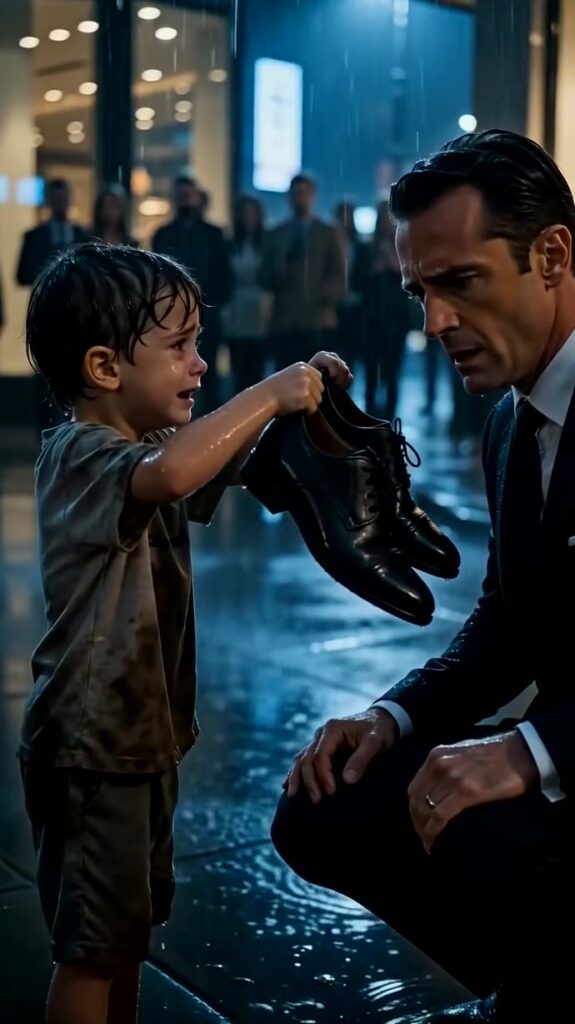
He was two steps from the curb when something collided with the calm: a boy, barefoot, splashing across the pavement, clutching a pair of worn shoes in both hands as if they were a gift and a confession. The boy’s hair lay plastered to his forehead, and water tracked down his cheeks in lines that could have been tears or could have been the rain—there was no way to separate them.
“Sir! Please—buy my shoes!” the boy cried. His voice broke on the plea, as if even his throat was cold. He held the shoes up higher, offering them like a sacrifice. They were old leather, scarred and softened by years, their laces frayed to pale strings. The man stopped so suddenly that the people behind him swerved, muttering. He didn’t hear them. All he saw were the boy’s feet: small, purpled at the toes, pressed against freezing asphalt.
“Please,” the boy said again, nearer now. His hands trembled so hard the shoes shook. “I need medicine.”
The man’s brows drew together. He had the kind of frown that usually ended conversations. “Medicine for what?” His voice was controlled, trained to never crack. But his eyes kept dropping to the bare feet, to the shivering knees under soaked, too-thin pants, to the boy’s ribs that seemed to press against his shirt.
“For my little sister,” the boy whispered, lifting the shoes as if the answer lived inside them. “She can’t breathe. She sounds like… like paper tearing.” The boy swallowed, trying to force the words out before panic stole them. “They said we need the inhaler again. But it costs… it costs more than food.”
For a moment, the city seemed to draw back. The hiss of tires through puddles softened. The distant blur of sirens drifted farther away. Even the rain felt as if it paused to listen. The man’s gloved hand tightened around his umbrella handle. He reached into his coat, the practiced motion of a man who could solve problems with folded bills.
Then he hesitated.
Not because he didn’t want to pay—he could, easily. Not because he doubted the boy—something in that voice was too raw to be rehearsed. He hesitated because he noticed the shoes properly. Not the wear on the soles or the cracked heel, but the shape of them, the careful stitch line along the side, the faint imprint of a maker’s mark he hadn’t seen in years. A memory rose, sharp as a pin: a narrow hallway, the scent of antiseptic, someone laughing softly to keep fear from spilling out.
He lowered himself, knees bending into the wet, his perfect coat losing its perfection in an instant. “Let me see,” he said, and it came out quieter than he intended.
The boy flinched as if expecting the shoes to be snatched away, but he held them out. The man took one, turning it over. Mud clung to the tread. Inside, packed deep against the sole, something pale was wedged where a foot would have rested. The man’s breath stuttered. He slid a finger inside and pulled it free: a folded paper, protected by the shoe as if the leather itself had been a hiding place.
He unfolded it carefully, rain speckling the ink. Hospital letterhead. A discharge summary, stamped and signed. His eyes found the surname first—like a punch to the sternum. His surname.
Color drained from his face so quickly it seemed the rain had washed it away.
“Where did you get these shoes?” he asked. The question wasn’t sharp; it was afraid.
“They were my daddy’s,” the boy said without hesitation, the words steady in a way his shaking body was not. “He’s gone. Mommy said he left a long time ago, before I could remember his face. But she kept these. She said they were important.” His voice wavered and then hardened, like a small fist closing. “She said if I ever found you… I should show you.”
The man stared down at the paper again. Under the surname was a note about emergency contact information, a name he knew too well—Mara—handwritten in a quick, slanted script. He remembered that script on grocery lists, on the backs of envelopes, in the margins of books she lent him. A name he hadn’t spoken in years because it hurt too much, because it was easier to pretend absence was a choice instead of a sentence.
His mouth opened, but no sound came. The rain tapped the umbrella above him with steady insistence, as if demanding an answer.
The boy’s eyes shone, dark and unblinking. “My mommy said… if I found you, you would know.” His lips trembled. “She said you’re the one who left us.”
The accusation landed with the weight of a door slamming shut. The man’s head snapped up, and the boy saw something shift behind the polished exterior: a fracture. Fear, yes—but also recognition, the painful kind that makes denial impossible.
“I didn’t,” the man managed, voice hoarse. “I didn’t leave you.” He looked back at the letter, at the date—years ago, the day he remembered as the day he’d woken in a hospital bed after an accident, groggy and stitched together, told that some records were missing, that some personal items never made it from the ambulance. He’d been told Mara had moved, that she didn’t want contact, that it was better to let go. He’d believed it because believing it was easier than tearing the world apart to find the truth.
The boy’s shoulders shook. “Then why didn’t you come?” he asked, and the question was not childish. It was older than him. “Why did we have to… why did she have to sell her rings? Why did she cry at night when she thought I was asleep?” He held up his own bare feet like evidence. “Why do I have to run in the rain to beg strangers for medicine?”
The man’s throat tightened until it felt like he was swallowing glass. The city rushed back in around them—engines, horns, the wet slap of footsteps—yet the space between them remained painfully quiet. He looked at the boy’s face, searching for something he was afraid to find. The curve of the brow. The set of the jaw. The stubbornness in the stare. It was there, unmistakable, like a mirror held up without mercy.
He reached out slowly, not touching yet, as if he feared the boy might vanish. “Where is your sister?” he asked.
“Home,” the boy said quickly, hope and panic tangling together. “In the room above the bakery. She’s small. She’s turning blue sometimes.” He swallowed hard. “Please, sir.”
The man rose in one swift motion, the decision made with the force of a dam breaking. He shrugged off his perfect coat and wrapped it around the boy’s shoulders, ignoring the boy’s startled protest. Then he scooped the shoes and the paper into his own hands, as if claiming them at last. “You’re not selling these,” he said, voice fierce now. “You’re not selling anything.”
The boy blinked up at him, rain clinging to his lashes. “Then… you’ll help?”
The man looked down at the hospital letter once more, at the surname that bound them, at the proof that someone had buried. His jaw tightened with a new kind of resolve—one sharpened by guilt and something like rage. “I’m going with you,” he said. “To your sister. To your mother. And then we’re going to find out who decided you were better off without me.”
He stepped into the street without waiting for the light, arm out to shield the boy as if the city itself were dangerous. The rain came harder, drumming on the umbrella, washing the shine off the world. Behind the man’s eyes, something shattered and rebuilt in the same breath. Ahead of them, somewhere in a room above a bakery, a child struggled for air.
And in the man’s hands, the old shoes felt heavier than leather—like the weight of years he could never return, and the only chance left to stop the next one from slipping away.