The first time Adrian Vale heard himself say it, he didn’t recognize his own voice.
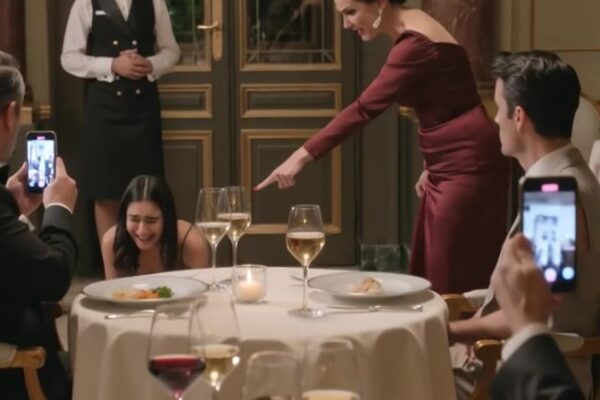
He was on the terrace of his penthouse, high above the city’s jeweled grid, where laughter traveled easily and sincerity rarely did. A string quartet performed near the glass railings, their bows moving like insects over polished wood. His friends—investors, artists, politicians who pretended not to know one another—lifted their phones to capture the skyline behind their champagne. Someone had made a joke about fate. Someone else had answered with a toast to luck.
Adrian was smiling the way he’d learned to smile: just enough to pass. He was telling a donor about a new wing of the children’s hospital he’d funded, and he could almost believe he was the kind of man who did things for reasons beyond control and image.
Then he saw her.
Not from the terrace itself—he saw her by way of a guest’s camera. A young woman had turned her phone to film the party, and the screen caught a blur as she swung it outward toward the open terrace doors, then beyond, down to the street where the building’s shadow pooled like ink. The motion was careless, a quick sweep meant to show the height, the privilege, the proof.
In the phone’s moving frame, a child appeared. Small, too small for the work she was doing. She held a broom nearly as tall as she was, pushing dust and cigarette butts into a neat line along the curb. Her clothes were thin and faded, the sort of hand-me-downs that had lived through more winters than they should have. She did not look up at the tower above her. She worked as if the world depended on a clean edge of pavement.
Adrian’s laughter ended mid-breath.
The donor stopped talking. Nearby, the quartet hit a sour note and recovered. A hush spread with unnatural speed, as if the air itself had been instructed to quiet.
“No,” Adrian heard himself whisper. “That’s impossible.”
Phones rose. People didn’t know why they were recording, only that something was happening near Adrian Vale and they wanted the moment caught. The terrace doors stood open; a warm wind moved in, carrying the smell of city heat, exhaust, and something like stormwater.
Adrian’s body moved before he made a decision. His glass slipped from his hand and shattered, but no one reacted. He was already sprinting through the terrace, through the living room with its museum-clean furniture and walls hung with paintings he could never truly own, down the private elevator where his reflection appeared in polished steel like a stranger running from himself.
In the lobby, the security guard started to speak. Adrian didn’t slow. He shoved past the revolving door and into the sunlight, the noise of traffic slamming into him. His lungs burned. His shoes struck the sidewalk hard enough to send pain up his legs, but he ran as if he were late for a birth he’d missed.
She was still there, sweeping in patient strokes. Up close she looked even thinner, all elbows and narrow shoulders. She had dark hair pulled into a rough tie and the kind of quiet expression adults wore when they’d learned to make themselves small. The broom moved; her eyes stayed down.
Adrian stopped so abruptly his vision flashed white. He crouched near her like a man trying not to frighten an animal.
“Wait,” he said, and the word came out too sharp. He softened it. “Please. Give me your hand.”
She flinched. Her grip tightened on the broom handle. She took a step back, searching his face for the usual threats: anger, hunger, the arrogance of money. When she found none she understood, she frowned deeper.
“Sir,” she said carefully, “I’m working.”
“I know.” Adrian’s hands trembled. He hated that they trembled; he’d spent years forcing them steady in boardrooms. “Just… your hand. I won’t hurt you.”
For a second she didn’t move. Then, as if weighing which choice would cost her less, she extended her left hand, palm half-open. Her fingers were cold, the nails bitten short.
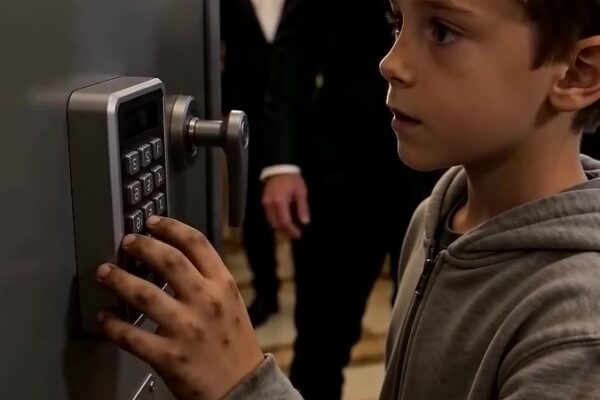
On the inside of her wrist, near the base of her thumb, was a birthmark—deep ink-black, sharply outlined. It wasn’t a smudge or a bruise. It was a shape. Not a perfect circle, not a random stain. It looked, absurdly, like a small keyhole.
The street seemed to tilt.
Adrian’s mind spun back fifteen years, to a clinic outside the city where the air had smelled of antiseptic and wet leaves. To a woman sitting on an exam table, palms pressed to her belly, the ultrasound gel glistening on her skin. To a doctor who’d said, with clinical interest, “A distinctive mark. It may be a birthmark. Could be nothing. Could be… memorable.”
Memorable. That had been the word. He remembered the laugh he’d forced then, the shallow denial. He remembered Elena’s eyes—sharp, bright, furious with love.
Adrian’s knees hit the sidewalk. It wasn’t a dramatic choice. Gravity simply chose for him. He held the child’s wrist as if it were a lifeline thrown across time.
“That mark,” he said, and his voice fractured, “it can’t be.”
The girl’s confusion hardened into alarm. She tried to pull back. Adrian loosened his grip instantly, horrified at himself, but he didn’t let her go.
“I’m sorry,” he whispered. “I’m sorry. I’m not—” His throat closed. He swallowed, tasting salt he didn’t remember allowing. “What’s your name?”
She watched him the way children watch storms. “Lina,” she said. The syllables were small and cautious, like a secret slid under a door.
It hit him with the force of a collision.
Lina.
Elena had said once, when they were young and stupid enough to believe futures could be planned: If it’s a girl, Lina. It means light. It means a way through.
Adrian’s breath stopped. His eyes burned. He looked up at her face, searching for proof beyond the mark: the angle of the cheekbone, the set of the brow. He found it, and it undid him. Elena’s defiance lived in that mouth. His own stubbornness sat in that chin.
“Your mother,” he said, and the words scraped his throat raw. “What’s your mother’s name?”
At once Lina’s shoulders tightened. She glanced down the street, as if expecting someone to appear from the shadows to punish her for answering. Her fingers curled inward, trying to hide the keyhole mark as if it were a door she could close.
“She told me,” Lina said, “not to say it.”
Adrian felt the city around them blur. Cars moved. Voices called. Somewhere above, on the terrace, the party had spilled into a crowd at the railing, phones pointed down like a constellation of cold stars. None of it mattered. The only sound was his heart, loud and desperate, like a fist against a locked gate.
“Please,” he said, leaning closer as if the word could bridge years. “I need to know.”
Lina lifted her wrist slightly, turning it so the sunlight caught the dark shape. The keyhole looked almost intentional, like a stamp from another life. Her gaze held his, steady now, too steady for a child.
“She said,” Lina told him, and her voice was calm as stone, “if someone ever finds me because of this… then he’s the one.”
Adrian’s mouth opened. No sound came.
“She said,” Lina continued, as if reciting instructions memorized for an emergency, “that I should show it, and if he reacts like he’s seen a ghost, then he’s my father.”
The world did not explode. There was no music cue, no cinematic crash. There was only Adrian on his knees, holding the wrist of the child he had abandoned without ever seeing, and the understanding that his life—his careful, untouchable life—had just been unlocked by a mark shaped like the very thing he had always feared: an entrance.
He looked up at Lina again, and the terror he’d mistaken for disbelief settled into something worse: recognition of what he’d done, and what it would cost to undo it.
“Where is she?” he asked.
Lina’s eyes did not soften. “She’s gone,” she said. “But she left me directions. For you. If you were real.”
Adrian’s fingers tightened, then relaxed, then tightened again—careful, reverent, as if he were learning to touch truth without breaking it. Behind him, the building’s doors opened and security spilled out, and above, the terrace crowd murmured like distant surf.
Adrian didn’t look back. He kept his gaze on the girl and the keyhole on her wrist, knowing that whatever door it led to, he would have to walk through it now—no matter what waited on the other side.