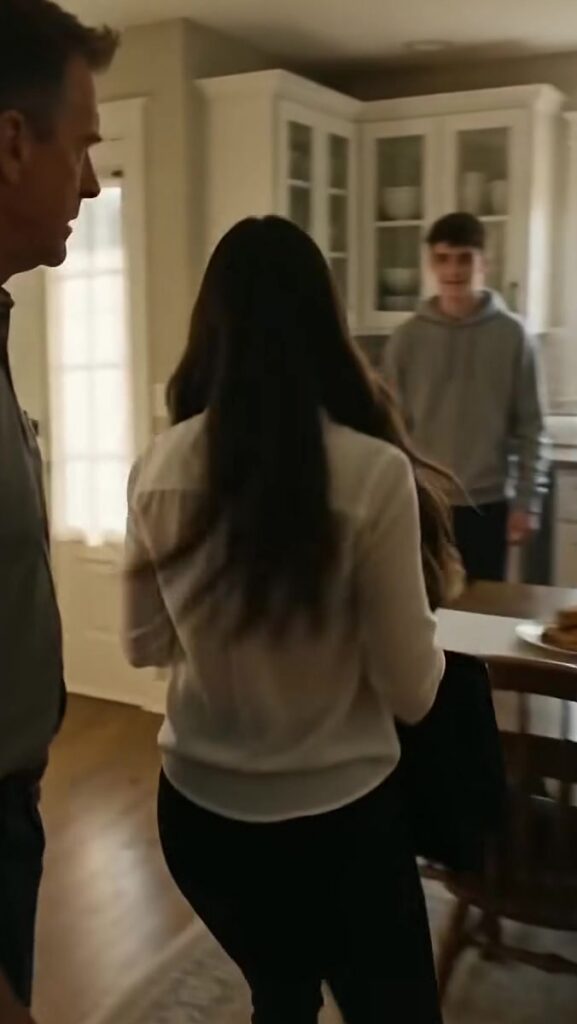
They told her to leave the house forever, as if a home were a coat you could shrug off and forget. As if the walls would keep holding their breath without the one person who had been quietly feeding them air.
The kitchen was too bright for what was happening in it. Late afternoon sun struck the linoleum in pale squares, turning spilled sugar on the counter into glitter. A kettle sat on the stove, cooling, its faint metallic scent mixing with dish soap and the sharpness of someone’s rage. Mara stood near the sink with her bag half-packed at her feet—an overnight bag, the kind you carry when you still believe you’ll be invited back.
The cabinet door snapped shut like a gunshot. Her mother, Lidia, gripped the handle as if she could squeeze obedience out of it. “You walk out of this house and you don’t come back,” she said, each word placed carefully, like bricks sealing a doorway. “I am done with your attitude.”
Mara didn’t understand at first how something so ordinary—sunlight, sugar, a cooling kettle—could share a room with an ending. She glanced at her father, Paolo, expecting the old familiar rescue: a sigh, a muttered compromise, a hand lifted to slow Lidia’s temper. But Paolo’s jaw was set in the way it became whenever he felt cornered. Behind him, Ethan—Lidia’s son from her first marriage—leaned on the refrigerator with his arms crossed, the corners of his mouth tilted as if this were a show he’d paid for.
“All I said,” Mara began, and her voice sounded strange to her, too controlled, “was that the roof is leaking again.” She’d said it the way she always did: matter-of-fact, like a person who knew how fast water could turn a small problem into rot. Mara fixed things. She noticed sagging steps and damp spots, she called plumbers and argued with insurance. She did it because nobody else did. Because loving the place had become her responsibility by default.
Lidia’s eyes flashed. “You always have a problem. You always have something to criticize. This is our house. Stop acting like you own it.”
The words hit Mara somewhere beneath her ribs. She looked at the kitchen table, scarred by years of hot pots and homework, and suddenly remembered being eighteen, signing papers at a bank while Paolo pretended it was just “helping with paperwork.” She’d been proud then—proud to be useful, proud to be trusted. She’d been working two jobs and taking classes at night, and every month she watched her paycheck dissolve into a mortgage payment she was told was “temporary.” Temporary lasted three years. Temporary had taken birthdays and weekends and the last scraps of her youth.
Mara lifted her eyes again. “I’m not acting,” she said softly. “I have been paying for this place.” The sentence came out with a calm that frightened her. Not angry. Not pleading. Just true.
Paolo took a step forward as if the truth were a physical thing he could push back into her mouth. “We never asked you to,” he snapped, and it was the same line he used when she bought groceries, when she replaced the broken dryer, when she paid the overdue water bill. As if refusing to ask erased the fact of taking.
Ethan let out a small laugh, the kind people make when they want to prove they’re not nervous. “Here we go,” he murmured. “She’s doing the martyr thing again.”
Mara’s gaze slid to him. Ethan had moved into the house last year “for a little while,” and somehow his little while came with new sneakers, late-night deliveries, and an easy claim on the living room TV. He called Mara dramatic whenever she asked for help. He called her selfish when she asked for quiet to sleep before work. He had never seen her at the bank or in the crawlspace under the porch, flashlight between her teeth, checking for termites. He only knew how to enjoy what she kept running.
Lidia’s finger jabbed toward the back door. “Leave, then. If you think money makes you important, go be important somewhere else.”
For a heartbeat Mara waited for someone—anyone—to soften it. To say, not like that. To say, we’re family. But Paolo stared past her shoulder like a man already rewriting history. Ethan watched with open curiosity, like a person waiting to see whether the glass would shatter.
Mara bent and zipped her bag. The sound was small, almost polite, in the middle of the storm. She walked to the hallway, pausing only once at the frame where her height had been measured in pencil marks. Someone had painted over them last year, a quick coat of beige, as if erasing proof she’d ever grown there. She stepped outside without slamming the door. She didn’t give them that much.
The air smelled of cut grass and car exhaust. Her hands shook when she reached the sidewalk, but she kept walking until she found herself at a bus stop, staring at the route map as though it might offer a different life. That night she slept on a narrow mattress in a sublet across town, listening to pipes knock in the walls. The room was cramped and smelled faintly of old curry, and it was the first space in years that belonged to no one but her. She cried once, quietly, into the sleeve of her sweatshirt, then wiped her face and opened her laptop.
She logged into the bank portal with the same password she’d used since she was eighteen. The mortgage account sat there like a stone. Her name was on it. Not in the “helpful daughter” way. In the legal way. Co-borrower. Co-responsible. Co-trapped. She clicked through tabs until she found what she’d been too afraid to look at before: the equity, the payment history, the automatic draft connected to her checking account. She stared at it a long time, and something inside her—something that had been bending for years—straightened.
The next morning, while she stood in line at a coffee shop with cracked tile floors, her phone rang. Paolo’s name flashed on the screen. For a second she imagined not answering, letting it fall silent the way they had let her disappear. But she put the cup down and stepped aside.
“Mara,” he said, and his voice was different—thinner, as though it had lost its armor overnight. “The payment… it didn’t go through. The bank called. They said we’re past due.”
Mara leaned her shoulder against the wall and watched steam curl up from an espresso machine. She could hear Lidia in the background, sharp and frantic, and Ethan’s voice rising, blaming someone else. The world kept moving. Cups clinked. A child laughed. She felt oddly distant from it all, as if she were watching from behind glass.
“I changed it,” Mara said. “The automatic draft.”
“Why would you do that?” Paolo’s breath hitched. “Mara, don’t be like this. Your mother—”
“You told me to go,” she replied, steady as a level placed on a crooked shelf. “You said forever. Forever doesn’t come with exceptions.”
Silence swallowed the line. In that silence, she pictured the house as it really was: not a symbol, not a battlefield, but an aging structure depending on invisible supports. She had been one of those supports. Not the only one, not the strongest, but the one no one bothered to notice until it was removed.
“Are you trying to take the house from us?” Paolo whispered, like the words tasted of metal.
Mara closed her eyes. “I’m trying to stop losing myself to it.” She opened them again and looked at her reflection in the dark phone screen—tired eyes, but clearer than yesterday. “You can talk to the bank. You can refinance. You can sell. You can do what grown people do when they own something. But you don’t get to throw me out and keep my hands under your foundation.”
Paolo began to speak, but she ended the call before the old pattern could wrap around her throat. Her fingers hovered over the screen for a moment. Then, with a deliberate calm, she sent one email to the loan officer she’d never met in person, attaching the documents that proved her contributions, and another to a lawyer whose name she’d gotten from a coworker. Each click felt like loosening a knot.
Outside the coffee shop, a wind pushed at the street trees, and petals from an early-blooming crabapple spiraled down, bright as confetti. Mara stood there, bag strap cutting into her shoulder, and understood something she hadn’t allowed herself to know: leaving wasn’t the punishment. It was the first act of repair. And somewhere behind her, in a house that suddenly felt too big for its own arrogance, the walls were learning what it meant to stand without her.