Nate’s palm struck the armrest hard enough to sting. Plastic creaked, metal shuddered, and the sound ricocheted through the hospital’s glass-walled lobby like a gunshot that never finished echoing. Beyond the windows, rain smeared the city into streaks of slate and neon. Inside, the air tasted of disinfectant and old coffee, and every person within hearing distance suddenly found something else to look at.
He kept his head down, eyes burning, shoulders rigid as if he could hold his own body together by refusing to move. The chair’s footplates gleamed under fluorescent lights—two cold crescents waiting for feet that didn’t answer anymore. He hated the chair for being honest. He hated the building for being quiet. He hated the pity he could feel from people he couldn’t even see.
“I said leave me alone!” he barked toward no one in particular and everyone at once. His voice cracked on the last word. That fracture—small and embarrassing—made his anger surge higher to cover it.
No footsteps retreated. No apology floated in. The silence remained, heavy as wet wool.
Then, from somewhere near the row of plastic plants and the vending machines, a small voice slid into the space he’d tried to defend.
“…you look hurt.”
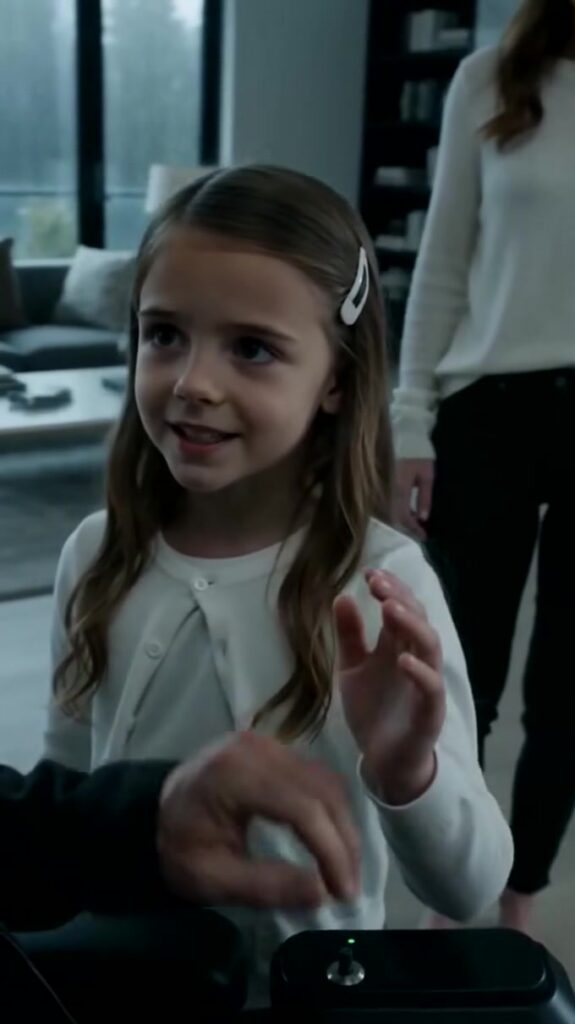
Nate’s head snapped up, ready to scorch whoever had decided to be gentle. A little girl stood a few feet away, framed by a pillar and a poster about handwashing. She couldn’t have been more than seven. Her hair was in two uneven braids, and her raincoat was too big, swallowing her arms. One of her sneakers blinked a red light whenever she shifted her weight, as if it was trying to cheer the room up on its own.
She wasn’t flinching. She wasn’t backing away. She studied him with the steady seriousness of someone who hadn’t learned yet that grown-ups preferred their pain to be ignored.
“I’m fine,” Nate said, the words quick and blunt, a practiced dismissal. He’d said them to nurses, to friends, to reporters, to his brother on the phone when the line went quiet for too long. He said them because “fine” was a wall, and walls were useful.
The girl didn’t argue. She didn’t tell him to breathe, or that everything happens for a reason, or that he needed to stay positive. She just took a careful step closer, like approaching an animal that might bolt.
“When I fall,” she said, “my mom fixes it.”
Nate felt something in his chest twist—irritation, maybe, at the simplicity of it. Or jealousy. Or the dull ache of remembering what it felt like to believe someone could fix anything.
“Your mom can’t fix everything,” he muttered.
“No,” she agreed, as if she’d already tested that hypothesis. “But she fixes what she can. And she holds me when she can’t.”
That was the kind of sentence adults said when they wanted to sound wise. Coming from a child, it was worse. It sounded like truth.
Nate looked past her. No parent rushed forward to yank her back. No nurse appeared. The lobby was so empty it felt staged—security desk glowing with sleepy monitors, the magazine rack untouched, the clock ticking like a slow drip. “Where’s your mom?” he demanded, too sharply.
The girl glanced toward the elevators. “Upstairs. She’s getting stitched.” She lifted her sleeve. A bandage wrapped her elbow, already spotted with rust-colored dots. “She fell in the rain, but she said it was okay. I said it wasn’t. She said it was.” The girl’s face tightened. “Grown-ups lie about being okay.”
Nate’s throat closed. He didn’t answer, because any answer would be an admission.
She took another step, close enough that he could see a crescent of dirt under one fingernail and a tiny scab on her knuckle. Close enough that the smell of rain clung to her coat. Her gaze dropped to his hand, still clenched on the chair’s armrest as if he could crush the whole day into dust.
“May I?” she asked.
“No,” Nate said automatically. It came out weak, the refusal of someone already losing. “Don’t—”
But she reached out anyway, slow and careful. Her hand was small and warm, her fingers feather-light as they settled over his.
For a moment, the lobby changed. The rain seemed to move farther away. The fluorescent lights softened. Nate’s anger, which had been a roaring engine, stalled. In its place was an unfamiliar quiet, the kind that let other things crawl out of the dark.
“What are you doing?” he whispered, and hated how unsure he sounded.
“Helping,” she said simply. She offered a small smile—just enough to be real. Not the kind people gave him when they wanted him to feel brave.
Nate tried to pull his hand away, but her grip—gentle, not strong—held him like a promise. The contact was nothing, and it was everything. His mind flashed, uninvited, to a different hand: a medic’s gloved fingers checking a pulse on the asphalt, the metallic taste of blood in the air, his helmet cracked open like an egg. The last time he’d felt his legs, they’d been pinned beneath the weight of a motorcycle that was still humming, still hot, still too heavy to be real.
“It’s not your job,” he said, and the words trembled. “You don’t even know me.”
The girl shrugged. “I know hurt.”
He wanted to laugh. The sound wouldn’t come.
Then something moved—so small that he nearly dismissed it as an illusion born from exhaustion. A flicker beneath the skin of his fingers. A twitch like a muscle remembering an old song.
Nate went perfectly still.
The girl’s eyes widened—not with fear, but with recognition, as if she’d been waiting for this exact note to ring out.
“Did you—” Nate started, then stopped. His breath caught halfway. He stared down at himself with the rigid focus of someone reading a verdict.
Nothing. Still nothing. His legs were stone. Always stone.
But then—again. A tremor in his right thigh, barely visible beneath the fabric of his jeans. A shiver. A tiny rebellion against months of silence.
His heart punched hard against his ribs. “No,” he breathed, the word splintering. “That’s not possible.”
He tried to command his body, the way he had in therapy, the way he had at night alone in his apartment, sweating with effort and humiliation. Move. Move, you traitor. Move. He poured every ounce of will into the instruction, and for a terrifying second nothing happened, and the hope that had leapt up inside him threatened to collapse into something worse than despair.
Then his leg shifted again. Slightly more this time. Not a miracle, not walking, not even lifting—just a definite, undeniable response. Alive.
Nate’s eyes flooded before he could stop them. He didn’t wipe them away. He couldn’t. The tears came hot and fast, cutting through the last brittle layer of anger he’d been using as armor.
“Wait,” he said, his voice shaking. “Don’t stop—please—”
The girl kept her hand on his as if she could anchor him to this new reality. “See?” she said, one word like a key turning in a lock.
Nate tried again. He focused, pushed, begged silently. This time the movement was clearer—a small lift, a quiver of muscle waking. His breath came in ragged pulls. He looked up at the girl as if she were a witness in a trial where he’d been wrongly sentenced.
“How—” he began.
She tilted her head. “Maybe you just needed someone to hold you when you couldn’t,” she said.
Footsteps rushed into the lobby—quick, purposeful. A nurse appeared first, then a security guard, then a woman with damp hair and a fresh bandage at her temple, eyes wide with panic when she saw the girl by the wheelchair.
“Mila!” the woman cried, voice breaking. “I told you to stay—” She stopped as she registered Nate’s face, his tears, the strange stillness of the room around them. “Oh my God. Are you—”
Nate couldn’t look away from his leg. He tried one more time, and felt the faintest answer, like a door cracking open in a house he’d thought was burned down. His laughter came out strangled, half-sob, half-disbelief.
The nurse knelt beside him, professional calm tightening around her mouth. “Sir, are you experiencing new sensation?” she asked, hands already reaching for his pulse, her eyes flicking between his legs and his face.
“I… I don’t know,” Nate said, shaking. “I think—I think it moved.” Saying it out loud made it real. Saying it out loud made it terrifying.
The nurse called for a wheelchair—then caught herself, realizing the absurdity. She called instead for a gurney, for neurology, for someone with authority. The lobby filled with voices and the squeak of shoes on polished floor. The rain outside grew louder, drumming as if it wanted in.
Mila’s mother reached for her daughter, but Mila slipped her hand out of Nate’s only after making sure he was looking at her.
“You don’t have to be fine,” she said, solemn as a promise. “You just have to try.”
Nate swallowed hard. His anger was gone, leaving a raw, aching space where it used to be. In that space, hope unfurled—sharp and terrifying, yes, but bright enough to hurt his eyes.
As they began to roll him toward the elevators, the overhead lights flickered once, as if the building itself blinked. For a heartbeat, the corridor ahead dimmed, shadow pooling at the edges of his vision.
He gripped the rails, suddenly afraid the darkness would swallow this moment whole. “Mila!” he called, because saying her name felt like holding onto the thread of what just happened.
She waved, her sneaker flashing red against the gray. “Tell them you moved,” she shouted back. “Don’t let them tell you you didn’t.”
The elevator doors yawned open. The lobby behind him fell away. The rain’s roar faded into a distant hiss.
And as the doors began to close, the lights flickered again—this time longer—plunging the space into a brief, swallowing dark that tasted like the edge of a dream.
Nate’s breath stopped. In the darkness, he tried one more time to move, to prove to himself that hope wasn’t just another lie.
Something answered.
Then the lights snapped back, harsh and bright, and the elevator carried him upward, leaving the echo of his own words behind—words that no longer fit him, scattered on the hospital floor like shattered glass.