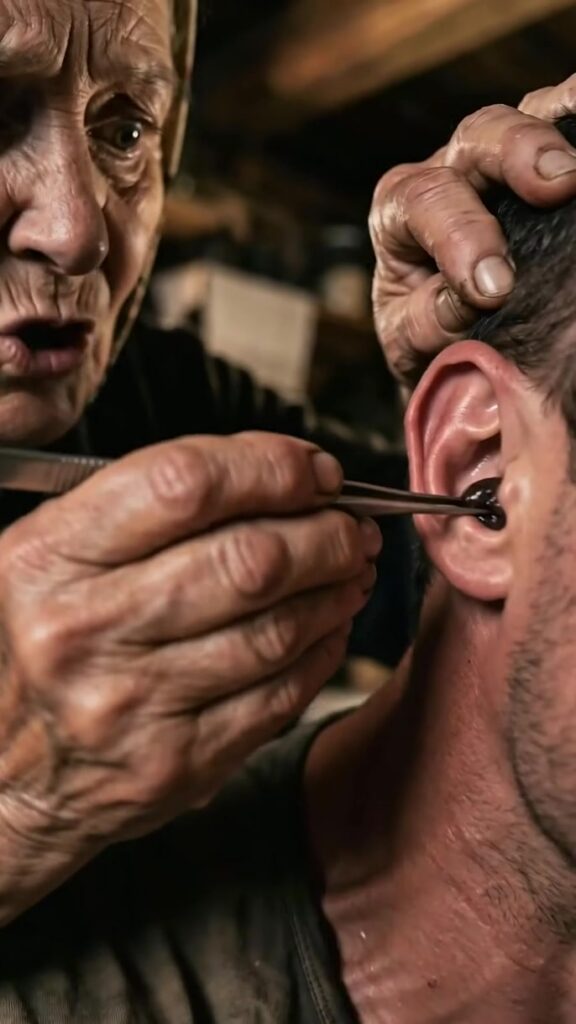
“STOP—DON’T TOUCH IT—!” Eli Mercer’s shout ripped through the shack like a thrown blade, but it arrived a heartbeat too late. The storm outside answered with a wall of thunder, and the lantern flame shuddered as if it wanted to flee. In the wavering light, the room looked smaller than it had a moment ago—too tight for breath, for prayer, for anything that might save them.
Agnes Wicker didn’t look up. Her hands were steady in the way only old hands can be, the way hands become when they’ve seen enough blood to stop flinching. She braced the man’s head against the chair’s high back with her left palm, fingers spread as if she could hold a soul in place by force. With her right hand she guided the tweezers toward his ear, the metal tips shining like a sliver of moon caught between storm clouds.
“Agnes,” Eli said again, softer, as if volume itself was dangerous. “Leave it.”
The man in the chair—Caleb Rusk—buckled hard against the restraints. Rope bit into his wrists. The chair legs scraped over the floorboards, and the sound traveled into the corners where damp wood and old secrets lived. Sweat poured off his temple and down his jaw, collecting at his throat. His eyes were wide, unfocused, a gaze fixed on something far behind the walls.
“It’s in there,” Agnes murmured, the words forming like frost. “I can see it.”
She leaned closer. The lantern flickered and briefly threw her shadow across Caleb’s face, making her look like a second mouth over his own. Eli took one step forward, then stopped. Between Agnes’s tools and Caleb’s frantic breaths, the air itself felt brittle, ready to crack.
Caleb’s voice broke into a plea that didn’t sound like his. “Get it out,” he rasped. “Please—get it out of me.”
Agnes slipped the tweezers in. Caleb screamed so sharply the sound seemed to split the storm, and in the same moment the thunder beyond the shack went oddly distant. The scraping began—metal against something that wasn’t bone and wasn’t wax. It was a wet, intimate sound, like a knife dragged through a fruit that should never have been opened.
Eli’s stomach turned. “That’s wrong,” he whispered, though no one asked.
Agnes’s brow furrowed. “Hold him still,” she ordered.
Eli moved to Caleb’s side and pressed his forearm against the man’s shoulder. Caleb shook with a violent strength, as if his body had forgotten whose it was. The ropes strained. The chair creaked. And the lantern flame shrank down to a thin, nervous thread.
Agnes paused, her breathing suddenly uneven. “It’s—” She swallowed. “It’s reacting.”
“What do you mean reacting?” Eli demanded.
Instead of answering, Agnes adjusted her grip and pulled very gently. The tweezers resisted, as if caught on a hook. She pulled again. Caleb’s eyes rolled back, his mouth open in a soundless howl. Then the resistance changed—not loosening, not tightening, but answering her movement with a slow, deliberate pull in the opposite direction.
“It’s holding on,” Agnes said, and her voice did something Eli had never heard from her before: it trembled.
The lantern sputtered. Shadows on the wall stretched longer than the room should allow, bending toward the chair like spectators hungry for the ending. Outside, rain beat the roof in rapid, frantic taps, but the world beyond the door felt farther away with each second, as if the storm were retreating and leaving them behind.
Agnes tightened her jaw and yanked. The sound that followed was not the scrape of metal but a soft, horrible snap—like sinew giving way, or a string cut under tension.
The tweezers sprang free, her hand jerking back. For a heartbeat her fingers hovered in the lantern light, and Eli saw what she’d brought into the world: a thin thread of darkness pinched between the tips, no thicker than a shoelace, slick with something that glistened like oil. It didn’t hang limp. It curled.
It moved with intention.
Agnes stared, mouth parted, as if the object had stolen her language. The thing twisted in the tweezers, pulsing faintly—an inward, patient rhythm that resembled breathing. Not Caleb’s breathing. Not any breathing Eli recognized.
Caleb went suddenly still.
The storm outside went suddenly silent.
No rain. No wind. No distant thunder rolling away. The absence pressed in against the shack from every side, turning the walls into a coffin lid that hadn’t yet closed.
“Caleb?” Eli whispered.
Slowly, Caleb lifted his head as if waking from a deep sleep. His eyes opened. The whites looked too clear, too clean, as though someone had washed them. He smiled, and the expression didn’t belong on his face—an easy, knowing curve that made Eli’s skin tighten.
“I can hear…” Caleb said, voice calm and level, “everything.”
Eli backed away without meaning to. “Agnes,” he breathed. “Put it down. Burn it. Now.”
Agnes’s knuckles were white around the tweezers. She looked from the thing to Caleb, and her lips moved in a soundless prayer. “This was inside you,” she said, as if the sentence might return the world to sense. “How could this be inside you?”
The dark strand flexed, and a tiny ripple traveled along its length to the tip. It made a sound—not quite a voice, not quite a hiss. Something between a whisper and a thought.
“Don’t,” it seemed to say.
The lantern died.
Darkness dropped like a curtain, instant and total. Eli’s arms shot out, searching, and his fingertips struck the table edge. Somewhere close, Agnes inhaled sharply, and he heard the tweezers clatter onto the floor. The sound felt impossibly loud in the void, like a bell struck in a tomb.
In the dark, Caleb’s voice came again, nearer than before. “He’s been listening,” it said—though the words were aimed at Agnes, the tone carried a private amusement. “He doesn’t know what he hears.”
Eli felt breath on his ear, warm and intimate. He froze. The silence outside the shack held, unbroken, as if the world had leaned in to listen too.
“Eli,” Agnes whispered, groping blindly, “don’t move.”
But it was too late. Something thin brushed Eli’s wrist—a slick touch that left cold behind it. His muscles locked as if a command had been spoken directly into his bones. In the darkness, he understood with a clarity that wasn’t his own: the thing hadn’t been removed. It had been invited.
Caleb laughed softly, and in that laugh Eli heard two voices overlapping, one familiar and one impossibly old. “You wanted it out,” Caleb said, a gentle mockery. “Now it can go anywhere.”
Eli tried to speak, but his tongue felt heavy, as if it belonged to someone else. Agnes was sobbing—quiet, controlled, the sound of a woman realizing that knowledge does not equal power. Somewhere on the floor, the dark strand made a faint wet sound as it moved.
Then, from the center of the room, as though it rose from beneath the floorboards, a new noise emerged: a slow, patient breathing that did not match any chest in the shack.
And outside, far away beyond the walls, the storm began again—as if the world had finally remembered it was allowed to make sound.
Eli’s last clear thought before the darkness filled with whispers was simple and useless: he had warned her not to touch it. He had not known he was also warning himself.