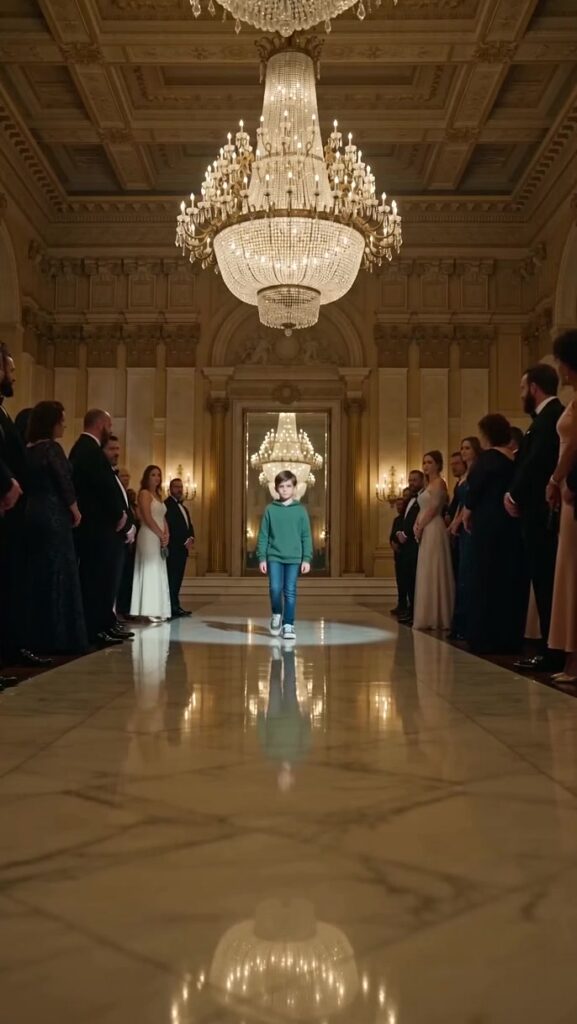
The chandelier burned above the ballroom like a second sun, pouring honeyed light over marble floors and satin gowns, but the air underneath it tasted of ice. Gold warmed the walls and gilded every face, yet no one looked comfortable in that glow. It was the wrong kind of brightness—the kind that makes shadows sharper, the kind that exposes what people came here to hide.
They had gathered for an anniversary, that was what the invitations said. A celebration of Victor Hale’s philanthropy and success. Waiters moved like clockwork, carrying flutes of champagne and trays of sugared fruit, while a string quartet tried to stitch cheer into the silence. But the music faltered as if the notes themselves were afraid to be heard.
At the center of the ballroom stood Victor in a red tuxedo that looked too vivid, too much like a warning sign against the gold. One hand clamped around a microphone; the other held his daughter’s small fingers. Lila Hale wore a pale-blue dress with a skirt that floated around her knees like mist, and a tiny tiara pinned to her dark hair. She was the picture of a storybook princess—except for the way her eyes did not match the costume.
They were steady, dry, far too old for her age. Her lips were slightly parted as if a word might fall out if gravity pulled hard enough, but nothing came. Not even a breathy giggle, not even a whispered complaint about scratchy lace. The kind of silence that should have been temporary had settled into her like a second skeleton.
Victor drew in a breath that shook his shoulders. The microphone caught the tremor, amplified it, flung it back at him from the vaulted ceiling. “My daughter,” he began, and the room leaned in, unable to pretend this was still a party. “She cannot speak.”
A murmur rippled through the guests—board members, donors, politicians who were used to applause, not helplessness. Victor’s knuckles whitened around the mic. “If anyone can bring her voice back… I will pay. A great deal. Whatever it takes.” The last words cracked, not for show but because something inside him had already broken and he was forcing it to stand upright.
No one stepped forward. The doctors Victor had flown in from three countries had already done their polite headshakes. The neurologists had praised his “devotion,” then sent invoices that looked like ransom notes. The therapists had tried games and pictures and gentle songs. Nothing moved the locked door in Lila’s throat. The guests had only rumors to offer: a shock, a fall, a fever, a curse. Each whispered theory kept Victor from noticing the simplest truth—that everyone was afraid of being the next person to fail her.
Then something shifted at the far end of the ballroom, near the tall doors where the staff entered. A boy appeared as if the room had exhaled him. He was small, eleven or twelve, in a green hoodie worn thin at the elbows and jeans faded at the knees. In a sea of silk and tailored suits, he looked like a smudge of street rain on polished glass.
He walked down the marble aisle that had formed naturally between guests. People moved aside without understanding why, their bodies obeying a pressure they couldn’t name. He didn’t glance at the chandelier or the dessert tables or the men with cufflinks shaped like lions. His gaze stayed on the child in blue.
When he stopped a few feet from Victor, he tipped his chin up, calm in a way that didn’t belong in a room full of money and fear. “I can help her speak,” he said, voice soft but steady, the words dropping like stones into a lake.
For an instant, hope flashed on Victor’s face—raw, involuntary. Then it hardened into anger, as if hope were a blade someone had tried to press into his palm. “This isn’t entertainment,” he snapped, the microphone turning his shame into thunder. “Get out. This isn’t a child’s stunt.”
The boy didn’t flinch. He didn’t argue. He didn’t plead. He just looked at Lila, and Lila looked back at him. A single tear slipped down her cheek, slow and bright in the chandelier’s gold. The room noticed, collectively, that she had not looked at her father once during the exchange. She had been staring past him—as if she had been waiting for the boy to cross the distance for a long time.
Victor tightened his grip on his daughter’s hand until her small fingers tensed. “Stop,” he hissed under his breath, not into the mic this time, but close enough that those in the front row heard. “Don’t embarrass me.”
The words were small, almost casual, and that was what made them deadly. Lila’s shoulders drew in a fraction, and the guests understood something they hadn’t wanted to: the cold in the room was not from grief alone. It came from a fear that had learned how to live in luxury.
The boy raised his hand slowly. Not like a magician. Like someone asking permission. Then he turned his palm toward Lila and began to move his fingers in deliberate shapes. A language without sound—clean, precise, gentle. His hands spoke in the air.
Lila’s eyes widened. Her breath hitched, the first visible crack in her stillness. Her free hand lifted uncertainly, then copied his motion, clumsy at first, like a bird testing a new wing. The boy nodded, patient, and signed again—slower this time. Lila followed, her fingers trembling as if the air were heavy.
Victor stared as if he were watching a lock pick slide into a door he’d sealed himself. “What is that?” he demanded, but his voice faltered.
The boy glanced up at him at last. There was no triumph on his face, only a sorrow that didn’t fit his age. “It’s how my mom talks,” he said. “She can’t use her voice either. She taught me so I could still hear her.” He returned his eyes to Lila and signed once more, the movements firm now. Lila mirrored him, and her lips moved without sound, shaping the meaning her hands were giving.
Her fingers spelled it out—slow, unmistakable: STOP HURTING ME.
A collective inhale swept the ballroom. Someone dropped a glass. The shatter sounded obscene beneath the chandelier, like a truth breaking.
Victor’s face drained of color. He tried to laugh, to turn it into misunderstanding, but the room had changed. The guests weren’t watching him to be entertained anymore; they were watching him the way juries watch defendants. Lila’s hand slipped from his grasp. For the first time that night, she stepped away from him—one small step that was larger than any speech.
The boy moved closer, not touching her, only offering his hands again like a bridge. Lila took it. She signed in a rush now, her fingers shaking with urgency. NOT SICK. NOT BROKEN. SCARED. Every motion cut through the ballroom’s gold like a blade through velvet.
Victor’s mouth opened, but whatever he meant to say didn’t arrive. His red tuxedo looked suddenly ridiculous, a costume from a play no one believed in. At the edges of the room, security shifted uncertainly, reading the donors’ faces, calculating loyalties. Someone—an older woman in pearls, one of Victor’s biggest benefactors—stepped forward and said quietly, “Call the authorities.” It wasn’t a question.
The chandelier continued to blaze overhead, indifferent, relentless. Warm gold kept flooding the room, but now it didn’t pretend to be comfort. It was interrogation light. It was sunrise on a night’s crimes. And in the center of it, a girl in blue finally had a way to speak—without giving her father a single sound to steal.
Victor reached for the microphone again, as if he could buy back control with volume. But the boy in the green hoodie held Lila’s gaze, signed one last sentence, and she nodded, tears spilling freely now, not from silence but from release.
Victor’s voice—so practiced, so powerful in boardrooms and press conferences—went nowhere. The room had stopped belonging to him. Under the second sun, the only speech that mattered was made with trembling hands and the courage to be understood.