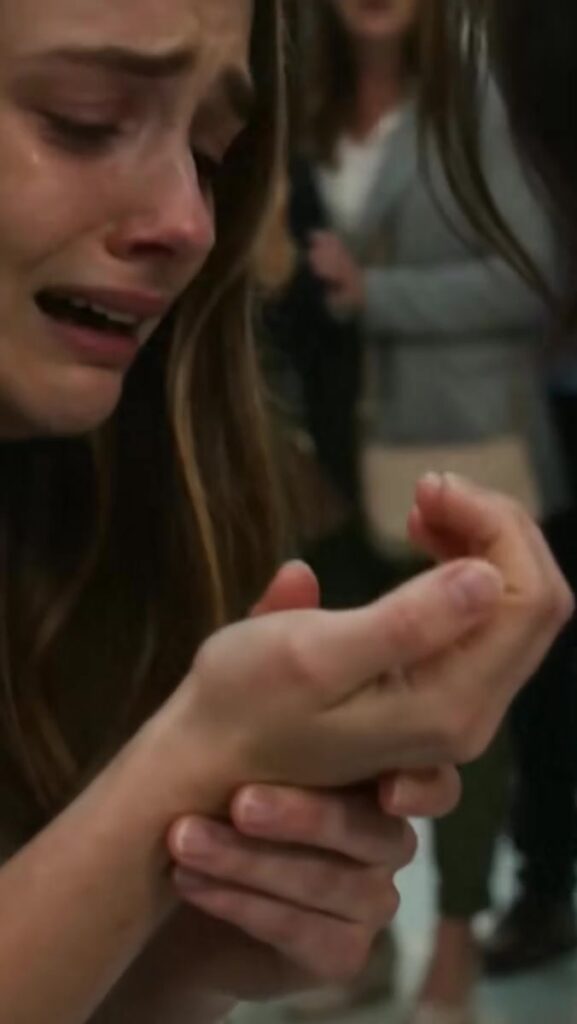
The shove landed like a verdict.
One moment Lina had been standing at the edge of the fountain plaza, clutching her tote to her ribs as if it could hold her upright; the next she was on the stone, skin burning where her palms had met the ground. The air left her lungs in a sharp, humiliating cough. Around her, a ring of strangers tightened, and their faces rose above her like a balcony of jurors.
Someone sucked in a breath. Someone else laughed—half a sound, half a shock. Then the phones appeared. They came up in unison, rectangular eyes widening, hungry for a spectacle. A chorus of soft chimes and camera shutters replaced the birds.
“Get out of here!” the woman in white hissed, her voice carrying with the practiced ease of someone used to being heard.
She was immaculate: cream coat fitted to her waist, hair glossy and pinned so perfectly it looked sculpted. Even the anger on her face seemed curated. Her heels clicked closer, sharp taps against stone, and she pointed down at Lina as if naming a stain.
“You ruined everything,” she said, each word a clean cut. “Do you understand what you’ve done?”
Lina tried to rise. Her knees trembled. She sat back, dizzy, the world bright and too loud. “Please,” she managed. “I didn’t… I didn’t do anything.” Her voice sounded younger than she felt, thin and breakable.
The woman in white—Evelyn Harrow, the name came to Lina with the same sting as her scraped hands—tilted her chin toward the crowd as though inviting them to witness her righteousness. “She’s a liar,” Evelyn announced. “A thief. A manipulator. She’s been circling my family for months.”
Murmurs ran through the ring. The phones adjusted, zooming, centering. Somewhere, a child asked a question and was hushed.
Lina’s throat tightened until it hurt. She hadn’t meant to come here. She’d told herself she would mail the letter, that she would leave everything to paper and distance. But the letter was still in her bag, still unsent, because words on a page couldn’t compete with the weight she carried in her fist.
Evelyn’s shadow fell over her. “Go,” Evelyn said, colder now, quieter, as if granting a mercy. “Before I call security.”
Lina’s hand, the one curled tight against her stomach, pulsed with its own small pain. A hard edge pressed into her palm. She stared at the stone between her knees and heard, for a moment, a different sound: a man’s laughter in a cheap diner, the clink of a spoon against a coffee cup, the way he’d said her name like it was something he’d been waiting to find.
“You’re lying,” Lina whispered. The words surprised her. They were not loud, but they were anchored to something steadier than fear.
The crowd quieted. Even the fountain seemed to soften its rush, as if listening.
Evelyn’s eyebrows lifted. “Excuse me?”
Lina swallowed against the ache in her chest. Her fingers uncurled slowly, as if she were opening a door no one could close behind her. In her palm lay a ring: yellowed gold, the band worn thin, an oval of dark stone set into it that caught the light like a watchful eye. It wasn’t new. It wasn’t expensive. It looked like it had lived on someone’s hand through work and weather and time.
More phones rose. The crowd leaned inward, a collective inhale.
Evelyn’s face changed first in the mouth, then in the eyes. The flush of indignation drained, leaving a pale, startled stillness. Her lips parted. “Where did you get that?” she demanded, but the demand cracked around the edges.
Lina lifted her chin. Tears blurred her vision, but she refused to blink them away. “He gave it to me,” she said. “He said it belonged to someone he loved before he learned how to keep promises.”
The circle of strangers tightened as if pulled by a string. A man in a gray suit muttered, “Is that—” and didn’t finish. Somewhere behind the phones, a woman whispered, “Oh my God.”
Evelyn took a step back, heel skidding slightly on the stone. “That’s impossible,” she said, though her voice lacked its earlier force. “That ring—”
“—was your father’s,” Lina finished. The name sat on her tongue like a bruise. “Arthur Harrow.”
The plaza seemed to tilt. In Lina’s mind, Arthur’s hands came back with painful clarity: big hands, careful hands, the way he’d held hers when she’d told him she was pregnant, as if he could keep her from falling through the floor. She had believed him when he promised he would speak to his family. She had believed him when he said he was different from the world he came from.
Evelyn’s gaze snapped to the ring, then to Lina’s face, searching for a familiar feature she had refused to see until now. “You—” she began, and stopped, as if the rest of the sentence might undo her.
Lina’s breath trembled. “He didn’t tell you about me,” she said. “Of course he didn’t.” She looked at the phones. At the hungry attention. At the neat woman standing above her with her life sewn into her clothes. “But he can’t erase me just because I don’t belong in your pictures.”
The ring warmed in Lina’s palm. It had been the only proof Arthur had left her, the only thing that had felt solid when the calls stopped and the apartment door had stayed shut for days. She had carried it like a secret that could either save her or ruin her, and she hadn’t known which until Evelyn shoved her to the ground.
Evelyn’s voice tightened. “My father is dead,” she said, each syllable clipped. “He died last winter.”
“I know,” Lina replied. “I went to the service. I stood behind a tree because I wasn’t supposed to exist.” The confession tasted of dirt and iron. “I watched you cry like you’d lost a man who never lied.”
A shiver ran through the crowd at that. A few phones angled toward Evelyn now, hungry for her cracks.
Evelyn’s eyes glistened, furious tears caught behind control. “You’re doing this for money,” she spat, grasping for an explanation that made her the victim again. “You found something of his and you think you can—”
“No,” Lina said, and there was steel in it now. “I’m doing this because he left more than a ring.”
She reached into her tote, fingers shaking, and pulled out a folded paper, softened at the creases from being opened and closed too many times. A letter. A birth certificate. Evidence that wasn’t meant for strangers’ eyes, but had become inevitable the moment Evelyn’s hand struck her shoulder.
Evelyn’s face went rigid. “Don’t,” she said, the word suddenly small.
Before Lina could unfold the papers, a third voice cut through the plaza—low, sharp, unmistakably real. It didn’t come from a phone. It came from the edge of the crowd, from a man who had been pushing forward with the urgency of someone running out of time.
“…What did you just say?”
The ring of strangers parted as if forced by a current. Heads turned. Screens pivoted. Lina’s stomach dropped as she recognized the voice before she saw the face: a timbre she had heard in the dark, laughing against her hair; a voice that had promised her she would never be alone.
Evelyn froze completely, her hand hovering in the air as if caught mid-slap. Lina’s breath hitched. The man stepped into view, his suit too expensive to be casual, his eyes too wild to be composed. His jaw was shadowed with grief or neglect—she couldn’t tell which.
Arthur Harrow looked at the ring in Lina’s palm as though it were a weapon pointed at him. Then he looked at Lina—really looked—and something in his expression splintered.
“That can’t be,” he whispered, and the plaza erupted in a wave of confused noise, because dead men were not supposed to speak.
Lina’s fingers tightened around the ring. The papers trembled in her other hand. Her heart slammed against her ribs, demanding answers and justice in the same breath.
Arthur took a step forward, voice ragged. “Lina,” he said, as if saying her name could stitch the world back together. “What are you doing here?”
Evelyn’s head snapped toward him. “Dad?” she breathed, horror and disbelief tangling in one sound.
Between them, Lina rose to her feet despite the sting in her palms. The crowd held its breath. The phones kept rolling, glassy and unblinking.
And just as Lina began to unfold the paper that could end the story Arthur had written for himself, a uniformed guard surged in from the side, reaching for her arm, the world rushing toward another shove—another verdict—another public, final moment.
Lina lifted the ring higher, letting it catch the sun.
“No,” she said, louder now, to the guard, to Evelyn, to Arthur, to the watching plaza. “You don’t get to make me disappear again.”
Arthur’s face went ashen. Evelyn’s lips parted on a soundless scream. The guard’s hand hovered inches from Lina’s sleeve.
And the truth, hanging in the space between a ring and a name, waited to fall.