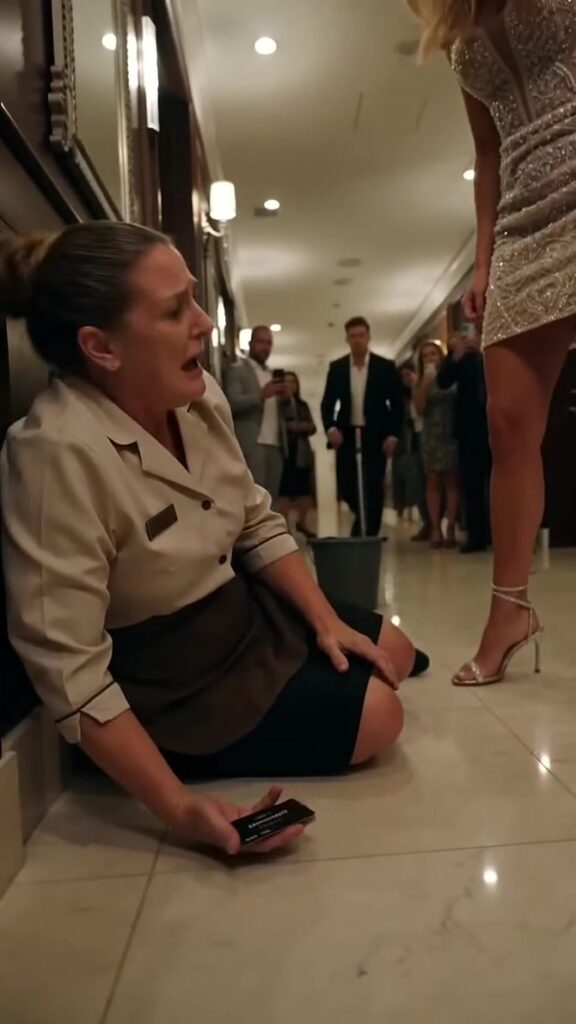
The shove landed like a verdict. One second Mireya was balancing a caddy of sprays and folded linens, the next her spine struck the wallpapered wall with a hollow thud that made the corridor’s gilded sconces seem to flicker. Bottles bounced, a dustpan clattered, and a bundle of white cloth skidded across the carpet like a surrender flag.
“You were in his room.” The woman’s words were not spoken so much as thrown. She stood in a satin wrap and diamond studs, hair pinned with the precision of someone who believed the world arranged itself around her. Her anger had a practiced edge; it cut cleanly and made an audience on contact.
“I was sent to tidy the suite,” Mireya said, tasting metal where her mouth had split. Her accent thickened when she was afraid. She lifted both hands, palms open, fingers trembling, as if she could display innocence the way she displayed keys. “Housekeeping scheduled me. I don’t—”
“Then why was the door latched?” the woman snapped. She jabbed a manicured finger toward the mahogany door behind them. “Why did you keep everyone out?”
People emerged from nearby rooms, curiosity drawn by the commotion. A couple in cocktail attire paused with their ice bucket. Someone with a silk scarf and a bracelet stacked like armor angled a phone, pretending to check messages while the camera lens peered between their fingers. A soft whisper ran down the hall and came back louder, hungry for a story it could fit into a caption.
Mireya’s lungs struggled. The corridor smelled of citrus cleaner and expensive perfume, and both made her dizzy. She reached for the pocket of her apron to prove she’d been assigned properly, but her hand shook too hard. A slim card slipped free, spun once in the air, then struck the marble edge of the corridor runner with a sharp, bright click. It skated away on its own, propelled by the tiniest slope, gliding past polished shoes and the reflected gold of the ceiling lights.
It stopped at the toe of a man’s black Oxford, shoes so carefully shined they looked wet. The hotel manager bent down with the calm of someone trained to retrieve dropped dignity as easily as a key. He pinched the card between thumb and forefinger and straightened, his face arranged into professionalism as if it were a uniform.
Then his eyes caught the number stamped on the plastic, and the arrangement faltered. Not dramatically at first—just a tightness at the corners of his mouth, the way a lock resists before giving. His fingers curled around the card. The little muscle in his jaw jumped.
The woman saw the hesitation and mistook it for fear. She crossed her arms, bracelets chiming. “Well? Tell her. Tell everyone she had no business anywhere near him.”
The manager did not answer. His gaze lifted—not to Mireya, who was still pressed to the wall trying not to slide down it, but to the couple at the center of the storm. The woman, and the man beside her: tall, tailored, his tie knotted perfectly, his expression composed in the way attractive men learn to wear like a shield. Her fiancé.
The corridor’s air changed, as if the building itself had inhaled. The fiancé shifted his weight a fraction, just enough to pull his elbow away from the woman’s arm. It was a small movement, almost nothing. But the manager saw it like a confession.
“Mr. Vale,” the manager said quietly, using the fiancé’s name without looking at the woman. “This card… this is not a guest key.”
The woman’s smirk wavered. “Of course it’s a guest key. It’s his suite.”
“No,” the manager replied, and now his voice was different—still polite, but steel threaded through it. “It’s a staff access card. Issued to engineering. Restricted floors.” He held it up so that the embossed number caught the light. “And it opens Room 1907.”
The woman blinked, as if she had misheard the room number. “We’re on twelve.”
“Room 1907 doesn’t appear on the directory,” the manager said. A few of the onlookers leaned in, sensing the story shift under their feet. “It’s a private service room. A storage suite the owners keep off the books.” His eyes did not leave Mr. Vale. “No housekeeper is assigned there. No guest is supposed to know it exists.”
Mireya found her voice again, thin but stubborn. “Someone texted me,” she said, swallowing hard. “They said the room needed to be sanitized. They said… ‘Use the card. Don’t sign in.’”
The manager’s nostrils flared once. He turned the card over and read the internal code printed in tiny font along the edge. “This card was reported missing three weeks ago,” he murmured, more to himself than anyone. Then, louder: “Mr. Vale, why do you have it?”
The fiancé’s smile appeared on schedule, slick as oil. “This is ridiculous,” he said. “Maybe she stole it. Maybe she’s trying to—”
“Don’t,” the manager cut in. The single word cracked like a whip in the plush corridor. The phones rose higher. The woman’s face tightened into something brittle. “Our security system logs every access. Every tap. Every minute.” He gestured toward the far end of the hall where a discreet camera dome sat in the corner, watching with the patience of a saint. “The last person who used this card was recorded. The footage is time-stamped.”
The fiancé opened his mouth again, but the sound that came out wasn’t a sentence. It was a breath that went wrong.
The manager’s gaze slid to the woman. “Ma’am, you said she was in his room. But the room on this card isn’t his.” He let the silence swell until it pressed against the walls. “Unless you mean ‘his’ in another sense.”
The woman’s eyes flashed. “What are you implying?”
“I’m implying,” the manager said carefully, “that your fiancé has been using a restricted room for reasons unrelated to lodging.” His thumb tapped the card once, a tiny, decisive sound. “And he tried to make your housekeeper the scapegoat.”
Mireya’s knees threatened to buckle. She remembered the smell in 1907—sharp chemicals layered over something sweet and rotten. She remembered the suit jacket hanging neatly on a chair, an expensive watch placed like a breadcrumb on the bedside table, and a laptop open to a page of bank transfers she couldn’t read. She remembered footsteps in the hallway, the sudden panic, the command in the text: Lock it. Now.
The woman stared at her fiancé as if seeing him without the filter of love. “You told me the owners were your investors,” she whispered, the rage draining into something colder. “You said you were negotiating an acquisition.”
Mr. Vale’s eyes darted—toward the stairwell, toward the elevator, toward any exit that didn’t require him to pass the manager. “Darling,” he began, voice softening, “this is a misunderstanding. That employee—she’s confused. The manager—he’s overstepping.”
“Call security,” the manager said into his lapel mic, no longer interested in the performance. “And the police. Also notify the owner’s representative. Now.”
The fiancé took a step back. It was not a dramatic move, just a cautious retreat. But the crowd sensed it and tightened, bodies turning into a living barrier. Someone near the ice bucket muttered, “He’s going to run,” with the relish of prophecy.
Mireya pushed herself off the wall, wincing. She looked at the woman who had shoved her, and for a moment there was no triumph in Mireya’s eyes—only exhaustion. “I didn’t lock it to hide,” she said softly. “I locked it because I was told if I didn’t, I’d lose my job. I have two kids. I can’t afford… mistakes.”
The woman’s mouth parted, and in that brief opening the façade cracked. She glanced at the phones, at the watchers, at the manager holding the card like evidence. Her gaze dropped to Mireya’s split lip, to the scattered cleaning tools still lying like a broken argument across the carpet. Her hand lifted, not to strike this time, but to touch her own throat as if she couldn’t find air.
When security arrived, the corridor erupted in murmurs, but the manager’s voice stayed steady. He handed the card over to the guard, and his eyes softened only once—when he met Mireya’s. “You’re coming with me,” he said, not as an order but as protection. “We’ll review the messages. We’ll clear your name.”
Behind them, the woman’s fiancé was being asked to keep his hands visible, his tailored composure unraveling thread by thread. He glanced at his fiancée as if she might save him. She did not move. Her silence was heavier than any accusation, and in it lived the sound of a shove that had landed too early—before anyone could speak, before the truth could catch up, before the corridor chose whom it would believe.