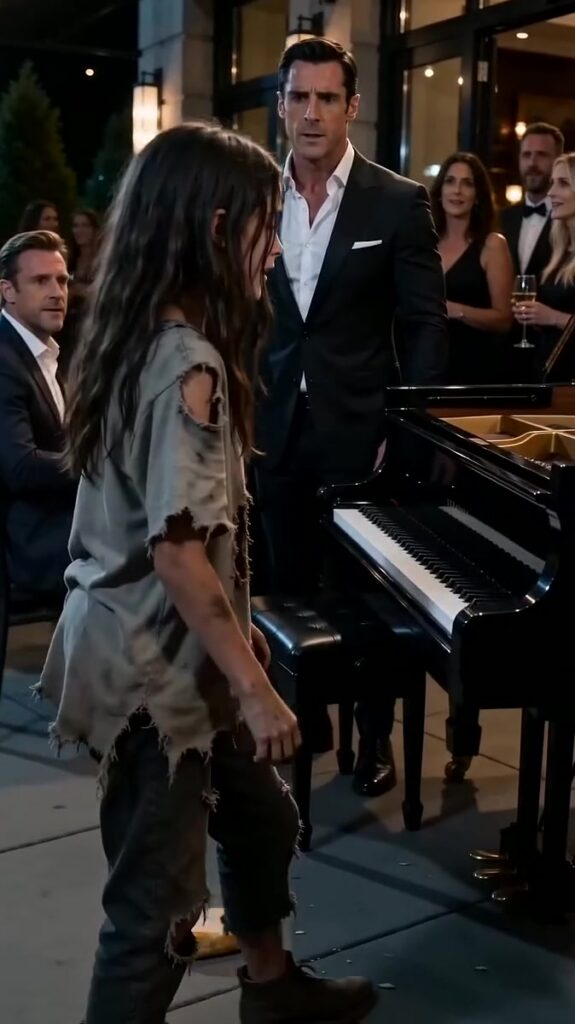
The laughter was louder than the music, and that was the first lie the evening told itself—because the piano was playing well. Soft, deliberate notes drifted across the terrace like a ribbon unspooling through warm air. They wrapped around crystal glasses and polished cutlery, around designer sleeves and perfume, around the low murmur of money congratulating itself for existing.
Below the terrace, the city pressed close: old stone sidewalks, damp corners, a drain that smelled of rain and discarded takeout. And in the seam between the two worlds, a girl sat on the pavement with her knees drawn tight. Her clothes held the color of dust. Her hair was matted back as if she’d once tried to make it presentable and given up halfway. She had a small, stubborn stillness that made her look like she was bracing for impact.
People passed her as if she were a shadow stitched into the ground. A glance slid off her and moved on. A heel tapped, a coat brushed the night, a waiter pretended he didn’t see. The terrace’s heat lamps softened everything into an illusion of safety—luxury as insulation, comfort as denial, control as a language only the well-fed spoke.
At the center table sat Marcus Vale, the man whose name was carved into buildings and headlines and charitable plaques. He wore his calm the way other men wore watches: expensive, precise, always visible. His guests orbited him, laughing in bursts that rose and fell like fireworks. Somewhere behind them, the pianist kept playing, obedient as a clock.
Someone made a joke. Someone else offered an imitation of a politician. The laughter swelled—too loud, too sharp, the kind that demanded agreement. A tall man in a linen blazer leaned back, tipped his wineglass, and glanced toward the pavement as if noticing an inconvenience on his shoe.
“Look at that,” he said, voice bright with cruelty disguised as humor. He tore a piece of bread from the basket, turned it between his fingers, then flicked it outward.
The bread arced through the night and landed near the girl’s feet, a pale scrap on dark stone.
“Hey,” the man called, laughing again, and several others joined in automatically, like trained seals. “Play something for it. Or is begging your only talent?”
The girl didn’t move at first. She stared at a point on the ground that wasn’t the bread and wasn’t the terrace. Her hands stayed locked around her knees, bare and grimy, nails broken, knuckles scraped as if she’d been negotiating with the world using her skin.
A few guests chuckled. Some smiled thinly. Others looked away with that particular kind of politeness that means, I have chosen not to know. The piano’s notes continued, gentle and detached, as if music could absolve anything.
Then—CRASH.
A glass slammed down on the table so hard the stem shivered. The sound cut across the terrace like a blade. It was not a scream, not a plea—something worse. A command.
“Enough,” Marcus Vale said. His voice wasn’t loud. It didn’t need to be. It arrived in the air and everyone recognized, instinctively, the authority they had come to bask in. “Sit down.”
The laughter died. Even the piano faltered, the player’s hands hesitating mid-phrase. Silence spread outward in rings, swallowing the clink of cutlery, the hush of the city, the easy cruelty that had been passing for entertainment.
The man in linen opened his mouth as if to protest, then thought better of it and folded back into his chair. Marcus remained standing. He did not look at the offender. He looked past him, past the terrace edge, down to the pavement.
He studied the girl, and it was strange to see him study anyone without turning them into an asset or a risk. His gaze did not linger on her ragged hem or the dirt under her fingers. It landed on her face, and something in his eyes shifted—not soft, not sentimental. Altered, as if a locked door inside him had been jarred open.
“Can you actually play?” he asked.
His tone was quiet, testing, like a man touching a bruise to see if it still hurt.
The girl’s throat moved as she swallowed. She slowly unfolded herself and stood, the motion careful, as though she expected someone to push her back down. Under the terrace lights her thinness was undeniable, but there was a steadiness beneath it, a wire of resolve holding her upright.
“I didn’t forget,” she said, the words rough from disuse. “Even when I lost everything.”
Her voice was not accusatory. It was simply a fact, like stating the weather.
Murmurs flickered among the guests—confusion, discomfort, curiosity sharpening into hunger. Marcus stepped away from the table, and the group instinctively made room, as if his decision created gravity.
“Let her,” he told the pianist, who froze with hands hovering above the keys like a prisoner awaiting judgment. “Move.”
The pianist slid from the bench as if it burned. The bench sat empty, suddenly too visible. The piano waited, glossy and black, a piece of furniture that had never expected to be challenged.
The girl climbed the two steps onto the terrace. Each one looked heavier than the last. She did not look at the bread on the pavement. She did not look at the man who had thrown it. She walked straight toward the piano as if pulled by something older than hunger.
Up close, her hands were worse than the guests had imagined—scraped, dirty, trembling. She held them above the keys for a long moment, and in that pause the terrace felt suspended between realities: in one, she was a spectacle; in the other, she was a door about to open.
She pressed a single note. Soft. Almost nothing.
Then she began to play.
The music that emerged was not the polite atmosphere the terrace had ordered. It was not decorative. It was a thing with teeth and breath. The melody rose, gathered itself, and struck the air with a force that made people straighten in their seats. It was beautiful, but not in a way that soothed. It was beautiful in the way truth is beautiful: undeniable, expensive, dangerous.
Glasses paused halfway to lips. A fork hovered above a plate. A laugh caught in someone’s throat and died there, ashamed.
The pianist, standing off to the side, stared as if watching his own profession being rewritten. The man in linen blazer looked suddenly small. The woman beside him whispered, “This is impossible,” as though talent required a certain address and a suitable wardrobe.
The music deepened. It carried pain without melodrama, memory without nostalgia. It felt like a door opening onto a house that no longer existed, and yet the scent of it was still in the air: polished wood, distant rain, a lullaby played too softly so the argument in the next room wouldn’t hear it.
Marcus Vale moved closer, step by step, slow as if afraid the sound would shatter. His face remained controlled, but control is a mask, and masks slip under pressure. Recognition crept across his features like a bruise surfacing beneath skin.
He was not hearing a stranger perform. He was hearing a piece that had once lived in his private life, before the world learned his name. A piece he had not heard in years because hearing it meant remembering the part of him he had amputated to survive.
“Wait,” he breathed, the word barely loud enough to exist. “You’re—”
The girl did not stop. Tears slid down her cheeks without changing her expression. She played through them, each note steady, each chord a confession she refused to speak aloud.
Then, mid-phrase, she looked up at him.
Her eyes locked onto his with a calm that made the terrace feel suddenly too small. There was no rage in her gaze. No theatrical hatred. Only a clean, devastating clarity.
“You left us,” she said.
The words fell into the music like stones dropped into a clear pond, ripples spreading outward. Marcus froze so completely that for a heartbeat it seemed the entire terrace froze with him.
He understood. Not intellectually, not as a public scandal to be managed, not as an awkward conversation to be postponed. He understood with the part of himself he had buried under acquisitions and press releases.
His hand lifted, fingers trembling, as if reaching toward her could confirm the impossible and undo it at once.
And then the melody shifted.
Darker. Heavier. Familiar in a way that made his lungs lock. It was the same piece—its bones, its shape, the secret turn in the middle that only one person had ever played for him in a cramped living room while rain ticked at the window and promises were made as if promises could hold.
A house he had not stepped into for years. A street he had driven past without looking. A name he had tried to erase by building higher.
The guests did not know what they were hearing, but they felt it. The air tightened. The terrace’s luxury suddenly looked fragile, like glass held too close to flame.
Marcus’s mouth formed the beginning of a name, his voice cracking around it as if it had been rusting in his throat.
The girl pressed one final chord. The sound rang out, vast and final, swallowing the terrace whole.
She leaned close enough that only he could hear her, and she whispered, “Too late.”
The note faded. The night rushed back in. And in the sudden quiet, the laughter that had once been louder than the music had nowhere left to hide.