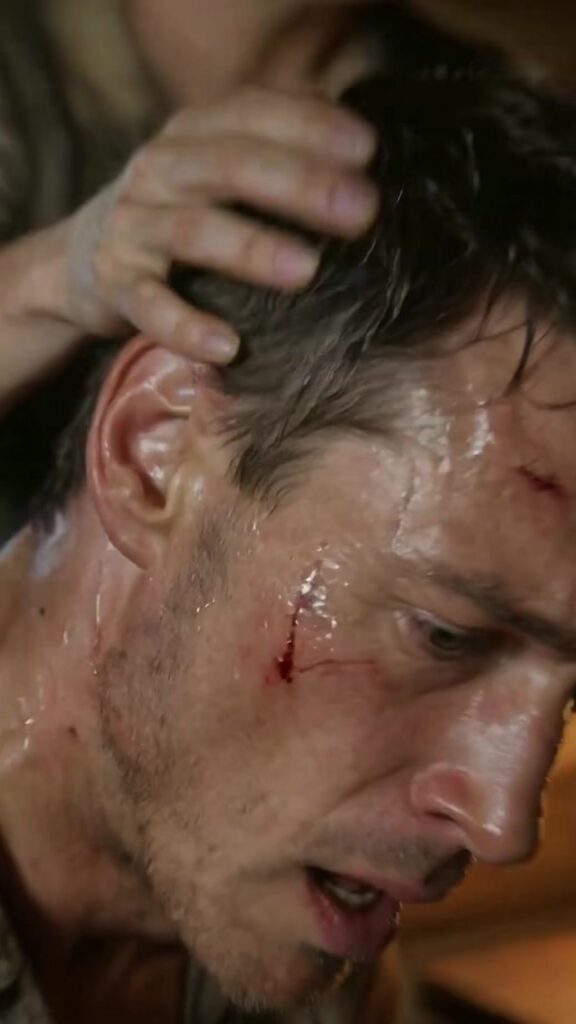
“STOP—DON’T TOUCH IT—!” Mara’s shout tore through the cabin like a thrown axe. It hit the low rafters and came back warped, as if the wood itself tried to swallow it.
Jonah didn’t stop. He sat in the only straight-backed chair, planted like a man waiting to be judged, his shoulders hunched as though the storm outside had found a way beneath his skin. The lantern on the table trembled with every gust that slammed the shutters, throwing frantic shadows along the log walls. Mara could smell wet pine and old smoke and the sharp copper tang of Jonah’s sweat.
“I’m not touching it,” he rasped, voice split by pain. “You are.”
Mara’s hands were already raised, and in them the tweezers flashed—thin, cruel metal scavenged from her emergency kit. She hadn’t meant to become this kind of nurse. She’d meant to spend this weekend proving she could hike the ridge in a single day, proving she could bring Jonah back to himself after the breakup and the months of silence. Instead, they had run for shelter when the clouds dropped and the radio hissed into dead air, and Jonah had started clawing at his left ear as if something had bitten him from the inside.
He gripped the chair’s back so hard the wood creaked. His knuckles were pale as bone. “It’s moving,” he whispered. Then he swallowed, eyes too bright in the lanternlight. “I can feel it moving.”
Mara stepped closer. “Let me look.” She tried to keep her voice steady, tried to sound like the paramedic she wasn’t. But when she leaned in, the sight turned her stomach: the ear canal glistened with a wet sheen that wasn’t wax, and the skin around it looked inflamed, pulsing. Beneath the rawness, something dark shifted, not a speck but a deliberate withdrawal, like an eyelid closing.
Jonah jerked. “Don’t.”
“If we don’t, it’ll burrow deeper.” Mara’s throat tightened. The nearest town was twenty miles of washed-out road away. Her phone showed one bar, then none. The storm didn’t care about their choices; it only hammered the cabin, impatient, wanting in. “Hold still.”
She braced her left hand on Jonah’s temple, feeling his fever heat, and guided the tweezers toward the canal with her right. The metal tips slid in with a soft resistance that made Jonah whimper. Mara’s own breath came shallow. She remembered her grandmother pulling thorns from her palms as a child, the same careful pinch. This was different. This was like reaching into a wound that wanted to close around her.
“Please—stop,” Jonah choked, and his voice broke into a scream as the tweezers touched something that pushed back.
Mara froze. “It’s not wax,” she said, though she wasn’t sure she spoke aloud. The tips nudged again. Something inside Jonah shifted away, then returned, curious. For a heartbeat Mara was certain she felt a pulse—an answering rhythm, faint but organized, like a tiny heart. Her stomach rolled, but she tightened her grip and advanced the tweezers another fraction.
Resistance. Not the blunt stop of bone. Not the sticky drag of fluid. A living tension, coiling and uncoiling against the metal.
Jonah’s body surged. The chair skidded and nearly toppled. “GET IT OUT!” he roared. “GET IT OUT OF ME!”
Mara locked her elbow, forced her shaking hands to become steady. She couldn’t let him thrash. She couldn’t let the thing retreat. She pinched—gently at first, then firmer. The tweezers closed on something that flexed, and Jonah’s scream changed pitch, rising into a raw note that made Mara’s eyes sting.
“I’ve got it,” she said, though fear leaked into every word. “I’ve got it. Hold on.”
She pulled.
At first it came like a stubborn thread, slick and resisting. Then there was a wet, tearing sound—small but intimate, the sound of something releasing from flesh. Mara yanked back instinctively, and the thing slid free into the lanternlight with a twitch.
It was longer than it should have been, thin as a shoelace, dark and wet, with segmented ridges that tightened and relaxed in ripples. It writhed around the tweezers, not flailing randomly but trying to orient itself, trying to turn as if it had a face it wanted to present.
For a second neither of them breathed.
Jonah sat utterly still. His chest rose once, slow. He blinked, as if waking from underwater. Then his shoulders lowered, the tension draining from him so suddenly it looked like surrender. “I…” he said softly. “I can hear.” He tilted his head toward the window. “The wind.”
Mara swallowed. She couldn’t hear the wind.
She listened harder. Nothing scraped the shutters. No rain struck the roof. The cabin had been a drum a moment ago, and now it was a sealed box. Even the forest beyond the logs felt muffled, as if someone had thrown a thick blanket over the world.
The lantern flame steadied, then leaned, then shivered as though it sensed a breath that Mara couldn’t feel.
Jonah turned toward her with a calmness that didn’t belong in his face. The pain was gone, yes, but so was the frantic edge that made him Jonah. His eyes—brown yesterday, brown all his life—looked black now in the dim, not empty but too full, as if crowded behind the pupils.
“Mara,” he said, and his voice was gentle in a way that raised the hair on her arms. “Do you hear it? It’s quiet. Finally quiet.”
Mara couldn’t answer. The thing in her tweezers pulsed, tightening, relaxing. She stared at it, trying to force her mind to label it: leech, worm, parasite, nightmare. It didn’t fit any category that let her remain sane. Along its length, minute hairs lay flat, then lifted as if tasting the air. Near one end, a thin seam parted and closed, parting again with a wet whisper.
“…don’t…” it breathed.
Mara’s fingers went numb. The word wasn’t sound exactly; it was pressure inside her skull, like a memory forced into place. The hairs on the thing rose, and it twisted harder, almost slipping from her grip. When it turned, she saw what she hadn’t wanted to see: not a face, but the suggestion of one—two pale nodules like eyes that had never needed light, and a mouth that wasn’t a mouth but a slit that could shape air into meaning.
Jonah’s head angled, listening to it. “That’s not for you,” he said, almost kindly. “That’s for me.”
“Jonah?” Mara’s voice came out thin. She backed up until her hip hit the table. The lantern glass clinked softly. “What is that?”
He stood with a smoothness that made her stomach drop. The chair didn’t scrape. Nothing in the cabin made a sound unless it was allowed. He took one step toward her, eyes fixed on what she held, and Mara realized with sudden clarity that the silence wasn’t the storm stopping. It was the world holding its breath.
The thing in the tweezers jerked, desperate, and Mara’s reflex was to fling it away—but her hand wouldn’t open. Her fingers tightened on their own, as though a command had been laid into her tendons.
Jonah reached out. His hand hovered an inch from hers. “You should’ve listened,” he said, and his voice wasn’t Jonah’s anymore. It was layered, harmonized with something smaller and older. “You should’ve stopped.”
The lantern flame bent sideways and went out.
Darkness swallowed the cabin, thick and immediate. Mara’s breath caught in her throat, loud in her own ears—too loud in a room that refused to make room for noise. In the black, she felt the brush of Jonah’s fingers against her wrist, gentle as a promise. Then the thing she held wriggled once, pleased, and whispered again, closer now, as if it had found its way back to where it belonged.
“…don’t touch it…”
And the world, obedient, remained silent.