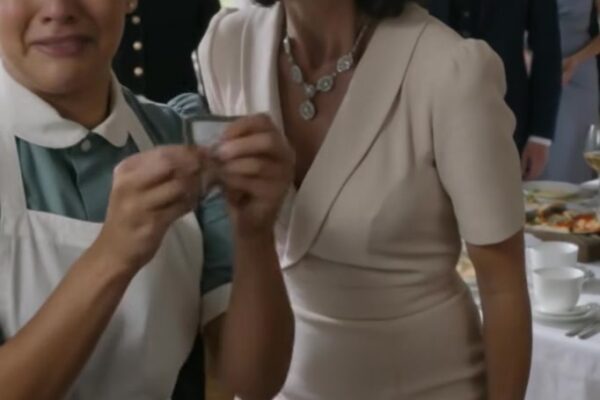
The music didn’t stop—at least not right away. The string quartet kept sawing through a waltz while laughter rang off the gilded walls and chandeliers scattered light like thrown coins. It was the kind of wedding people described with the word “society,” a night meant to be remembered in magazines and boardrooms. Even the air smelled expensive: white lilies, champagne, and the faint sting of new money.
Then the slap landed.
It was quick, sharp, the sound of skin on porcelain more than skin on skin. A dessert plate slipped from a server’s hand as he recoiled, and it hit the marble floor with a clean, final crack. Pieces exploded outward—bright shards skating beneath sequined shoes—like a small, violent firework. For a breath the quartet kept playing, as if refusing to believe the room had changed. Then a violinist’s bow stuttered. A cello drew out a note too long. The music thinned to a single trembling thread and snapped.
Every face turned toward the bride.
Celeste Armand stood with her hand still lifted, as if she could rewind the moment by holding it in place. Her lips were perfect; her eyes were not. Anger made them too bright, the way a match looks just before it burns down. She pointed past the cake table, her finger an accusation with diamond rings.
“Who let that child in here?” she said, voice carrying without effort. “Look at him. This is disgusting.”
Guests rustled. Someone laughed uncertainly, then stopped. Phones appeared like reflexes, glowing rectangles rising above shoulders. The staff froze, trained by years of fear to do nothing until told.
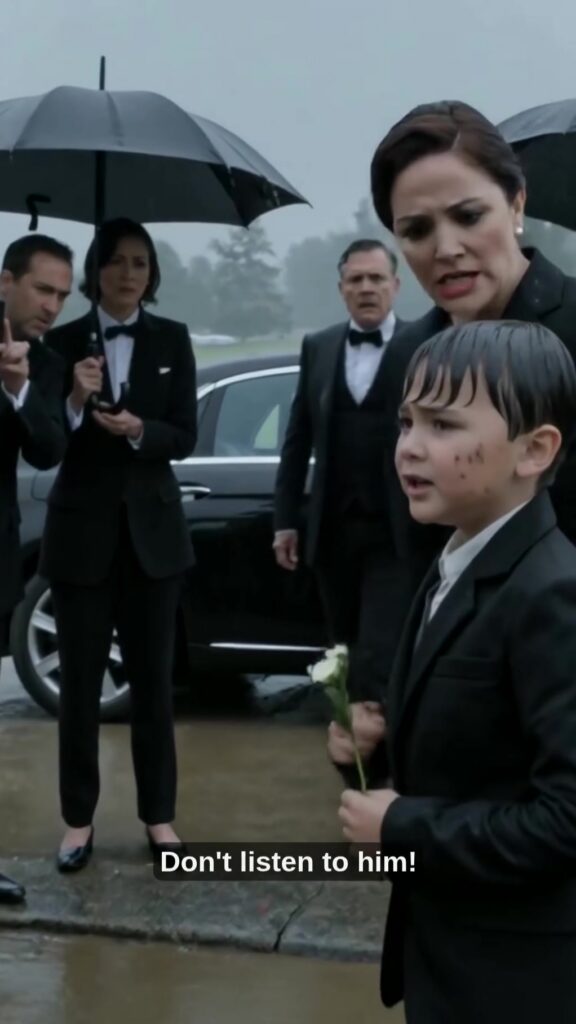
Near the towering cake—five tiers of sugar flowers and edible gold—stood a boy. Ten, maybe eleven. He was too small for the room, swallowed by it: a thin jacket, sleeves frayed, dark smudges on his hands like he’d been digging in damp earth. His hair lay in uneven clumps, as if cut by someone who’d learned with kitchen scissors. He looked as if he’d walked out of a storm and into a painting.
He didn’t run. He didn’t even step back.
Both hands were wrapped around a cassette tape. Not new. Not collectible. The plastic was scratched and the label was half peeled, a name written in hurried ink that had bled: “M.” The boy held it so carefully it seemed heavy, as if it might fall through him if he loosened his grip.
The groom turned with a sigh that had entitlement in it, the practiced irritation of a man whose evening was being inconvenienced. Julian Armand—Celeste had taken his name like it was a prize—was immaculate in black and white, his smile ready to flash when cameras demanded it.
“What is this now—” he began, and then his voice failed in the middle of the sentence.
Because he saw the boy’s face.
It wasn’t the dirt that struck him. It was the shape of the eyes, the slight tilt at the outer corners, the way the boy’s brows pinched together as if he were holding himself upright by force. Julian’s expression moved through stages too quickly to hide: annoyance thinning into confusion, confusion into something that looked like nausea. Recognition, like a hand closing around his throat.
Celeste mistook the pause for hesitation on the part of the staff. She snapped her gaze toward the nearest guard. “Get him out,” she said. “Now. I don’t care who—”
No one moved.
The guard’s eyes had flicked to Julian, and Julian had not given the order. He stood as if the marble had risen around his shoes.
The boy spoke. The words were quiet, almost swallowed, but the room had become so still that even quiet turned into a command.
“My mom died this morning.”
That sentence slid across the ballroom and took the air with it. A few guests inhaled sharply, then seemed ashamed of their own breathing. Even the ice in the champagne buckets stopped clinking.
The boy blinked hard, as if trying not to spill what was already spilling. “She… she didn’t want to come,” he went on, eyes fixed on Julian like a compass needle locked to north. “She said not to make trouble. But she made me promise.”
Celeste’s mouth twisted. “Oh, spare us,” she said, too loud, too brittle. “Some pathetic story to—”
Julian’s hand lifted, not toward the boy but toward Celeste, a small gesture that cut her off. It was the first time anyone had seen him silence her.
The boy took a step forward. The crowd parted without thinking, as if the air itself made room. His shoes made almost no sound on the marble. He held out the cassette with both hands, arms shaking with effort.
“She said I had to give it to you,” he whispered. “Before you… before you said the words.”
Julian’s throat moved. He looked for a moment like he might deny the boy existed, like he might turn and force the night to continue by sheer will. Then he reached out, slowly, as if approaching a wild animal. His fingers closed around the cassette, and the boy’s hands lingered for a second, reluctant to let go, as though releasing it meant releasing his mother too.
Celeste stepped closer, her veil shivering over her shoulders. “Julian,” she said, smile stretched thin, “this is absurd. Whoever he is, he’s clearly been sent—”
“Sent?” Julian echoed, and the word came out wrong, scraped raw. He stared down at the label. The single letter. The smudged ink. His thumb rubbed the corner where the plastic had worn cloudy. “Mara,” he said, not loudly, but enough that the front tables heard.
The boy’s face tightened at the name, and the tightening was a confession all by itself.
“She said… if you hear her voice,” the boy said, and his breath hitched as if the next part had teeth, “…you’ll understand why I have your eyes.”
One of Celeste’s bridesmaids made a sound like she’d been punched. Somewhere near the back, a man muttered, “No.” A phone camera lowered, then lifted again, uncertain.
Julian went pale in a way that makeup could not fix. For a heartbeat he looked younger, stripped of tailored wealth and practiced charm, exposed as a man with a past he’d buried under contracts and granite. His fingers tightened around the cassette until it creaked.
Celeste’s gaze snapped from the boy to Julian, searching his face the way she searched balance sheets—looking for hidden liabilities. She found them. Whatever she saw there stole the red from her cheeks and replaced it with a cold, careful white.
“Tell me this is a trick,” she said softly, and the softness was worse than shouting. “Tell me he’s lying.”
Julian didn’t answer.
The boy wiped his nose with his sleeve and stood his ground like someone with nothing left to lose. “She was sick,” he said. “For a long time. She didn’t want money. She didn’t want you to come. She just… she just didn’t want you to forget.” His voice cracked. “She said you’d already forgotten once.”
A server, trembling, held out a small silver tray with a portable tape player on it—an antique novelty the wedding planner had insisted would be “charming,” a prop for nostalgia. It had been meant for party favors, for jokes about old songs. Now it looked like an instrument of judgment.
Julian stared at the player as though it were a gun.
Celeste reached for his sleeve. “Don’t,” she hissed, low enough that only those closest could hear. “Not here. Not in front of them. If you play that—”
Julian pulled his arm away. Not violently. Simply, finally. He set the cassette into the player with hands that did not feel like his own. The click of plastic meeting mechanism sounded louder than any toast.
The boy squeezed his eyes shut, as if bracing for a wave.
Celeste stood very straight, chin high, the picture of a bride carved from ice. But her fingers dug into her bouquet so hard that petals dropped, one by one, like quiet alarms.
Julian’s thumb hovered over the button. Around him, the room held its breath, waiting to be told what kind of story this wedding would become.
Outside, beyond the tall windows, fireworks from some distant celebration bloomed and vanished without sound. Inside, under crystal and gold, Julian pressed play.
And the first hiss of tape began to speak.