The ballroom looked perfect. Light fell in clean sheets from crystal chandeliers, scattering across the polished marble like spilled diamonds. A string quartet tucked into a gilded alcove coaxed the air into softness. Roses—too many to count, too perfectly arranged—climbed the walls and ringed the dance floor in disciplined, expensive abundance. It was the sort of room that insisted nothing ugly could happen inside it.
I stood near the champagne tower, where my job as wedding planner became a quiet choreography of keeping disasters invisible. I had already intercepted one argumentative uncle, bribed a flower girl with macarons to stop her sobbing, and replaced the groom’s lost cufflink with a spare from my own emergency kit. Everything was sealed, glossy, rehearsed. Even the bride, Eliana Harrow, looked like a portrait made real—ivory silk, a cathedral veil, a smile trained to never falter.
At precisely seven forty-five, the emcee lifted the microphone to announce the couple’s entrance. The first notes of the chosen song hovered expectantly. I scanned the doors in their arched frame of orchids and felt that rare satisfaction—this would be a flawless night, one the family would tell and retell until the edges dulled into legend.
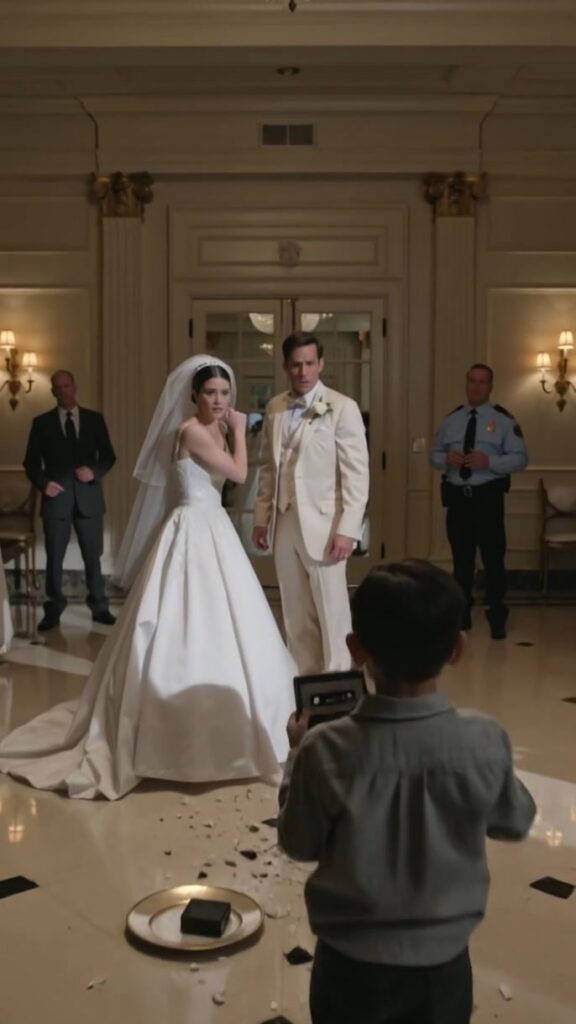
A sharp crack snapped the air in half. A porcelain plate—one of the custom monogrammed chargers—had exploded against the marble. Shards skittered under tables. The quartet faltered, then died. Conversation collapsed into a stunned hush so total I could hear the ice settling in glasses.
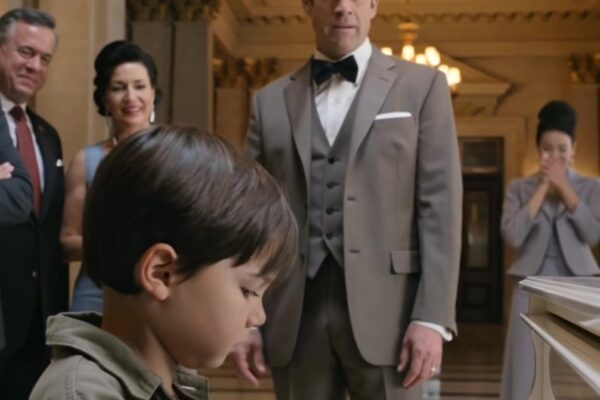
In the bright center of the room stood Eliana, her hand still lifted, as if she had just released the plate and hadn’t yet decided where to put her fingers. In front of her was a boy, no more than eight, thin as a sapling, dressed in clothes that didn’t belong among tailored suits and satin gowns. His hair was damp at the temples. His mouth was set tight, the way a child holds back sound when he’s learned noise makes adults worse. Tears hung in his lashes but didn’t fall.
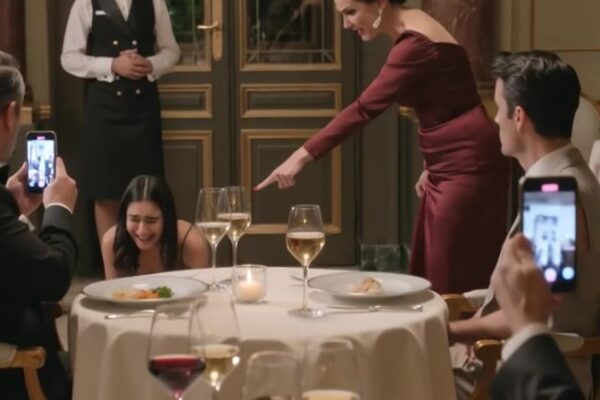
Eliana’s voice, when it came, carried like a knife on a dinner plate. “Who let him in?” she demanded, loud enough for every table. “Get this child out of here.” She didn’t say please. Her gaze moved over him as though he were a stain on her hem. Phones appeared in hands like reflexes; you could feel the room hungry for a scene.
Two security guards stepped forward, then slowed. The boy wasn’t running. He wasn’t begging. He simply held something small and rectangular in his trembling fist: a cassette tape, its plastic shell worn cloudy, a paper label smeared by time. I hadn’t seen one in years. In the age of instant everything, the object looked like evidence from a different life.
“Come on,” one guard muttered, reaching. The boy flinched—not away, but inward—and swallowed hard. When he spoke, his voice was thin and frayed at the edges. “My mom died this morning.” The words dropped into the ballroom with a weight no one could pretend not to feel.
Silence thickened. Even Eliana’s expression twitched, as if a second self had briefly looked through her eyes and then ducked away. The boy drew a breath that shook. “She told me to bring this here. She said I had to give it to him before he married.” His chin lifted, and he looked past Eliana to the groom, Adrian Vale, who stood at the head of the room beside his best man, halfway between irritation and disbelief.
Adrian’s annoyance began as a practiced frown—another interruption, another problem someone else would handle. Then his eyes landed on the boy’s face and something in him unstitched. His jaw slackened. The color drained from his cheeks as if a hand had turned a knob. I watched recognition travel through him, slow and devastating, like a dark tide.
The boy raised the cassette a fraction higher. “She said if you heard her voice, you’d understand why… why I look like you.” A murmur rolled through the guests, then died again as if strangled. Eliana turned her head toward Adrian, her veil sliding over her shoulder like a pale wave. “Adrian?” she whispered, and for the first time that night, the word sounded like fear.
Adrian didn’t answer. His gaze stayed fixed on the tape as though it were a weapon aimed at his chest. He took one step, then another, moving with the careful slowness of a man approaching a cliff edge in fog. Eliana caught his sleeve, her fingers tightening. “No,” she hissed, low and urgent. “Don’t—this is some kind of stunt.”
The boy’s lips trembled. “It’s not. She wrote your name on it. She said you’d know her.” He blinked rapidly, and at last a tear fell, cutting a clean line down his cheek. “Her name was Mara.”
At that, Adrian’s shoulders sagged as if someone had pressed a hand between them. “Mara,” he echoed, barely audible. The room seemed to lean forward. I felt my own pulse in my throat. I remembered the groom’s file: pristine background checks, glossy engagement photos, the charitable foundation press releases. Nothing about a Mara. Nothing about a child.
Adrian extended his hand. It shook so hard his cuff flashed. Eliana stepped between them, her smile gone now, replaced by a brittle brightness. “This is insane,” she said, too loudly. “Who are you? Where is your father?” Her eyes flicked to the guards as if authority could be reassembled by force.
“He’s right there,” the boy said, and the simplicity of it struck harder than any accusation. A collective inhale moved through the guests. Eliana’s face went still, a porcelain mask beginning to crack. Adrian’s fingers closed around the tape, gentle as if it might bruise.
There was an old boom box in the band’s equipment pile—retro décor that Eliana had insisted on for photographs. I watched Adrian cross to it, the tape clenched to his chest like a heart. The best man made a small motion as though to stop him, then thought better. I could have intervened. I could have called this a breach, a disruption, a crisis to be managed. But the look on the boy’s face—equal parts terror and duty—held me in place.
Adrian slid the cassette in. The click was loud in the hush. He pressed play. For a moment, only the soft whir of tape filled the air, a mechanical breathing. Then a woman’s voice emerged, scratchy with age and grief, intimate as a confession made at midnight.
“Adrian,” the recording said. “If you’re hearing this, it means I’m not there to look you in the eye, and you’re about to promise a life that isn’t built on truth. I tried to forget you. I tried to hate you. But then Leo was born, and he had your eyes, and I knew the past would walk back into the room someday.”
The boy’s shoulders caved as if the sound proved something he’d been afraid to believe. Adrian’s hand went to his mouth. Eliana stared at the boom box like it had begun to speak in tongues.
“I won’t ask you to love me,” Mara’s voice continued, the tape warbling. “I won’t ask you to choose me. But you owe him—our son—your honesty. He deserves to know where he comes from. And you deserve to stop running from the man you were.” A pause, then a softer line, almost a breath against the microphone: “I’m sorry I waited. I was scared of what you’d do. I was right to be scared. But I’m more scared of him growing up thinking he wasn’t wanted.”
When the tape clicked off, the silence that followed was not empty. It was crowded with every unspoken thing in the room: Eliana’s humiliation, Adrian’s unraveling, the guests’ voyeurism, the boy’s raw hope. Adrian turned slowly. His eyes were wet, shining under the chandelier light that suddenly looked less like diamonds and more like broken glass.
He walked back to Leo—because now the name mattered—and knelt until they were eye level. “I didn’t know,” Adrian said, voice hoarse. “I swear I didn’t know.” He reached out, stopped himself, then gently touched the boy’s shoulder as if asking permission with his fingertips. Leo didn’t pull away. His sob, when it came, was silent but violent, shaking his small frame.
Eliana stood very still, her hands folded over her bouquet so tightly the stems bent. “So that’s it,” she said, and there was a strange calm in her tone, the kind that arrives when a person has run out of ways to pretend. “You have a son. And you were going to marry me without telling me.” She looked at the guests, then at me, as if the room itself had betrayed her. “The ballroom looked perfect,” she added, almost to herself, and the bitterness of it made my skin prickle.
Adrian rose, still facing Leo, as though Eliana had become a distant sound. “I was a coward,” he said. “I buried it. I told myself it was over. And I was wrong.” He turned to Eliana at last. His voice didn’t soften. “I can’t say vows over a lie.”
For a moment, no one moved. The chandeliers kept shimmering. The roses kept their disciplined bloom. The marble kept reflecting every face in a cold, honest mirror. Perfection held its pose while everything living inside it broke apart.
I watched Eliana’s chin lift, watched her swallow down whatever she wanted to scream. She set her bouquet on a table with ceremonial care, as if placing a crown aside. “Then don’t,” she said. And with that, she walked toward the exit alone, her veil trailing behind her like the last page of a story being torn away.
Adrian didn’t follow. He stayed with the boy, one hand hovering near his back, uncertain but trying. Guests began to whisper again, the spell of silence shattering into a thousand sharp pieces. Phones lowered. Some people stood. The night resumed its motion, but it had changed its shape.
In the corner, the boom box sat quietly, a ridiculous relic that had just rewritten a future. I found myself thinking that the ballroom had indeed looked perfect—until truth, stubborn and poorly timed, stepped across its threshold with a worn cassette tape and a child’s trembling hand.