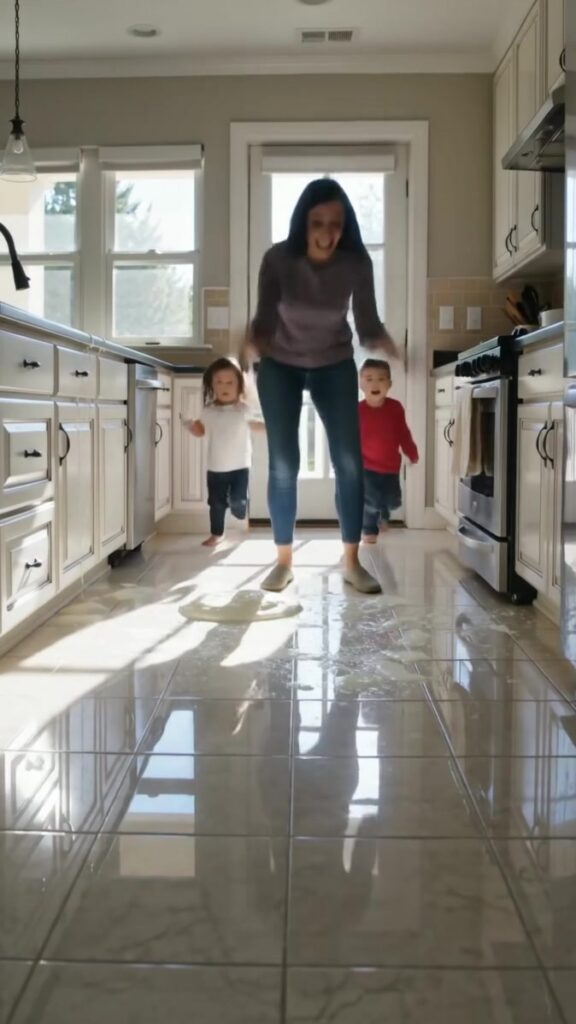
The kitchen had the clean, expectant hush of morning—sunlight laid in pale rectangles across the tiles, the kettle still warm from a first boil, a single spoon abandoned beside the sink like a forgotten witness. On the table sat a bowl of sour cream, thick as wet paint, waiting to be folded into something civilized. It looked harmless. It looked like a plan.
In the doorway, the boy steadied himself with one hand on the cabinet and the other on the air. He was barely a year old, a creature made of balance experiments and sudden courage. His sister—two years, all knees and quick decisions—watched him with the solemn attention of someone who understood that every day was a rehearsal for catastrophe.
Their mother had stepped away for the briefest human interval: to answer a buzzing phone in the hall, to rescue a towel from the laundry basket, to do the tiny chores that keep a home from sliding into entropy. In the second she turned her back, time became elastic. Small feet found a chair. Small hands found the table edge. A small palm slid along the bowl’s rim, curious about the chill and the shine and the way the surface held its shape.
The boy tipped it. Not out of malice, not even fully out of choice—more like a branch surrendering to wind. The bowl rolled, hesitated, then surrendered. The sour cream left the ceramic in a thick, slow sheet before gravity remembered itself. It struck the tile with a slap that sounded too loud for something so soft. White burst outward in a star of splatter: across the floor, up the cupboard doors, onto the baseboards, and—by some cruel comic precision—onto that stray spoon, which now looked like it had been dipped in snow.
There was a beat of silence in which the children stared at the transformed world. Then the girl’s mouth opened into a giggle so bright it felt like it could scrub the air clean. She stepped forward, touched one finger to the mess, and held it up like a magician showing proof of a spell. “Cold,” she whispered, delighted. The boy made a pleased sound—half hum, half triumph—and planted his hand directly into the creamy lake. It oozed between his fingers and he looked at his palm as if it had become a new kind of animal.
They began to “help.” That was what their minds called it, the same way the moon calls itself light because it reflects what it loves. The girl smeared arcs on the tile with both hands, making crescents and streaks. The boy patted, then scooped, then patted again, fascinated by the way his prints remained, ghostly and perfect. Their knees slipped and they steadied each other, sticky palms leaving handprints on each other’s shirts. The room brightened, not from the sun but from the reckless joy of discovery.
And then their mother returned.
She entered like a storm with a human face—eyes wide, breath caught, voice arriving before her body fully crossed the threshold. “What did you do?” The words struck the kitchen harder than the sour cream had. For a moment everything froze: the boy’s hand suspended mid-pat, the girl’s laugh swallowed mid-bubble. Cream dripped from their fingers in slow, undeniable threads, each drop landing with a quiet, humiliating tap.
The girl looked up first, her cheeks shiny with evidence. Her voice came out small, but brave. “We… helping?” The boy echoed her with a murmur that wasn’t quite language, only intention—“Yummy”—and he brought his coated fingers toward his mouth before thinking better of it, as if even instinct knew the stakes had changed.
The mother’s gaze ran from tile to cupboard to spoon to their smeared clothing and back again, a frantic inventory. She planted her hands on her hips like she could hold the whole kitchen together by will alone. “This is a mess. Look at this floor.” The words were sharp, but underneath them lay a tremor: fatigue from nights broken into hours, worry about money and schedules, the constant pressure of keeping life upright when everything in it kept tipping.
The children made their first attempt at escape. The boy turned, his foot slid, and he sat down abruptly with a soft plop, startled into stillness. The girl tried to dart past her mother and skidded, arms windmilling, catching herself against a cupboard—leaving two perfect handprints on the door, like blame written in a language only parents can read. Their mother’s voice rose, not because she wanted it to, but because her body was trying to build a wall out of sound. “No. No more playing with food. Mommy is very upset.”
The word upset hung in the air, heavy and adult. The children stared at her the way sailors stare at changing weather. Then, impossibly, a tiny giggle slipped out of the girl again—not defiant, just uncontrollable, like a hiccup of joy. The boy followed with a squeak of amusement, and the kitchen, for all its ruined cleanliness, became alive with a strange, unbearable honesty: that they were too young to understand consequences but old enough to recognize a feeling on a face.
Their hands reached toward the mess as if reaching toward forgiveness. “We clean?” the girl asked, hopeful, her eyes shiny with the kind of trust that can make an adult’s throat tighten. The boy nodded vigorously, smearing his own chest in the process, and held out his palms—offerings of trouble and sincerity.
The mother’s shoulders lifted on a long inhale. She looked at the white-spattered room, at the morning light reflecting off every smear as if the disaster were lit for a film. She looked at their small bodies—so eager to repair a world they had only just learned they could break. Her anger wavered, reshaped itself into something closer to sorrow and, beneath that, love. She exhaled, and the sound wasn’t surrender so much as a decision. “Okay,” she said, the word thin but real. “But carefully.”
She grabbed paper towels and a damp cloth, moving with brisk determination, wiping at the floor in frantic strokes that only spread the cream into wider, shinier rivers. The girl copied her, proud and serious, pressing a towel down with both hands. The boy, determined to contribute, tried to wring a cloth like he’d seen her do, instead flinging a ribbon of sour cream onto the lower cabinet. Their mother closed her eyes for a beat, then opened them with a half-smile she didn’t mean to show. It was the kind of smile that arrives through exhaustion, the kind that says: this is chaos, and it is ours.
By the time the worst of the spill was contained, the kitchen smelled faintly tangy and clean at the same time, like a lesson that hadn’t finished teaching. The children stood in the middle of it, wet-handed and proud, and their mother looked at them as if seeing the future in their sticky fingerprints: accidents, repairs, laughter in the wrong moments, and the long work of turning mess into memory. Somewhere on the counter, a blender waited—silent, shining, innocent. It would not remain innocent for long.