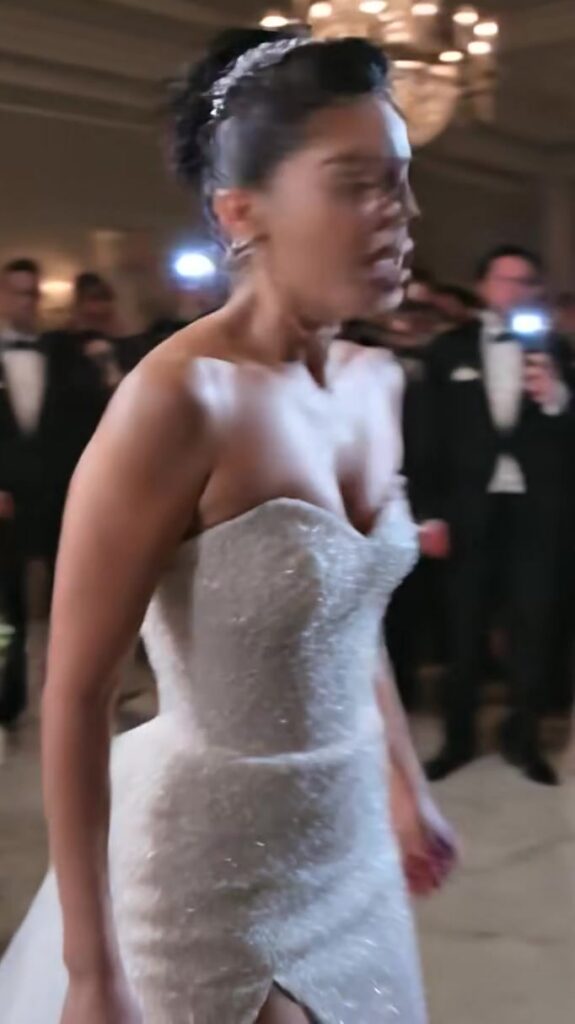
The chandeliers hung like constellations caught in crystal cages, casting molten gold over the ballroom’s polished marble. Every surface gleamed—silverware aligned with mathematical precision, napkins folded into swans, and white flowers stretching down the tables like fresh snow that refused to melt. The guests spoke in careful murmurs, a cultivated hush that made the clink of champagne flutes sound like bells in a distant chapel.
At the head of the room, beneath the largest chandelier, Elara Voss stood with her new husband’s arm at her waist. Her gown was a masterpiece of glittering audacity—strapless, short enough to scandalize the older relatives, slit high as if to declare conquest over modesty. She wore her beauty like armor and looked at the room as though it belonged to her because, tonight, it did. Photographers drifted around her like obedient moths, hungry for any flicker of drama.
Damian Hale smiled when he was expected to smile. He had the handsome, well-rested look of a man who’d never had to wonder where the next meal would come from. His family’s money built half the city’s glass towers, and their name held doors open without anyone needing to touch the handle. He leaned toward Elara, murmuring something that made her laugh, and the guests relaxed, reassured by the theater of perfection.
The cake waited near the center of the room—tiers of ivory fondant draped with sugar roses, a miniature palace lit by soft spotlights. The staff guarded it as if it were a crown jewel. Children weren’t invited; it was an adults-only affair, the kind where even the laughter wore a tuxedo.
So when a child appeared, it took several seconds for anyone to register him as real.
He seemed to have stepped out of a different world. His clothes were neat but tired, the fabric thinned at the knees and elbows as if it had outlived a previous owner. His hair had been combed with earnest care. He moved with the hesitant courage of someone who has rehearsed being brave but has never been certain it would work. In his hand was a small rectangle—black plastic, scuffed at the edges, the label peeled and re-stuck so many times it looked like a wound.
He stopped at the cake table and stared at the tiers as if he weren’t sure what he was allowed to touch. Then he reached for a plate. The action was simple—too simple to justify the sudden tightening of the air.
Elara noticed first. Her smile collapsed into a sharp line. She stepped away from Damian, heels snapping across the marble like gunshots. “No,” she hissed, not quite loud enough for the whole room, but loud enough that nearby guests turned their heads.
The boy looked up, startled by the force of her approach. “I—” he began, but his voice was swallowed by the music and the rising rustle of attention.
Elara’s hand flashed out. Not toward him—toward the plate in his fingers. She struck it with the flat of her palm. Porcelain flew, met the floor, and exploded into bright fragments that skittered under tables. A gasp rolled through the hall like wind through a field.
“Who brought him here?” Elara’s voice cracked across the room, now unmistakably loud. “This is a private event. Get him out.” Her eyes weren’t just angry; they were panicked, the kind of panic that wears anger as a mask.
Phones rose almost instinctively. Guests who had promised themselves they’d never be “that person” found their screens already recording, drawn by the primitive certainty that this would be worth rewatching later.
The boy’s face flushed, not with defiance but with humiliation. Tears gathered, making his eyes shine under the chandelier light. Yet he didn’t run. He didn’t even step back. His fingers tightened around the black cassette tape, his knuckles bleaching white.
Two security men moved in, coordinated and expressionless, the way expensive security always is. Elara pointed at the child as if she were directing the removal of trash. “Now,” she snapped. “Before he ruins—” Her mouth stopped. She couldn’t finish the sentence, because the room had already begun to tilt toward something she didn’t control.
The boy lifted his chin. His voice trembled at first, then steadied with a strange, borrowed strength. “I have to give this to him,” he said, pointing—not at Elara, but at Damian. “Please. She told me I had to, before you say the words.”
Damian’s brows knit. He looked irritated, then confused, as if trying to place a face he’d seen once in a dream. “Kid,” he said carefully, the way adults speak when they want to sound gentle and authoritative at the same time. “Who are you? Where are your parents?”
“My mother can’t come,” the boy answered, swallowing hard. “She… she died this morning.” The sentence landed like a dropped glass. Conversations stopped. The music, still playing, became unbearably inappropriate—a bright melody over an open grave.
Elara’s eyes flashed. “Don’t you dare,” she whispered, but it sounded like a warning to the universe itself.
The boy lifted the cassette higher. “She said you have to hear her. She said if you hear her voice, you’ll understand.” He paused, breath shaking. “She said you’ll know why I have your eyes.”
Damian froze as if the words had hooked into him. The irritation drained from his face in stages, each one leaving him paler. His gaze locked on the child’s—dark irises ringed with the same faint gray as his own. A similarity that could have been coincidence a minute ago became a mirror held too close.
“That’s impossible,” Damian murmured, but he didn’t sound certain. His wedding ring felt suddenly heavy, like a cuff. The room watched his expression shift, documenting it in real time, hungry for the moment it broke.
Elara stepped between them, glittering and furious, her body a barricade. “This is a stunt,” she said sharply, eyes wide with terror disguised as contempt. “Someone’s trying to extort us. Damian, don’t—”
“Elara,” Damian said, and the single word carried a quiet authority that silenced her. He stared at the cassette as if it were a live wire. “What’s on it?”
The boy’s lower lip trembled, but he didn’t look away. “Her voice,” he said. “She recorded it a long time ago. She kept it hidden. She kept me hidden.” He drew in a breath that sounded too big for his chest. “She said you promised her you’d come back. She said you left because you were scared. She said… she didn’t want me to grow up thinking you didn’t care.”
The security men hesitated, glancing to Damian for instruction. For the first time that night, the groom looked like a man standing at the edge of a cliff, his life behind him, the fall waiting in front of him.
“Give it to me,” Damian said.
Elara made a sound—half laugh, half sob. “No,” she insisted, turning to the guests as if their gaze could save her. “This is disgusting. Do you see what he’s doing? Look at him. Look at the dirt—”
“Stop,” Damian said, and the word cut her in two.
The boy took a step forward, slow, careful, as if the marble might crack beneath him. He offered the cassette on an open palm. Damian reached for it, then paused at the last inch, his fingers hovering. In that suspended moment, the chandelier light caught the tape’s scratched surface and made it glint like a confession.
Damian took it.
The room held its breath as if oxygen had become a luxury. Elara’s eyes darted around, calculating escape routes, alibis, narratives. Her glamour suddenly looked fragile, a mask in danger of slipping.
“There’s a player in the coat room,” the boy whispered, voice small again now that the hardest part was done. “She said you’d know where to find one. She said… you keep one for old memories.” His gaze flicked to Damian’s face, searching for a reaction, a sign that he’d been right to come.
Damian’s jaw clenched. His pupils seemed to widen as the past rushed at him, loud and unstoppable. He stared at the child, then at Elara, whose smile was trembling at the corners, and finally at the doors as if expecting a ghost to walk in and take its seat among the flowers.
“What’s your name?” Damian asked, voice rougher than before.
The boy swallowed. “Milo.”
“Milo,” Damian repeated, and the syllables tasted unfamiliar, intimate. He looked down at the cassette in his hand as though it might burn through his skin. “Stay here,” he told the security men, and his tone made it clear it wasn’t a suggestion.
Elara grabbed his arm, nails digging into his sleeve. “Damian, you can’t do this to me,” she hissed, her breath scented with champagne and desperation. “Not here. Not now. Think about the investors. Think about the cameras.”
He didn’t pull away from her grip. He simply turned his head and looked at her, and whatever she saw in his eyes made her loosen her fingers one by one. It wasn’t anger. It was something colder: a man realizing his life had been arranged like centerpieces on a table, and someone had finally knocked the vase over.
Damian stepped away. He held the cassette as if it contained a heart still beating.
Milo stood amid the glittering hall, small and steady, surrounded by strangers in wealth and perfume. He watched Damian walk toward the coat room, toward whatever waited in a recorded voice. The chandeliers continued to shine, indifferent as stars, while the room—so perfect a moment ago—began to fracture along invisible lines.
Elara remained under the brightest light, smiling too hard at guests who wouldn’t look away, her gown sparkling as though it could distract from the truth tightening around her throat. And Milo, clutching nothing now, whispered to himself as if praying, “You’ll understand.”