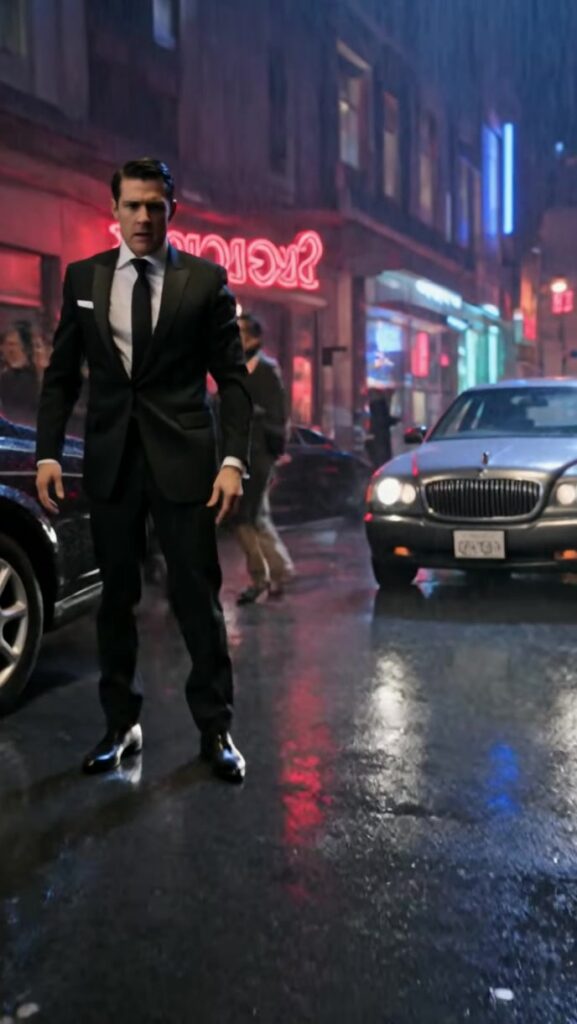
Rain hammers the neon-lit street, turning the avenue into a ribbon of black glass. The signs above the shops bleed color into every puddle—violet, electric blue, a violent pink that makes the night feel louder than the traffic. In front of the Grand Meridian Hotel, a line of idling cars glows with taillights and impatience. Their windows are tinted like secrets.
A soft tap… then another. Tap. Tap. Tap. It isn’t loud enough to compete with the storm, but it is steady, the kind of sound that makes you look even when you don’t want to. A small hand presses against the rear window of a pearl-white luxury sedan parked at the curb. The window beads with water and the handprint disappears as quickly as it forms.
The boy attached to that hand can’t be more than eight. His hoodie is two shades darker from being soaked through, the cloth sticking to his narrow shoulders. Water runs off his bangs into his eyes, and he blinks it away without wiping his face. He holds a paper cup in the other hand, the rim bent and softened by rain. His gaze is fixed, not pleading exactly—more like someone who has decided he will not be moved, no matter how hard the world tries.
Inside the sedan, warmth and laughter. A man in a tailored suit leans toward a woman whose coat looks like it was made for a magazine cover. They share a phone screen and laugh again, the sound bright and careless. The woman’s lipstick is perfect, her hair swept up and pinned as if the weather has no jurisdiction over her. The man’s watch catches a flash of neon; his cufflinks look like tiny mirrors.
The boy taps again. The woman glances up for a second, her smile faltering as she notices the shape beyond the glass. She says something to the man—perhaps a suggestion to ignore it, perhaps a complaint—then looks away, deciding the night is too fine to let it be complicated.
The man’s face shifts as if a switch has been flipped. Annoyance hardens him. He reaches for the door handle, and the car’s interior light flares, turning his expression sharp and pale. The door swings open into the rain with a hiss of displaced air. He steps out as though he owns the sidewalk.
“Stop touching my car,” he snaps, the words slicing through the storm. His shoes hit the pavement with a wet slap, and he looms over the boy like a shadow given shape. “Get away from it.”
The boy doesn’t retreat. He raises the cup as if to show it, as if the coins are proof of something—proof of hunger, proof of effort, proof that he is asking for help the only way he knows. His lips part, but the rain steals whatever sound tries to come out.
The man’s hand shoots out, fast and angry. He snatches the cup from the boy’s grip. The paper collapses under his fingers, and the contents spill. Coins scatter across the wet pavement like a sudden burst of silver rain, skittering into gutters and disappearing beneath the parked cars. A few roll, stubbornly, toward the street, reflecting neon as they go.
A gasp ripples down the line outside the hotel. People waiting beneath umbrellas lift their heads. A valet pauses, hand frozen mid-gesture. Someone’s phone appears, then another—rectangles of light rising like fireflies. The storm seems to quiet for a heartbeat, though it doesn’t; it only feels that way because everyone is listening.
The boy flinches as if struck. His shoulders jerk, and for an instant it looks like he might bolt. Instead he drops to his knees, plunging his hands into the shallow water to catch coins before they vanish. His fingers shake so badly he fumbles, and each time a coin slips from his grasp, the tremor worsens. He is not crying. He is working. He is surviving.
Then something slides free from inside his hoodie—something thin and pale. A photograph, softened by moisture, skates across the asphalt as if it has a mind of its own. It spins once, lands face-up in a puddle, and the image blurs at the edges. But the center remains clear enough.
The woman in the car doorframe sees it first. Her laughter has vanished. She steps out into the rain without seeming to notice what it does to her coat, without caring that droplets are crawling down her eyelashes. She stares at the photo as if it’s a snake. Her hand lifts to her mouth, and her breath leaves her in a small, broken sound.
The man follows her gaze. His posture, so confident a moment ago, loosens. He takes one involuntary step back, as though the street has tilted. His face drains from tan to gray, and the arrogance that held him upright evaporates in the downpour.
The photograph shows a younger version of him: hair longer, smile looser, arms wrapped around a woman with tired eyes and a cheap dress. In her arms is a newborn, swaddled in a blanket that looks too thin for any weather. The woman’s expression is not romantic. It is resolute, as if she already knows the future will demand more than she has.
The boy snatches the photo from the puddle and lifts it, holding it with both hands like a sign. Rain streams over his knuckles, over the glossy paper, over the faces captured there. He looks up at the man with an intensity too large for his small body.
“My mother,” he says, voice rough from cold and effort. The words come out halting, but they land clean. “She told me to find you… when she died.”
The street seems to stop. The neon reflections dance wildly in the puddles, but the people holding phones go still, their mouths slightly open, their eyes fixed. Even the valet’s whistle remains unblown. The rain keeps falling, relentless, but it feels suddenly like a curtain that has been pulled back.
The man’s lips move, forming a sound that doesn’t become a word. He stares at the photograph as if it might rewrite itself. His throat works. He looks at the boy’s face—at the shape of his jaw, the set of his eyes, the stubbornness in his brow—and something in him breaks open like a seam under pressure.
“That’s—” he begins, then stops. He swallows hard, and the motion looks painful. “No.”
The woman beside him turns her head sharply, as if struck by the same realization from a different angle. She studies the boy, the way his hair clings to his forehead, the way his fingers clutch the photo as if letting go would be death. Her eyes flick to the man, searching his face for denial and finding only terror.
The boy’s shoulders tremble, not from crying but from cold. He glances down at the scattered coins—his small fortune, now spread across the gutter—and something like humiliation flashes across his expression. He lifts his chin anyway. “She said you would know,” he adds. “She said… you left, but you promised.”
“I didn’t—” The man’s voice cracks. He looks around at the phones, at the watching strangers, and shame climbs his neck like a rising tide. “I didn’t know,” he says, softer now, and the softness makes it worse, because it sounds like truth. “I didn’t know there was a child.”
The boy’s eyes do not forgive him. They don’t even ask him to be forgiven. They simply hold him there, pinned to the wet pavement under the neon, while the storm witnesses everything. “She’s gone,” the boy says, and for the first time his defiance wavers, letting grief show through like a bruise. “I came because she told me not to be afraid.”
The man looks down at the crushed paper cup in his hand, at the coins still stuck to the damp crease. Slowly—too slowly, like each movement costs him—he lowers himself into a crouch. The rain soaks his suit pants instantly. He begins to gather coins, one by one, placing them carefully into the cup as if the act might undo what he has done. His hands are clumsy. He drops a coin and scrambles for it, splashing his sleeve into a puddle.
The woman kneels too, the elegance of her coat forgotten, and reaches for a coin near the curb. Her fingers close around it with a strange tenderness. She glances at the boy, and her expression isn’t sympathy exactly; it’s shock laced with something else—fear of the life that has been happening beyond their walls.
When the cup is filled again, the man holds it out. He doesn’t speak. His eyes are glassy, and rainwater runs down his face so it’s impossible to tell what else might be there. The boy hesitates, then takes it, but he doesn’t thank him. He keeps the photograph.
“What’s your name?” the man asks finally, voice barely audible under the downpour.
The boy’s answer is almost lost in the rain, but it lands like a final coin in an empty jar. “Eli.” He clutches the photo tighter, then looks past the man to the bright doors of the hotel, to the world of warmth and light where he does not belong. “She said you’d be there,” he whispers, and the words are both accusation and prayer.
The man’s shoulders sag, as though the years between the photograph and this moment have fallen onto him all at once. He looks at the boy—his boy, the thought insists, unwelcome and undeniable—and then at the crowd recording the unraveling of his life. In the neon’s harsh glow, the truth has nowhere to hide. The rain keeps hammering the street, and the sound becomes, somehow, the only mercy: loud enough to cover the first ragged breath he takes before he says, “Come with me.”