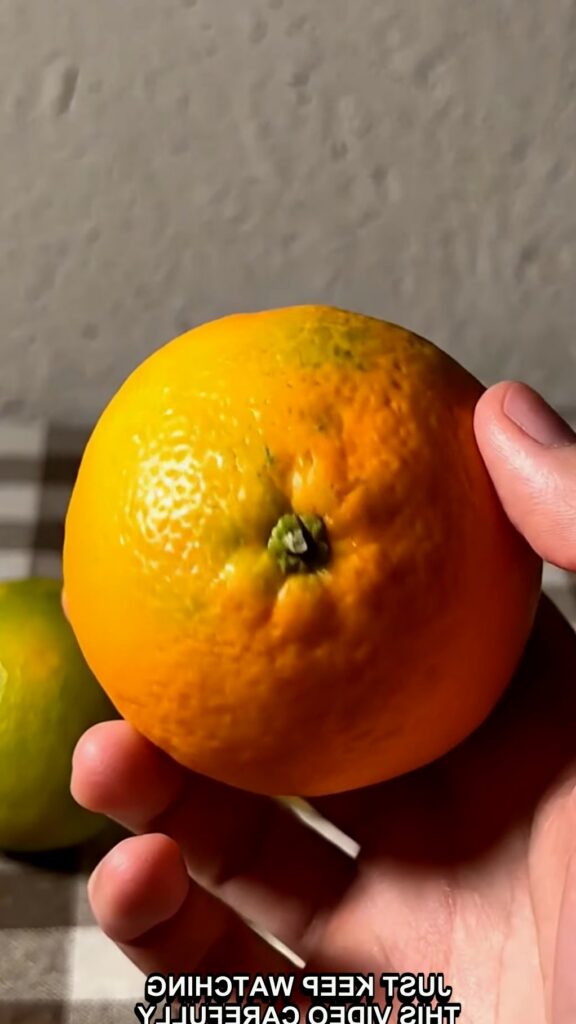
The sign was nailed crookedly to the telephone pole outside Elmswick Station, as if whoever hung it had been in a hurry—or afraid of being seen. The paper was too white to belong in this rain-soaked town, and the letters were thick, impatient strokes of black: NEVER WEAR GLASSES AGAIN! THIS FRUIT CURES BLINDNESS. RESTORES SIGHT. Beneath it, someone had drawn a lopsided starburst and a pair of eyes that looked more startled than healed.
Mara Quinlan read the words twice. The first time, she snorted; the second time, she felt the familiar ache behind her own eyes, the kind that came after a long day peering through lenses that never quite kept up with her changing prescription. She was thirty-four and already tired of the tiny humiliations—fogged frames when she entered a warm room, fingerprints on every surface, the panic of losing her glasses in the sheets at night like she’d misplaced her own face.
She tore the sign down. The paper came away too easily, as though it wanted to travel. Under it was an address written in smaller script: Orchard House, Hollow Road. There was no phone number. Of course there wasn’t. Miracles did not accept appointments.
She folded the paper and slipped it into her coat pocket anyway. She told herself it was for an article. Mara wrote for the Elmswick Herald, a paper that had once covered wars and elections and now mostly documented potholes and the occasional dog show. A story about a miracle fruit peddler was exactly the kind of thing the editor would chuckle at over cold coffee.
Yet the paper warmed in her pocket as she walked, and it wasn’t only her curiosity. It was the memory of her father sitting at the kitchen table in the last year of his life, his hands trembling around a mug he no longer trusted. His vision had narrowed to a tunnel, then to a dim hallway, then to nothing at all. “It’s like the world forgot me,” he had whispered, staring at a window he could not see. “Like someone turned off the lights and didn’t tell me.”
Hollow Road ran along the edge of the marsh, where reeds shivered and the air tasted of iron. Mara parked near a sagging gate and walked the rest of the way, her boots sinking into wet earth. Orchard House stood at the end of a long drive, a manor that had decided to pretend it was still grand. Its roofline slouched; its windows were cloudy with neglect. But the orchard itself—rows upon rows of low trees—looked oddly tended, as if the land remembered how to be obedient even when the house did not.
A woman stepped onto the porch as Mara approached, as though she’d been expecting her. She wore a simple dress and a shawl the color of soot, and her hair was pinned with a silver comb shaped like a leaf. Her eyes—sharp, unsettlingly bright—found Mara’s glasses at once.
“You came,” the woman said, not asking. “People always come when they’re tired of being broken.”
“I’m a journalist,” Mara lied, lifting her chin. “I’m here to ask about your advertisement.”
“Advertisement,” the woman repeated, savoring the word like it had thorns. “No. It’s a warning. A doorway. And sometimes a last chance.” She turned without waiting and beckoned Mara inside.
The air in Orchard House smelled of boiled fruit and old wood. Bowls sat on every surface, filled with small, dark berries that looked almost black—except when the light caught them and revealed a bruise-purple sheen. The woman lifted one berry between finger and thumb.
“The nightplum,” she said. “It grows only where the soil remembers grief. It feeds on what the earth has swallowed.” She studied Mara’s face as if reading text on a page. “What do you want to see?”
Mara almost laughed. “I want people to stop getting scammed,” she said. But her voice betrayed her; it cracked around the word “want.”
The woman’s gaze softened, but not with kindness. With understanding that felt more dangerous. “We all pretend we’re here for something noble.” She set the berry on Mara’s palm. “Eat it. If you can.”
Mara hesitated. She imagined headlines about reckless reporters. She imagined her editor’s sigh. She imagined her father’s hands feeling the air for a chair that had always been there. She ate the berry.
It tasted like cold metal at first, then like honey that had been left too long in the dark. Heat spread through her mouth, her throat, behind her eyes. For a moment she thought she’d made a terrible mistake—her vision shimmered, the room tilting. The lenses on her face felt suddenly too heavy, too distant, like they belonged to someone else.
“Take them off,” the woman said quietly.
Mara’s fingers went to the hinges of her glasses. She hesitated again, not from fear of blur but from fear of hope. Then she removed them.
The room sharpened.
It was not the gentle clarity of a new prescription; it was violent, like someone had torn a veil from the world. She could see dust motes spinning in the air like miniature planets. She could see the seam in the woman’s shawl, each thread distinct. She could see the orchard outside through a grimy window, each branch outlined as if drawn with ink. Her breath caught. Her eyes burned—then steadied, adjusting as if they had been waiting all her life to remember what they could do.
“Oh my God,” Mara whispered. She didn’t mean it as prayer. It came out as accusation.
The woman nodded once. “It works,” she said. “For those who can pay.”
The words sobered Mara faster than any cold water. “Pay? How much?”
“Not money.” The woman crossed to a cabinet and opened it. Inside were jars. Not of fruit—of things that made Mara’s stomach twist. A baby tooth. A lock of hair tied with ribbon. A wedding ring. A folded photograph of someone smiling. Each jar had a label in careful handwriting: FIRST KISS. MOTHER’S VOICE. BROTHER’S LAUGH.
Mara’s throat tightened. “Those are… memories.”
“Not all memories,” the woman said. “Only the ones that keep you whole. The fruit doesn’t give sight for free. It demands something you can’t easily replace.”
Mara staggered back a step. Her vision was still pristine—if anything, too pristine, making every object cruelly detailed. “That’s monstrous.”
“It’s honest,” the woman replied. “People think health should come with no cost, and then they blame the world when the bill arrives. Here, the bill is visible.” She leaned closer, her voice lowering. “You already paid a little. The berry took a sliver. Do you feel it?”
Mara searched herself, suddenly panicked. Something in her mind was… smooth, like a stone rubbed clean. She tried to recall her father’s face. She could see the shape of him, the outline of his shoulders, but the color of his eyes—were they hazel? Green? For the first time in her life, she wasn’t sure. The memory wobbled, then slid away like a picture pulled from a frame.
“No,” Mara breathed. “No, give it back.”
The woman’s expression did not change. “I can’t. It’s fed now. The orchard is hungry.”
Mara’s hands shook. She wanted to run, to vomit, to smash every jar in the cabinet and let stolen pieces of people spill out onto the floor. But another thought struck her like lightning: if this was true—if the fruit could restore vision—then desperate people would come. Blind people. Parents with blind children. Old men who missed the shape of their wives’ faces. They would trade anything. They would trade themselves and call it salvation.
“Why are you doing this?” Mara demanded. “Why are you advertising?”
The woman’s eyes flashed. “Because I’m tired,” she said, and for a fraction of a second the sharpness cracked, revealing something exhausted beneath. “Because the fruit keeps growing, and the town keeps whispering, and people keep begging at my gate. I tried to hide it. It found you anyway.” She lifted a jar labeled SUNLIGHT ON MY SKIN and held it up to the dim room like a lantern. “Some gifts rot the giver. Some rot everyone.”
Mara swallowed, tasting again that dark honey. Her sight was still perfect; she could not deny the miracle in her own skull. But the price had already started carving her. She touched her face where her glasses had sat for years, as if her skin missed them. “If I write about this,” she said hoarsely, “people will come in droves.”
“Yes,” the woman said. “And if you don’t, they’ll still come, one by one, because hope travels faster than truth.”
Mara stared at the jars, at the orchard beyond the window, at the woman who had become both villain and gatekeeper. Her journalist’s instincts screamed to expose it. Her human instincts screamed to protect people from their own desperation. And somewhere deeper, where the fruit had taken its first bite of her past, she felt a cold, calculating clarity: with sight like this, she could read every lie in a face, every tremor in a hand. She could see too much.
She put her glasses back on out of reflex. The world blurred instantly, turning the room into soft edges and watercolor shapes. But beneath the blur, she still sensed the sharper reality, like a blade hidden under cloth. The fruit’s gift hadn’t vanished. It was waiting.
“There’s a way to stop it,” Mara said, surprising herself with the steadiness of her voice. “To stop the orchard.”
The woman’s gaze held hers. “There is,” she admitted. “But it will cost more than a face you loved.”
Mara looked at the jars again, at the bottled fragments of joy and identity. She thought of her father’s darkness, of the cruel mercy of forgetting, of the temptation to bargain with anything if it meant seeing the world return. Outside, the wind moved through the trees, making them whisper like a crowd gathering at a door.
She slid the folded sign from her pocket and smoothed it on her palm. The letters were bold, confident, irresponsible. She crumpled it slowly until the paper groaned.
“Then tell me,” Mara said, and her voice sounded like the start of a confession, “what it costs to burn a miracle.”
The woman stepped closer, and the house seemed to lean in with her, listening. In the dimness, jars glimmered like captive stars. The orchard waited, patient as hunger. And Mara, standing at the edge of her own stolen clarity, realized that the most dangerous thing about seeing was not what it revealed.
It was what it demanded you do once you knew.