The restaurant looked like something out of a dream, the kind you woke from with your heart still full and your hands still reaching for whatever warmth had vanished. It sat on the cliff like a chandelier hung from the edge of the world, all glass and pale stone, its open terrace spilling toward the sea. Sunset poured over everything in a syrupy gold—over the white linen, the silverware laid with mathematical precision, the candles sheltered inside crystal chimneys that caught the breeze and made the flames dance. Wine glasses glimmered, and the distant music—strings and a slow piano—made even the sound of laughter seem curated.
Adrian Voss had chosen the table closest to the railing, where the view could perform for him while he performed for everyone else. His suit jacket lay draped over the back of his chair like a prop, and the watch on his wrist was a quiet warning that his time had a price. Across from him, two investors smiled too eagerly and kept their voices low, as if the air itself was expensive.
“The numbers are clean,” one of them said, sliding a folder forward. “If you approve the expansion tonight, we break ground within the month.”
Adrian did not touch the folder. He turned his glass by the stem, watching the candlelight spiral through the red. “Clean numbers are not a story,” he murmured. “And I do not buy without a story.”
The investors laughed politely, the way people laughed when they weren’t certain whether they’d been insulted. Around them, the terrace hummed—soft compliments, clinking crystal, the sea below breathing against the rocks. Everything fit. Everything behaved.
Then something fell out of place.
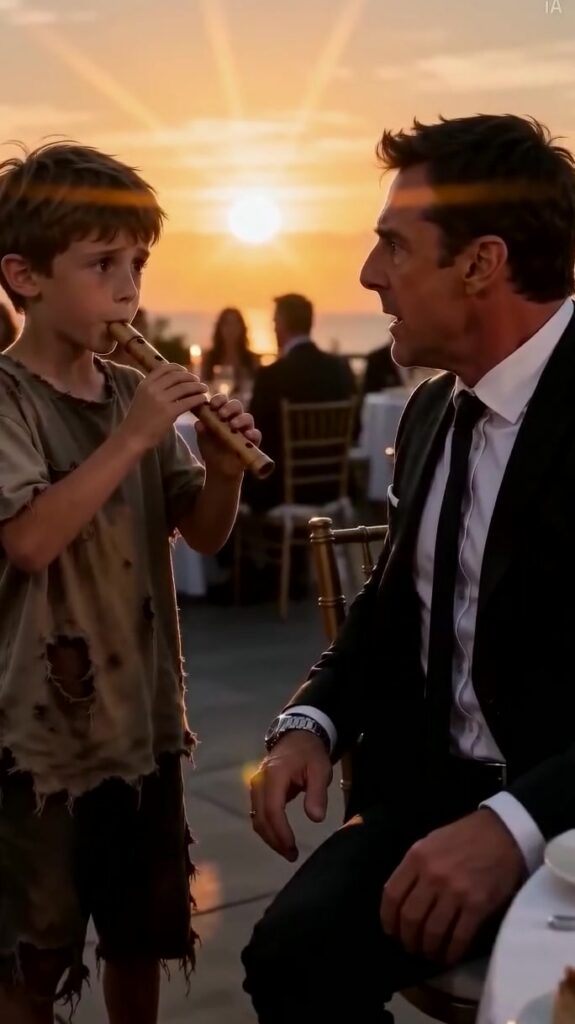
A shadow moved between the tables. Bare feet on polished stone. A small body that didn’t belong among silk dresses and tailored jackets. A boy—no older than nine, maybe ten—stood in the aisle as though the room had spat him out from somewhere darker. His shirt was too thin, sleeves frayed; his trousers hung in desperation rather than style. In his hands he held a wooden flute, plain and scratched, gripped so tightly his knuckles were pale.
One of the waiters started toward him with the careful smile of a man trained to remove discomfort without creating a scene. Adrian lifted a finger without looking. The waiter slowed, then stopped, unsure.
The boy’s gaze landed on Adrian as if it had been guided there. Not pleading. Not searching. Just fixed, like an arrow already loosed.
“Sir,” the boy said, voice small but steady enough to cut across the music. “My mom… she’s dying.”
The investors blinked, the words refusing to fit into the evening. A woman at the next table lowered her fork. Someone’s laugh died halfway through.
Adrian’s jaw tightened. He did not like surprises. He did not like mess. His life was built on the elimination of both. He leaned forward, not with concern, but with annoyance as sharp as a knife.
“If you’re here for charity,” Adrian said, loud enough for the boy and quiet enough to preserve the illusion of civility, “you’re late. If you’re here to sell something, sell it to someone else.”
The boy’s throat bobbed. He did not step back. “She said you would be here.”
That irritated Adrian more than the intrusion itself—the idea that anyone could predict him. He glanced toward the investors, then back at the boy, as if this were simply a negotiation with a smaller opponent.
“Then earn it,” Adrian said, and in the sudden hush the words sounded crueler than he intended. He meant them to be efficient. Final. The way he ended deals, the way he ended people.
The boy flinched, but it was not fear that crossed his face. It was a brief, bright ache, like someone pressing on an old bruise. He did not beg. He did not argue. He slowly raised the flute to his lips.
The first note stumbled out, thin as a thread. A few diners shifted, expecting the inevitable awkwardness: a street performance that would be politely tolerated, then erased. But the second note found its footing. The third note arrived like a confession. The melody that unfolded did not match the restaurant’s soft music; it didn’t float, it bled. It held the salt of the ocean and the grit of pavement and the tremble of someone who had learned to play not for applause but for survival.
Adrian meant to dismiss it. He meant to signal the waiter, to reclaim the night. But something in the tune snagged inside him, an invisible hook. His fingers paused on the wine stem. His breath slowed as if the song were reaching into his chest and rearranging the beat of his heart.
He had heard this melody before. Not in a concert hall. Not on a record. In a room with peeling paint and a window that wouldn’t close, where rain came in sideways and laughter still lived anyway. He had been younger then, softer, still capable of believing that love could be a plan rather than a liability.
“…That song,” Adrian whispered, the words escaping him like a betrayal.
The investors stared. Nearby, a woman covered her mouth with her napkin. The terrace, once full of curated noise, became a single listening body. Even the sea seemed to lean in.
The boy played on, eyes half-closed, as if the flute were telling the story and he was only the mouth that let it through. The melody rose, broke, and mended itself again. It carried a name Adrian had not spoken in years. It carried a night he had buried under money and distance. It carried a promise he had failed to keep.
When the last note faded, it did not disappear. It hung in the air like smoke after a fire. No one moved. Candle flames shivered. The breeze felt suddenly cold.
The boy lowered the flute and looked directly at Adrian. There was no triumph in his face. Only a hard kind of certainty, like someone who had been forced to grow bones too early.
“You remember it,” the boy said. It was not a question meant to be answered. It was a verdict.
Adrian’s mouth went dry. He had built empires on denial. He had denied debts, denied needs, denied the past. Yet the song had walked straight through every wall he’d raised.
The boy reached into his pocket with deliberate care and pulled out a photograph. It was worn, edges curled, the surface dulled by fingers and time. He held it out as if it weighed more than he could carry.
Adrian hesitated. The terrace seemed to tilt, the dreamlike restaurant suddenly a stage, the sunset a spotlight. He took the photograph between two fingers, as if it might burn him.
It did.
On the photo: a young woman with tired eyes and a smile that refused to quit. Her hair was tied back with a ribbon. She was laughing at something off-camera, and beside her—too close to deny—was a younger Adrian, arm slung around her shoulders, face open in a way his face had not been in a decade. In the corner, barely in frame, a cheap wooden flute lay on a bedspread, as ordinary as a spoon.
“Where did you get this?” Adrian asked, and the question came out wrong, stripped of authority. His fingers trembled. He hated that more than anything.
The boy’s voice softened, and in that softness was a blade. “She kept it. She said it was proof you were real.”
Adrian swallowed, trying to moisten a throat that had gone to sand. Around them, strangers watched as if witnessing a verdict being delivered. The investors sat frozen, the folder forgotten. Somewhere, the restaurant’s music had stopped without anyone noticing.
The boy took a step closer. “She said… you left us.”
The word us hit Adrian harder than any accusation. Not I. Not her. Us. A plural he had refused to acknowledge.
Adrian’s eyes darted to the back of the photograph, as if there might be a loophole hidden there, a date he could argue with, a mistake to exploit. His thumb rubbed the paper, and then he turned it over.
On the back, in handwriting he would have recognized blind, were four words and a number—an address, old and familiar, and a message that was less a plea than a curse: If you ever become human again.
Adrian’s vision narrowed. The ocean roared up from below like an animal waking. Candlelight smeared into streaks. The terrace, the faces, the white linen, the glittering glasses—all of it bent and warped as if the dream were finally tearing.
He tried to speak, to ask the boy’s name, to deny, to demand, to do anything that resembled control. But the world went black at the edges, rushing inward. The last thing he saw before darkness took him was the boy’s expression—neither cruel nor kind, only resolute—as if this collapse had been inevitable all along.
And somewhere, in the dark, the haunting melody began again, not from the flute, but from inside Adrian’s own chest, where the past had been waiting for the right note to break him open.