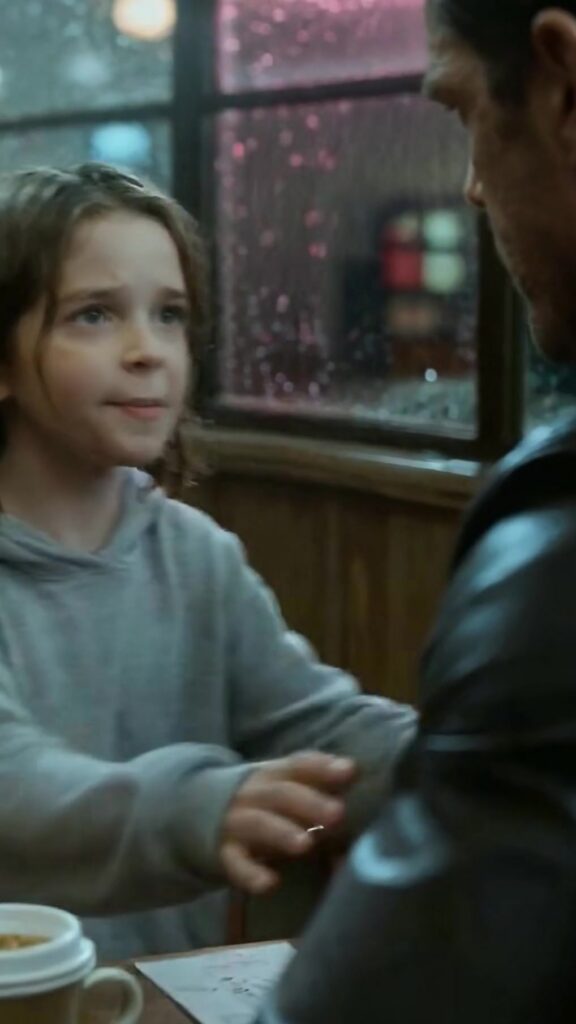
The rain had been falling long enough to erase the highway’s edges, turning the world into a smear of headlights and wet asphalt. The diner sat in the middle of that blur, a low, stubborn building with a flickering sign that promised HOT PIE as if that could fix anything. Inside, the air held a layered perfume of burned coffee, fryer oil, and the sour patience of people waiting to become someone else.
Jonah Pike took the corner booth with his back to the wall, not out of paranoia—out of practice. Broad shoulders under a black leather jacket that had outlived a dozen arguments with gravel. A wolf inked along his neck, faded and half-swallowed by time, the kind of tattoo people noticed only after they had already decided what they believed about him.
He kept his eyes on the table’s chipped surface, tracing cracks that looked like little roads to nowhere. The waitress had refilled his mug twice without asking questions. Nobody asked questions in a place like this. Not if they wanted their night to remain normal.
Then a child’s stare found him and refused to let go.
She sat in a booth across the aisle, too small for the seat, her hoodie bunching at her wrists like she was borrowing herself. Her fries went untouched. Her face had the washed-out look of someone who’d spent too much time in the wrong kind of light. Beside her, a man with neat hair and a clean jacket held a fork as if it were a tool, not a utensil. He watched the door more than he watched the girl. He smiled at no one, and somehow the smile was still there, like a thin film over his mouth.
Jonah didn’t like noticing things. Not because he couldn’t. Because noticing had a cost.
He was deciding whether to pay and leave when the girl slid out of her booth. She moved carefully, as if any sudden motion might shatter her courage. The bell over the door jingled when a couple came in, laughing too loudly; the laugh died halfway to a whisper when they saw the girl walking across the floor with the seriousness of an adult.
She stopped at Jonah’s table.
“Mister,” she said, and her voice did not match her size. It sounded older, as if fear had been teaching her a language for years.
Jonah lifted his eyes. He kept his face neutral and his hands where they could be seen. “You lost?” he asked softly, as if softness might keep the room from breaking.
The girl shook her head once. Then she leaned in, close enough that Jonah could see a faint bruise under her collar, yellowing at the edges.
“He isn’t my dad,” she whispered.
A utensil clattered somewhere behind them. A chair scraped. Even the sizzling from the kitchen seemed to thin, like the building itself was listening.
Jonah didn’t look away from her. “Where’s your dad, then?” he asked, careful to keep his voice steady.
Her eyes flicked toward the counter—quick, scared, practiced. The neat man had stood up. His movements were measured, too smooth for a stranger in a roadside diner. He wasn’t surprised. He was ready.
Jonah felt the shift in his bones before his mind caught up. He stood, just enough to put himself between the girl and the man’s line of sight.
“Behind me,” Jonah murmured.
She didn’t step back. Instead, her small hand reached for his, gripping with a desperate certainty. The touch was like a key turning in an old lock.
“My mom said,” she breathed, “if I ever saw the sign, I have to find you.”
Jonah froze, not from fear but from recognition so sharp it tasted metallic.
He glanced down. The girl tugged up her sleeve with her free hand, baring her wrist. There, drawn in blue ink, were three short lines and a small dot—an old marker Jonah hadn’t seen in years, something he’d once used in a world where people didn’t call the police because there was no one to call. A signal for safe contact. A code for a man who had sworn he’d never go back.
He swallowed. “What’s your name?” he asked, buying time.
“Emmy.” She blinked fast, like she was holding back tears on purpose. “But she calls me Em.”
“Your mother,” Jonah said, and the word mother landed heavy in his mouth. “What’s her name?”
The girl didn’t hesitate. “Sarah.”
Jonah’s chest tightened as if a belt had been cinched around his ribs. Sarah. Sarah who used to laugh like sunlight in a room full of guns. Sarah who vanished on a night Jonah had promised would be quiet. Sarah who had looked at him once and said, If you ever disappear on me, I’ll leave a trail only you would follow.
Across the diner, the neat man took a slow step forward. Another. He slid a hand into his jacket pocket with the casual confidence of someone who expected obedience.
Jonah raised his voice just enough to carry. “Hey,” he called, as if addressing a stranger who’d bumped into him. “You her dad?”
The man’s eyes were flat. “She’s with me,” he said. Not an answer. A claim.
Jonah’s fingers tightened around Emmy’s hand. “She says otherwise.”
The man smiled then, and the smile was worse than anger. “Kids say things. Kids get confused.” He took another step. “Let’s not make a scene.”
Jonah felt the room’s attention gather like a stormfront. A trucker by the window stopped chewing. The waitress paused mid-step, a pot of coffee hanging in her hand like a question. No one moved to intervene. They were all waiting to find out what kind of night this would become.
Jonah reached into his own jacket—not for a weapon. For a worn leather wallet. He opened it with deliberate slowness, exposing a faded photograph tucked behind an old license. Sarah’s face stared up at the diner lights. Younger. Fiercer. Alive in a way memory couldn’t copy.
He held the photo where Emmy could see it. “Is that your mom?” he asked.
Emmy’s eyes widened. Her throat worked. “Yes,” she whispered, and the single word carried a whole history behind it.
The neat man’s expression twitched, just once, like a mask slipping. He stepped faster now. “That’s enough,” he snapped, and the hand in his pocket shifted, shaping around something hard.
Jonah’s instincts rose from the old grave he’d buried them in. He moved the table slightly with his knee, angling it. Not dramatic. Practical. He leaned close to Emmy. “When I say run, you run to the kitchen. Find the back door. Don’t stop.”
Her fingers clenched tighter. “I can’t,” she said, and in her voice Jonah heard the weight of whatever the neat man had taught her to fear. “He’ll—”
“He won’t,” Jonah said, and surprised himself by believing it. Because Sarah’s sign hadn’t sent her daughter to him to die. It had sent her daughter to him to live.
The neat man was within a few steps now, the diner lights catching on a thin sheen of sweat at his temple. “You don’t know what you’re stepping into,” he warned Jonah, the politeness finally draining away. “Hand her over and walk out. You can still keep your quiet life.”
Jonah looked at Emmy’s drawn-on symbol again, then up at the man. “My quiet life ended the moment she said her mother’s name.”
In the brief space between heartbeats, Jonah saw it all: Sarah cornered, writing the code on her daughter’s skin like a prayer; the road leading Emmy here; the neat man’s patience breaking because the trap had failed. Jonah’s hands steadied, his choices narrowing into a single line.
He lifted his mug and let it fall—not at the floor, but at the neat man’s shoes. Coffee exploded across polished leather. The man flinched on instinct, stepping back just enough.
Jonah didn’t waste the gift. He pushed Emmy toward the aisle. “Now,” he said.
She ran, small sneakers slapping the tile, vanishing through the swinging kitchen door as the waitress gasped and shouted something Jonah couldn’t catch.
The neat man lunged, too late. Jonah caught his arm, twisting hard, forcing the hand out of the jacket pocket. Metal flashed—something compact, ugly, and real. Jonah slammed the man’s wrist against the table edge. The object clattered away under a booth.
The diner erupted into motion—chairs scraping, voices rising, someone screaming for the police. Jonah felt the neat man’s strength, trained and desperate, but Jonah had been trained too, and desperation had once been his native language.
He leaned in close, their foreheads nearly touching, and spoke so only the man could hear. “Where is Sarah?”
The neat man’s eyes darted toward the kitchen door, toward the rain-streaked windows, toward any exit. “You think she’s yours?” he hissed.
Jonah tightened his grip until the man’s breath hitched. “I think she’s alive,” Jonah said. “And I think you’re the reason she had to hide her child behind a code.”
Outside, distant sirens began to wail, thin at first, then growing louder, threading through the rain like a promise. Jonah didn’t know if they’d arrive in time. He didn’t know what waited beyond the diner doors. He only knew this was no longer a night that would pass unnoticed.
It had been supposed to be normal. But normal nights don’t come with secret signs, or children carrying messages from ghosts, or men in clean jackets with dirty intentions.
Normal nights don’t bring you back to the one name that can still make you forget to breathe.
And as Jonah held the neat man pinned against the table, listening to the kitchen’s frantic sounds where Emmy had vanished, he realized the truth with a clarity that hurt: Sarah hadn’t sent her daughter to him because he was safe.
She’d sent her because Jonah was the last person on earth who would stop fighting once the storm finally found him.
And the storm had arrived.