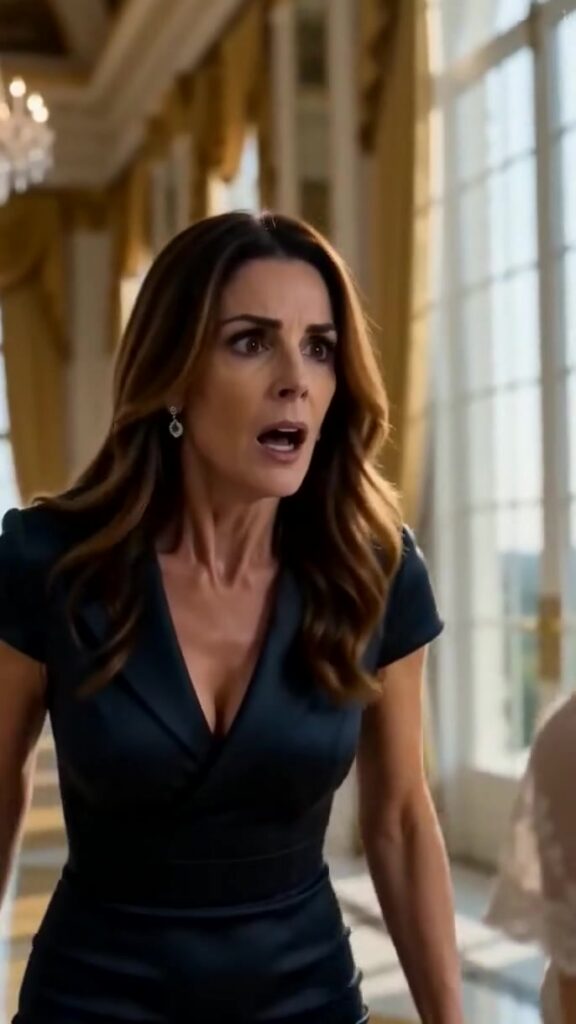
The golden hallway felt unreal—too perfect, too silent, like it was built to hide something forbidden. Its walls were not merely gilded; they were paneled in a kind of lacquered metal that swallowed sound and threw back light in a soft, honeyed sheen. Elena’s footsteps should have echoed, but the corridor drank each one, leaving only the pulse in her throat and the faint slide of her own breath.
She walked as if she had wandered into a museum after closing, when the exhibits were awake and the air itself listened. Her fingers rose, almost without permission, to the emerald necklace resting on her collarbone. The stone was set in old-fashioned filigree—delicate, floral work, too intricate for modern mass production. It was heavier than it looked. Not just in weight, but in meaning, as though every facet carried a story she had never been allowed to hear.
She shouldn’t have been here. The invitation had arrived with no return address, the envelope thick as a legal notice and sealed with wax the color of dried blood. Marrow House requests the presence of Elena Varga. There had been no signature, only a date and a time, and a note in smaller handwriting: Wear what was left to you.
Left by whom? Her adoptive mother, Dian, had placed the necklace in Elena’s palm on the day of her graduation, her eyes too bright, her smile too forced. “It belonged to your parents,” Dian had said, and then—because she always did—she had looked away when Elena asked which parents she meant. Elena wore it now because she wanted answers more than she wanted safety.
The corridor widened ahead, opening toward a set of double doors that gleamed like polished coin. Before she reached them, a voice sliced through the hush like a knife.
“Stop her.”
Elena halted, her skin tightening as if the air had turned to wire. She turned slowly.
At the far end of the golden hallway stood a woman in a black designer dress that fit her like armor. Her posture was flawless, her hair pinned into a severe knot, her face arranged into a neutral mask. But her eyes—sharp, pale, and intensely alive—were fixed on Elena’s neck. Not her face. The necklace.
Two men appeared behind the woman, their suits dark, their hands low at their sides as if they carried something more persuasive than words. Elena’s mouth went dry. She tried to remember the quickest path back to the entrance, but the hallway seemed longer now, stretching in a way architecture shouldn’t.
The woman crossed the distance with impossible speed. One moment she was a poised silhouette; the next her hand clamped down on Elena’s shoulder, fingers digging through fabric as though testing the bone beneath.
“Where did you get that?” the woman demanded. Her voice was controlled, but there was a tremor inside it—a dangerous vibration, like a glass under too much pressure.
Elena flinched. The grip hurt, but not as much as the certainty in the woman’s gaze, as though she already knew the answer and hated it. Elena forced herself to speak.
“I… I was told it belonged to my parents.”
The woman went utterly still. For a breath, the golden hallway seemed to shrink, the air pulling inward until Elena thought she might be crushed by silence alone. Then the woman released her, not gently, but abruptly—like she’d touched something burning.
Without a word, she turned and walked toward a narrow table tucked into an alcove. On it sat a velvet jewelry box the color of midnight. Her hands shook as she opened it.
Inside lay another emerald necklace.
Identical.
Elena’s heart dropped so hard she felt it in her stomach. She took a step back, pressing her fingers to her own throat as if to make sure the first necklace was real. The second stone caught the light and flashed, the same deep green, the same tiny inclusions that looked like threads trapped in glass.
“That’s impossible,” Elena whispered. “This—this is mine.”
The woman’s mouth opened, and her expression fractured, the mask slipping. “No,” she breathed, and the single word carried the weight of a collapse. “It can’t be real.”
She lifted her eyes to Elena’s face for the first time. The authority was gone. What remained was fear—and recognition, as sharp as grief.
“Who are you?” Elena asked, though the question felt backward. The necklace had drawn her here like a hook. The woman was the one reacting, the one unraveling. “Why did you bring me here?”
“I didn’t,” the woman said hoarsely. “I didn’t send anything. I haven’t spoken your name in—” She stopped, swallowing. “No. This is a mistake.”
One of the men behind her shifted, uneasy. “Ms. Sable, should we—”
“Not yet,” the woman snapped, and her voice returned to steel for a second, then melted again. She stared at the two necklaces—one in the box, one on Elena’s throat—as if they were a mirror showing her a version of herself she had sworn she’d buried.
Elena’s hands curled into fists. “If you didn’t invite me, then why am I here? Why does this place feel like it’s trying to swallow me?”
Ms. Sable—so that was her name—closed the velvet box with a soft, final click. “Because Marrow House is built for swallowing,” she said. She stepped closer, not touching Elena this time, but leaning in as if to speak to the necklace itself. “Because it was designed to hide what the world refused to forgive.”
Elena’s voice shook. “What are you talking about?”
Ms. Sable’s eyes drifted to the emerald. “That piece was made as a pair. Twin stones cut from the same raw crystal. One was meant for a daughter who would be celebrated. One was meant for a daughter who would be erased.”
Elena felt her blood go cold. “I don’t have a twin.”
“You did,” Ms. Sable whispered.
The golden hallway seemed to tilt, the light thickening into something syrupy and unreal. Elena’s knees threatened to give out, but anger bolted her upright. “No,” she said. “That’s a story people tell to make tragedies sound poetic.”
“It’s not poetry,” Ms. Sable said. Her eyes shone, wet but unblinking. “It’s a ledger.”
She turned sharply, pacing two steps as if the floor burned her, then faced Elena again. “There was a fire, years ago. That’s what your paperwork will say if you ever saw it. There were photographs in the file—smoke, char, a grieving couple, a hero narrative. But the truth is… there were two cradles in the nursery. And only one baby left the house in daylight.”
Elena’s hands rose to the emerald again. The stone felt hotter now, as if it had been waiting for these words. “So who are you?” she demanded, voice raw. “What does this have to do with you?”
Ms. Sable’s throat bobbed. “My name used to be Sabina Varga,” she said. “Before they scrubbed it off the records. Before I learned to wear black like a warning.”
Elena’s breath snagged. Varga was the name on her adoption papers. The name Dian had never explained. “Varga,” she repeated, and it tasted like iron. “That was my parents’ name.”
Sabina’s eyes flicked to the necklace, then to Elena’s face, searching for an echo. “Yes,” she said. “And I knew them.”
Elena shook her head hard, as if she could dislodge the possibility. “No. You can’t. They died. That’s what I was told. My whole life—”
“You were told what kept the machine clean,” Sabina said, voice cracking. “They needed one child to disappear. They needed one to grow up elsewhere, unconnected. Untouched by this house.”
“They,” Elena repeated. “Who are they?”
Sabina hesitated, and in that hesitation Elena understood something terrible: whatever Sabina feared was closer than the men in suits. It was in the walls. In the gold. In the silence that never echoed.
Sabina reached for the velvet box again, lifted it, and pressed it into Elena’s hands. Elena flinched at the weight, at the impossible duplication. The second necklace lay within like an accusation.
“Listen to me,” Sabina said, low and urgent. “If you came here because you wanted the truth, then you have to decide what you’re willing to lose to keep it. Marrow House doesn’t like loose ends.”
Elena stared down at the two emeralds—one against her skin, one cradled in velvet—twin hearts cut from the same stone. She felt the hallway tighten around her, golden and immaculate, built to hide what was forbidden.
And somewhere beyond the double doors ahead, she heard the faintest sound at last: not footsteps, but something like a lock turning, slow and deliberate, as if the house itself had just realized she existed.
Sabina’s voice dropped to a whisper. “Your sister is alive,” she said. “And she has been waiting behind that gold for you to remember.”