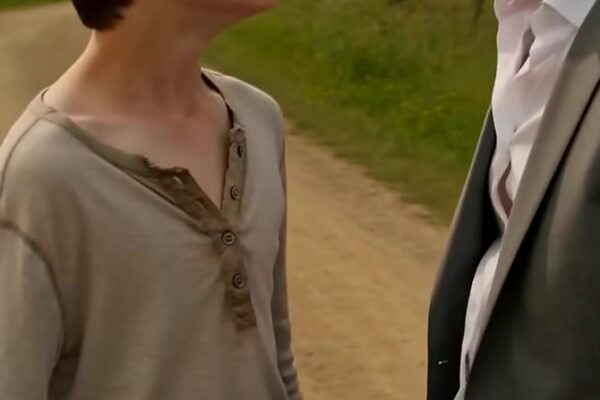
For five years, Daniel Reed lived like a ghost in his own life. He didn’t haunt old houses or rattle chains; he haunted routines. Every morning the same charcoal suit—creased in the same places, repaired at the elbows by a tailor who stopped asking questions. Every evening the same walk home along the same worn stones, as if repeating the route could rewind time and return him to the one moment he wanted to relive: Elena laughing with sunlight in her hair, turning her face up like she could drink the day.
The city learned him the way a streetlamp learns rain. The barista handed him black coffee before he spoke. The doorman nodded with pity. Even the stray cat outside the bakery stopped flinching when he passed. Daniel kept his grief arranged and quiet, like a room nobody entered anymore.
He carried one object that proved he’d once been alive: a photograph, soft at the corners, the surface rubbed thin from the pad of his thumb. Elena in a yellow dress, squinting at the camera, her smile caught mid-mock as if she’d just said something wicked and tender. It wasn’t a memorial; it was a tether. Without it, he feared he might drift fully out of himself.
People told him the phrases they thought grief required. Time heals. She’d want you happy. There will be someone else. Daniel thanked them with the careful politeness of a man reading lines. There had been no funeral to seal anything. No body. No last touch. Elena had vanished five years ago on a rain-swollen night when the river chewed at its banks and the police wrote words like presumed and likely. They gave him a bag of her things found near the water: her scarf, her keys, and nothing else. A conclusion wrapped in paperwork.
He did not accept conclusions that lacked proof.
On the fifth anniversary of the day the river stole her name, the light turned strangely golden near dusk, as if the sky had been bruised and was now trying to forgive itself. Daniel left his office late, declining invitations he didn’t remember being offered. He walked with his head down, letting memory keep him company. His fingers brushed his coat pocket—empty air. The photograph, unmoored by a frayed lining, slid free without his noticing and whispered to the street.
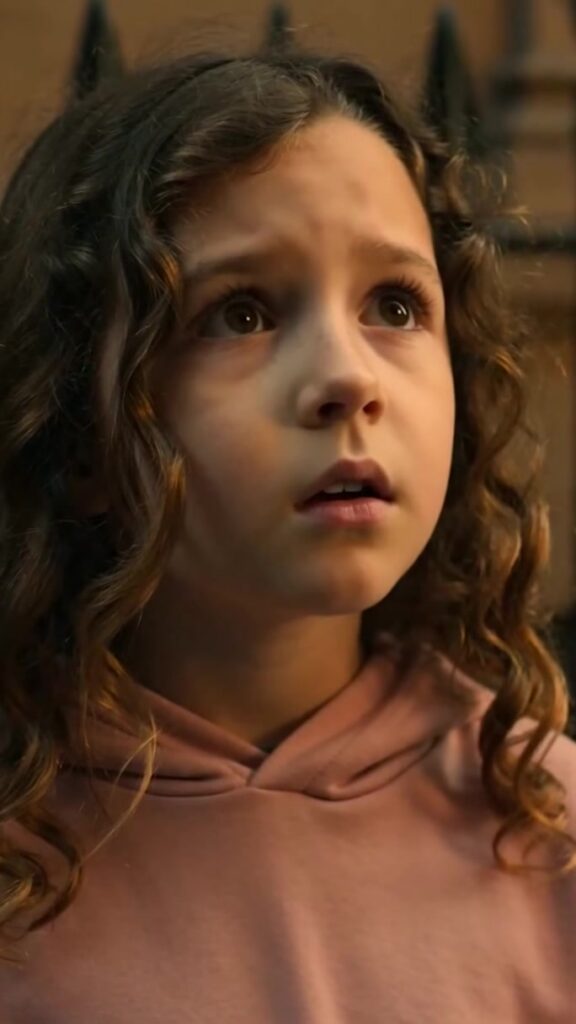
It landed near the curb where chalk drawings faded under old gum stains. A small hand reached for it before a breeze could claim it. The hand belonged to a girl no older than seven, wearing a pink hoodie too big at the sleeves. She studied the picture without smiling, as if it were a test she’d expected.
“Mister,” she said, her voice threading through the street noise with a sharpness that made Daniel stop. “Why do you have a picture of my mom?”
He turned as if someone had grabbed his spine. The girl held the photograph carefully—two hands, thumbs tucked in, reverent. Daniel’s mouth opened but no sound came at first. The city did not pause for him; tires hissed, a bus sighed, someone laughed too loudly. Yet inside Daniel, something snapped to attention like a long-sleeping animal.
“What did you say?” he managed.
The girl stepped closer, close enough that he saw the smudge of chocolate at the corner of her mouth and the steadiness in her eyes. “My mom,” she repeated, softer now, not accusing, just stating a fact. “That’s her.”
Daniel’s throat tightened until it hurt. “That’s my wife,” he said, the words scraping. “Her name is Elena. She… she died.”
“No,” the girl replied simply. Her certainty was not childish stubbornness. It was the calm of someone who had been instructed carefully. “She didn’t die.”
Daniel crouched so fast his knee hit the cobblestones and pain flared up his leg. He didn’t care. “What’s your name?”
“Lucy.”
“Lucy,” he said, tasting the name as if it might unlock something. “Where is your mother?”
Lucy’s fingers tightened around the photograph. “She told me to wait here sometimes. She said… if I ever saw a man with that picture, I should ask him why he still looks so sad.”
Daniel felt the street tilt. That sentence—its shape, its gentle cruelty—was Elena down to the bone. Elena who used humor like a key, who picked at his silences and called them hiding places.
His hands began to tremble. “When did you see her?” he whispered.
“This morning.” Lucy lifted her chin toward a narrow alley between a closed florist and a barber shop. The alley had always been there, but Daniel had never walked through it. He had never needed to. “She said she’d be back before it got dark.”
Daniel rose unsteadily, as if gravity had changed. He followed Lucy into the alley, his shoes striking damp stone. The air smelled like rust and old detergent. At the far end stood an apartment building with soot-dark bricks and a small iron staircase curling up its side. Second floor: a window with a pale curtain that stirred, then stillened.
Lucy stopped at the bottom of the stairs. She didn’t climb. She waited, as if crossing that threshold required permission. Daniel looked up. The curtain shifted again. A shadow moved behind it—someone passing close to the glass.
His heart pounded so violently he thought it might bruise his ribs. “Lucy,” he said, barely breathing, “are you sure?”
Lucy’s gaze never wavered. “I’m sure.”
The curtain drew back. A woman stepped into the window’s light, and the alley suddenly felt too small for Daniel’s shock. Same dark hair, though shorter. Same slope of shoulders. Same hand lifting to the glass, palm pressed there as if feeling for a heartbeat on the other side.
Daniel’s knees threatened to fold. His mind tried to protect him by calling it resemblance, coincidence, a cruel trick. But his body recognized her before his thoughts could argue. It was Elena.
Alive.
For a second, her expression held no recognition—just wariness, like someone prepared to flee. Then her eyes met his, and something in her face faltered, the way ice fractures when a stone drops beneath it. She vanished from the window.
“Elena!” Daniel’s voice cracked open the alley. He took the stairs two at a time, Lucy’s footsteps quick behind him. On the landing, he saw a door slightly ajar. Beyond it, a dim hallway and the scent of lavender—Elena’s scent, impossibly intact.
He pushed the door wider. Inside, the apartment was sparsely furnished, the kind of place meant for temporary existence: a small table, mismatched chairs, a kettle on the stove. A child’s backpack lay by the wall. A radio sat unplugged. And there, standing near the sink with her hands braced on the counter as if steadying herself, was Elena.
She looked at him with a stranger’s caution and a loved one’s pain layered beneath. On her wrist, a thin scar looped like a bracelet. Her eyes flicked to Lucy, then back to Daniel, as if measuring the danger in his hope.
“Daniel,” she said, and his name in her mouth was both a return and a warning.
He couldn’t move. He couldn’t swallow. Five years of silence pressed against his teeth. “Where have you been?” he whispered, and the question carried every night he’d spent bargaining with the dark.
Elena’s jaw tightened. She glanced toward the window, toward the street, toward unseen corners. When she spoke again, her voice was low, urgent, not the voice of a woman stepping back into a life, but of a woman who had been running from one.
“You can’t be here,” she said. “Not like this. Not with her.” She reached for Lucy’s shoulder, protective, desperate. “I didn’t want you to find me. I tried not to.”
Daniel’s chest caved in with confusion. “Tried?”
Elena’s eyes shone, but no tears fell. “Because if you’re here,” she said, each word careful as if it might detonate, “it means they followed you.”
From the alley below came the slow crunch of footsteps on gravel—measured, deliberate, not Lucy’s small hurried steps, not Daniel’s stumbling climb. Elena’s head snapped toward the door. Lucy’s hand slid into Daniel’s like she’d been trained to do it when the world turned sharp.
Daniel stared at Elena, alive and terrified, and realized the truth might be worse than death.
Someone knocked once—polite, almost gentle—on the apartment door.
Elena leaned close to Daniel, her breath trembling against his ear. “If you ever loved me,” she whispered, “don’t ask questions yet. Just do exactly what I say.”
Then she turned to the door, and her voice changed into something steady, practiced, and utterly unfamiliar. “One moment,” she called, as if she had all the time in the world.
Daniel, still holding Lucy’s hand, felt the ghost of his old life lift its head—only to see the shadow behind it.
Elena met his eyes one last time, and in that look was a plea and a confession: she had not simply survived. She had been taken apart and rebuilt with secrets.
The lock clicked.
The door began to open.
And Daniel finally understood that finding Elena was not the end of his haunting. It was the beginning.