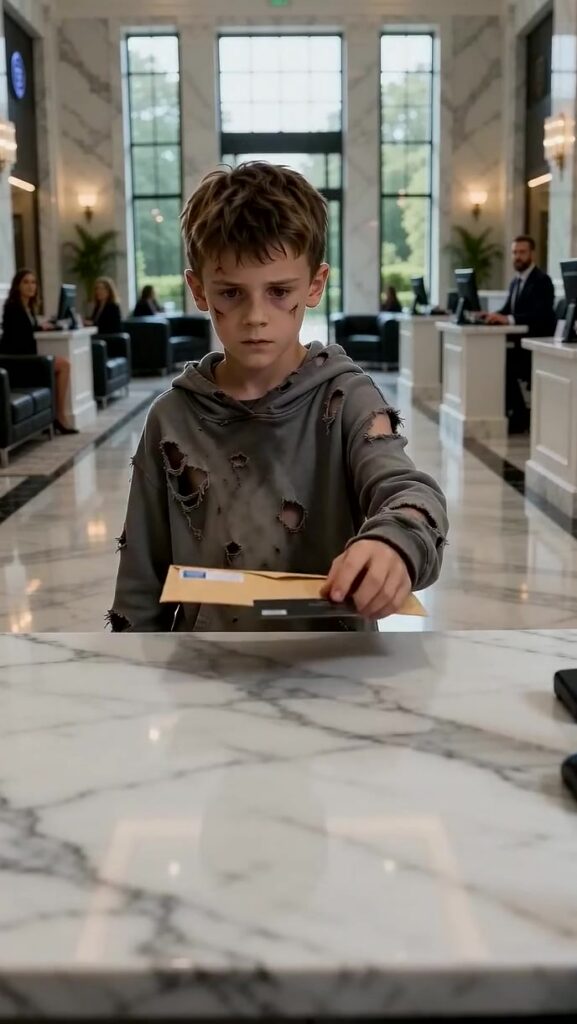
“Get out of here before I call the police!”
The words ricocheted off marble columns and glass dividers, louder than they had any right to be inside a place designed to swallow sound. Even the fountain in the lobby seemed to pause mid-trickle, as if water itself had been startled into silence.
The boy in the worn jacket didn’t flinch. He stood with his shoulders squared, as if he had practiced standing that way when the world tried to push him smaller. A few people in line turned their heads, pretending not to stare while staring anyway. A man with cufflinks the color of bone smirked behind his phone. A woman in a winter-white coat lowered her sunglasses just enough to sharpen her look into a blade.
The employee behind the counter—hair too neat, smile too rehearsed—kept one hand hovering near the security button under the desk. She looked at the boy like he was something that had wandered in from the rain. “You heard me,” she said, voice pitched for an audience. “We don’t tolerate—” She searched for the right word and landed on the safest weapon she had. “Loitering.”
“I’m not loitering,” the boy said. His voice was soft, but it carried. He wasn’t pleading. He wasn’t angry. He sounded as though he were stating a date or reading a line from a book he’d already finished. “I need to check my account.”
A laugh slipped from somewhere near the velvet rope. Not cruel enough to be called cruel in public, but precise enough to draw blood in private. A second laugh followed—sympathetic, to the first laugh, not to the boy.
The security guard started moving, the way a boulder begins to roll when it finally commits. He was large and bored, eyes heavy-lidded from years of being asked to enforce decorum. “Kid,” he said, lowering his voice as if offering kindness, “let’s not make a thing of this.”
The boy’s gaze flicked up. For an instant the entire lobby felt as if it had tilted. His eyes were an impossible blue, not bright like summer, but deep like something cold and unfathomable. There was no frantic desperation in them. There wasn’t even hope. There was certainty.
He stepped forward anyway.
No hesitation. No glance at the guard. No apology. The people watching shifted, suddenly alert to the possibility that something more than embarrassment was happening. The boy reached into his jacket and withdrew an envelope that looked as if it had been carried for years—corners softened, paper creased, seal long since broken and resealed with care. He laid it on the counter with deliberate gentleness, like setting down a photograph.
Then he placed a card beside it.
It wasn’t flashy. It was almost offensively plain: matte black, no logo, no raised numbers, only a thin silver line along one edge that caught the bank lights and threw back a quiet glint. The kind of thing that looked fake because it didn’t try to prove itself.
The employee’s mouth tightened into a smirk. “This better not be one of those internet—” She pinched the card as if she didn’t want it to contaminate her fingers. “Fine. We’ll play.”
She slid it through the terminal with practiced impatience and began typing. Her nails made sharp little clicks—quick, careless, the rhythm of someone who expected an error message and intended to enjoy it. She angled the monitor away from the public, but the glossy screen still caught her reflection: her eyebrows slightly raised, her lips pressed into amusement.
Seconds passed. The clicks slowed. Her shoulders went rigid. She typed again, harder, as if force could correct whatever she didn’t like. Her smirk fell away, replaced by a look so nakedly confused that the people watching stopped pretending they weren’t invested.
“Is there a problem?” the suited man asked, enjoying the performance. He crossed his arms, expensive cologne drifting like a claim of ownership.
The employee didn’t answer him. She stared at the screen as if it had turned into a mirror and was showing her something she didn’t recognize. Numbers crawled across the display—too many digits, too long a balance, an account history that didn’t fit inside the usual confines of personal finance. Her fingers hovered, trembling, then flew again. Clicking. Pausing. Clicking. Her throat bobbed.
“…What?” she whispered.
The guard leaned closer. “Ma’am?”
The boy didn’t move. He didn’t gloat. He simply waited, as if he’d set a timer and knew exactly when it would ring. “Just tell me the number,” he said. Calm. Controlled. “And the name on the account.”
The employee’s lips parted. She swallowed twice. “I… I can’t—” Her gaze darted to the guard, then back to the boy, then toward the glass offices along the wall where executives worked behind frosted doors. She looked like someone standing on a trapdoor, realizing too late that the lever had already been pulled.
“Get the manager,” she snapped, and her voice cracked on the last word.
The manager arrived as if summoned by the tremor in the building. He was a compact man with a tie that always looked slightly too tight, the kind of person who collected other people’s stress and turned it into efficiency. “What is it?” he demanded without looking at the boy. “We have clients waiting.”
The employee pointed at the screen with a shaking finger. “This account,” she said, “it—”
The manager’s expression hardened. “We do not discuss accounts aloud.” He leaned in to chastise her properly, then his eyes found the numbers.
His face emptied. Not paled—emptied, as if someone had erased him in a single stroke. His mouth worked soundlessly. He looked up at the boy at last, and the lobby watched him do it, watched the whole hierarchy shift in the space between one breath and the next.
“This account…” the manager began, voice suddenly small in the cathedral of marble. He glanced around, as if afraid the walls might be listening. “This account is—”
The guard took a step back. Even the suited man lowered his phone. The woman in white lifted her sunglasses completely off her face, not caring who saw her surprise.
“Say it,” the boy murmured. Not unkindly. Like a doctor asking a patient to name the pain.
The manager’s lips trembled. “It owns the bank.”
Silence fell so hard it felt physical. The fountain resumed its trickle, but now it sounded indecent, like laughter at a funeral.
The employee made a small sound, half gasp, half sob, her hand flying to her mouth. “That can’t be true,” she said, as if denial could rearrange the digits on the screen.
The boy finally smiled. It wasn’t wide. It wasn’t triumphant. It was the expression of someone watching a door open that had been locked for a long time. “It is,” he said quietly. “It’s always been true.”
He tapped the old envelope. “My mother worked here. Not as someone you’d remember. Not in these offices.” His eyes swept across the marble, the polished brass, the floating art on the walls. “She cleaned the floors after hours. She emptied trash. She listened to the way people spoke when they thought nobody important was nearby.”
The manager blinked, as if the story had no place in the present. “Sir, if you’re telling me—”
“I’m telling you,” the boy said, “that she understood paperwork better than most of the people who signed it. She read what fell into bins. She copied what she wasn’t meant to see. She saved what you threw away.”
His hand slid across the counter, and he pulled the envelope toward him. From it, he drew a single sheet of paper—yellowed, but carefully preserved—stamped with seals and signatures. He didn’t need to hold it up. The manager leaned forward as if drawn by gravity.
“She was tired of being treated like air,” the boy continued. “Tired of watching men laugh about bonuses while she counted coins for bus fare. So she did something very simple. She made sure the bank would never be able to pretend she didn’t exist again.”
The manager’s eyes flicked to the guard, then toward the executive offices. His voice dropped to a whisper. “Where did you get this?”
“From her,” the boy said. “Before she died.”
The word death hung in the air and changed the temperature of the room. The employee’s face softened, horror and shame mixing like ink in water. The suited man looked away as if the marble suddenly held an interesting pattern.
The boy’s gaze fixed on the employee, the one who’d shouted first, the one who’d threatened the police like it was the only power she knew how to touch. “I didn’t come to ruin your day,” he said. “I came to learn if what she left me was real.”
The manager straightened slowly, as if standing too quickly might fracture the moment. “We should go somewhere private,” he said, words drenched in deference. “Please. We can—”
“No,” the boy replied. He glanced around the lobby, at the watching eyes, at the people who had laughed just enough to wound. “Not private. Not this time.”
He turned back to the counter. “Read the name,” he said. “Out loud.”
The employee’s trembling fingers hovered over the keyboard. She typed once, then looked at the manager as if asking permission. He gave a tiny nod, the kind reserved for judges and storms. She swallowed and spoke, voice thin but clear.
“Account holder,” she read. “Marisol Reyes.”
The boy exhaled as if he’d been holding his breath for years. The name filled the lobby and refused to be ignored. The people in line shifted, suddenly unsure of their posture, their place, their own importance.
“That was my mother,” the boy said. “And if this bank belongs to anyone, it belongs to the hands that scrubbed its floors until they cracked.”
He looked at the guard, then the manager, then the employee who had tried to erase him with a shout. His eyes—too blue, too calm—did not soften, but they did not burn either. They simply saw.
“Now,” he said, and the word sounded like a verdict and an invitation all at once, “let’s talk about what happens when the invisible finally owns the building.”