The café was soft with golden light, the kind of place where people wore clean clothes, lowered their voices, and pretended not to see suffering. Sunlight sifted through plane tree leaves and fell in careful squares across marble tables, as if the afternoon itself had been trained to behave. Glasses clinked politely. A laugh rose, immediately trimmed down to a tasteful volume. Even the fountain at the garden’s edge seemed to murmur rather than speak.
Clara March sat alone where the shade was flattering and the staff knew not to interrupt. Her black sleeveless dress made a clean line from shoulder to knee, as severe as ink. She held her coffee cup with one hand and kept the other resting lightly on her thigh, fingertips relaxed, posture composed to the point of distance. She looked like a woman who had learned that stillness could be armor.
For twelve minutes she had stared into the coffee without drinking it. For twelve minutes she had not looked at her phone. She had come early on purpose—early meant control, and control meant safety. She told herself she was waiting for a client, a colleague, anyone with a name and a calendar. Not for the memory she carried like a bruise beneath her ribs.
A shadow slipped across the table.
Clara barely registered it. The café had shadows in abundance—waiters passing with trays, women leaning close to confess small betrayals, men whose expensive watches flashed like lures. Her eyes remained on the cup. She might have let the moment drift by, might have left the shadow to move on, if not for the sensation that followed: the lightest brush against her hair, a touch so tentative it could have been a leaf.
She flinched as if struck. Her chair scraped harshly against the stone terrace, loud enough to turn heads. Clara’s hand flew up, not to protect her hair but to claim her space.
“Don’t touch me,” she said, and her voice came out sharper than she intended—sharp enough to cut through the café’s gentility.
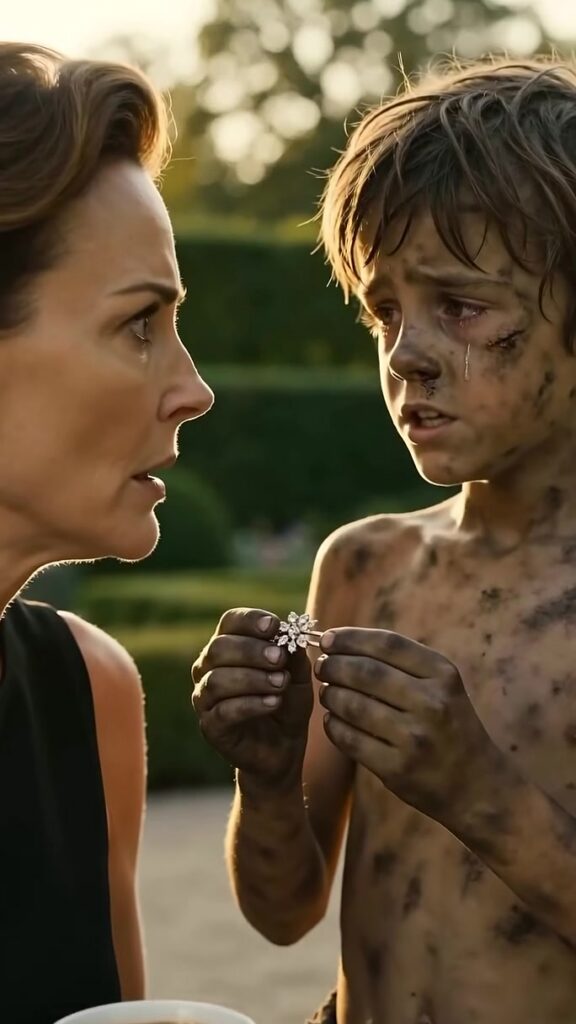
The boy snatched his hand back. He was so thin his ribs mapped themselves beneath his skin. He wore no shirt, only ragged shorts that hung from his hips as if they belonged to a different child. Soot darkened his arms and collarbones; dirt lodged in the lines of his knuckles. His eyes were huge, wet already, and his lips trembled with an apology he seemed afraid to deliver.
“Sorry,” he whispered.
Clara stared at him with an anger that had nowhere sensible to land. How had he gotten past the host? How had no one stopped him? She saw, in the same instant, how the other patrons were reacting: not with concern, but with the particular stiffness of people whose comfort has been disturbed. A woman near the hedge angled her phone as though filming wildlife. A man lowered his gaze to his pastry as if avoiding eye contact could erase responsibility.
The boy did not run. He stayed, close enough that Clara could smell smoke and street dust on him, and something else—an old scent of rain on concrete. His gaze was fixed not on her face but on her hair, the dark waves pinned back neatly above her ear.
Then, in a voice so quiet it almost vanished under the fountain’s polite trickle, he said, “Same as hers.”
Clara’s throat tightened. She didn’t want to ask, yet the question climbed out of her anyway, pulled by an old thread.
“Whose?”
He swallowed hard. “My mom’s.” He said it as if the word had weight, as if it could bruise his tongue. “She had hair like that. She told me to look for it.”
Clara’s first instinct was to deny him. Her mind reached for explanations—con, mistake, coincidence. But the boy’s face held no practiced angle, no performer’s confidence. Only a raw, desperate precision, as if he was repeating instructions that had been pressed into him with trembling hands.
The café’s noise receded. The murmurs became distant, muffled by the sudden drum of Clara’s heart. She realized she had stood halfway from her chair, poised between leaving and listening.
The boy lifted his hand again, slower this time, as if asking permission from the air. Between his thumb and forefinger he held a small silver hair clip. It was delicate, a narrow curve of metal set with tiny stones, some dull from age, others still catching the sun. It flashed once in the golden light and pierced Clara with a memory she had spent years building walls around.
Her breath stopped. The cup in her hand lowered, trembling, until it nearly touched the table.
“That’s impossible,” she whispered.
She had once owned a clip like that. She had lost it—no, she had abandoned it—on a day she had trained herself not to revisit. A day filled with sirens and smoke and the taste of metal in her mouth. A day she told herself belonged to another life, another Clara.
The boy’s eyes overflowed. A single tear cut through the grime on his cheek, leaving a clean track like a wound.
“She said you’d say that,” he murmured, clutching the clip tighter as if it might be stolen by disbelief alone. “She said you wouldn’t want to remember.”
Clara’s anger drained away, leaving something colder, more frightening: recognition. Not of the boy—she had never seen him before—but of the object, the way it seemed to hum with a past she had buried with careful paperwork and even more careful silence.
“Where did you get this?” Clara asked. Her voice shook now, and she hated herself for it. She had made a career out of steady voices, out of negotiating with people who expected her to blink first.
“She gave it to me,” the boy said. “She told me to bring it here. To the garden place. To the café with the trees.” He looked around as if the world might contradict him. “She said you’d be sitting alone.”
Clara’s fingers hovered toward the clip but stopped short, as though the air around it might burn. Her mind raced through names and dates. There was only one woman she could imagine attaching a message to an object like this. Only one woman who knew where Clara hid when she needed to feel untouched by the world.
“Where is she?” Clara asked. The question scraped out of her like gravel. “Where is your mother?”
The boy’s gaze slid past Clara’s shoulder, past the linen napkins and polished cutlery, past the people pretending to read menus while their attention fed on the scene. He looked toward the far edge of the garden where a manicured hedge drew a neat border between beauty and whatever lay beyond it.
There, in the warm evening light, stood a woman in a beige suit.
She was still. So still Clara first thought she might be a statue placed for decoration. But then a leaf fell, spinning slowly, and the woman didn’t move to let it pass; it landed on her shoulder and stayed. Her hands were at her sides. Her posture held a tension that made stillness feel like restraint. She was watching Clara as if she had been watching for hours.
The boy’s voice came out barely above a whisper, and yet it sounded louder than the fountain, louder than any clink of porcelain.
“She’s been waiting.”
Clara’s world narrowed until it contained only that figure and the space between them. Her lips parted. Her eyes burned. She did not cry—she hadn’t cried in public in years—but her vision blurred as if her body was trying to betray the rules she lived by.
The woman in beige took one small step forward.
Clara’s knees went weak, and she gripped the edge of the marble table to keep from collapsing. The hair clip in the boy’s hand glinted again, a tiny signal flare from the past. Around them, the café held its breath, elegant and cruel in its quiet, waiting to see whether Clara March would turn this child and his soot-streaked message into an inconvenience—or whether she would finally look directly at the suffering she had spent so long pretending not to see.
The woman in beige took another step. This time, Clara saw it: the faint tremor in her jaw, the way her eyes shone with a pain that had learned how to disguise itself as composure.
Clara opened her mouth, and for once the words she had rehearsed—denials, dismissals, polite refusals—did not come. Only a name rose from somewhere deep and locked away, a name she had not spoken since the day the world caught fire.
“Elena?” she breathed.
The woman’s expression broke—not into a smile, not into relief, but into something raw and human. She stopped just beyond the hedge’s shadow, as if crossing that last line would make it all too real.
And the boy, still standing between them like a bridge made of bone and courage, held out the silver clip with both hands, offering it not as proof, but as a key.
Clara reached for it at last. Her fingers closed around the cold metal, and the moment she touched it, the golden light no longer felt soft. It felt like a spotlight.
“You came,” she whispered, though she didn’t know which of them she meant—the boy, the woman, or the past itself. “After all this time… you came.”