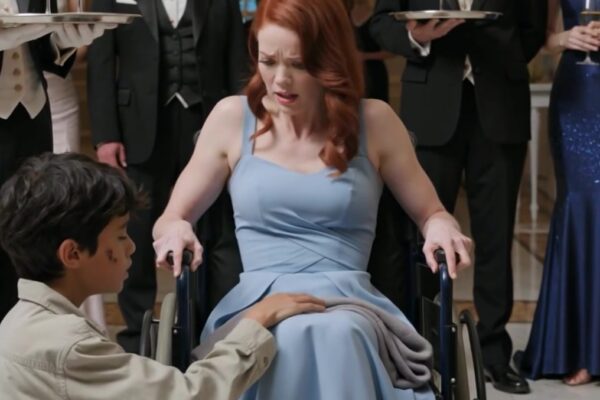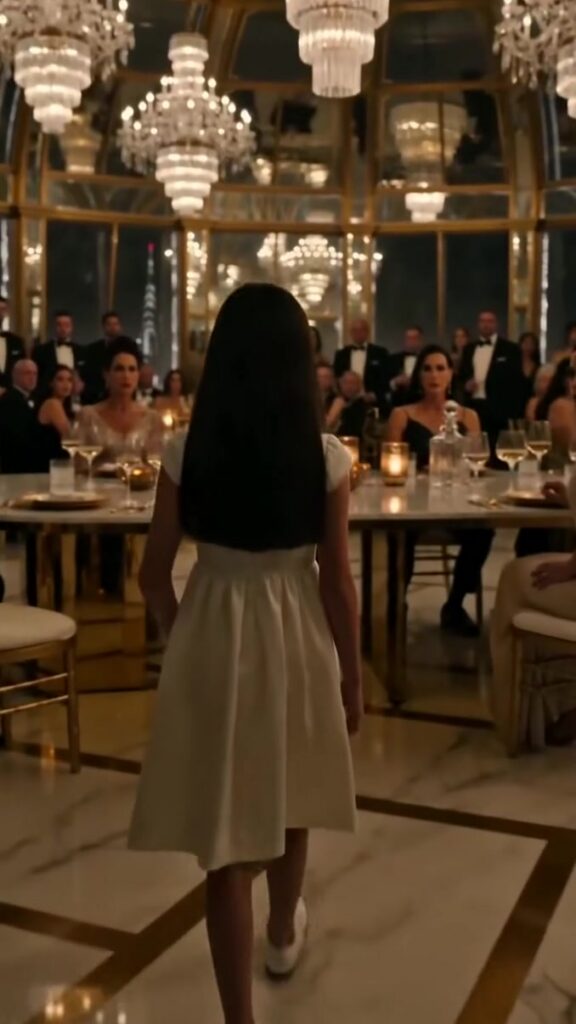
No one in the crystal ballroom noticed the girl at first. The room did what it had been built to do: it swallowed anything ordinary. It turned breath into etiquette and footsteps into whispers. Under chandeliers cut so sharply they seemed to have teeth, the guests moved with the slow confidence of people who had never been turned away from a door. Every laugh was measured. Every compliment carried the weight of an exchange.
The Crystal Ballroom sat at the crown of the Aureate Hotel, a square of polished marble and mirrored walls where the city’s rich could watch themselves reflected into permanence. Tonight’s gala was not a celebration so much as a demonstration. Everything was too expensive, too perfect, too controlled. Golden light poured down like honey, coating shoulders and diamonds alike. A string quartet played something bright and harmless, a melody meant to be heard but not remembered.
At the center, as always, sat Dorian Vell. He was not announced. He did not need to be. Men in tailored suits orbited him at respectful distance, each waiting for a nod. Women angled their bodies toward him as though their ribs were compasses and he was north. Dorian sat in a low chair upholstered in pale velvet—too casual to be a throne, too intentional not to be one—and spoke softly. People leaned in as if the air around him was rarer, more valuable.
There were rules in the Crystal Ballroom, and the first rule was that the doors stayed closed.
Then the doors opened.
The sound wasn’t loud, but it was wrong. Hinges moved. A draft slid across the marble. The quartet faltered for half a beat, bows stuttering as if someone had touched their wrists. A few guests turned, not from curiosity but offense, because air from the outside did not belong here.
She walked in alone.
At first she looked like a shadow pulled loose from the night beyond the windows. No gown that flared dramatically, no glittering entourage. She wore a dark dress that could have been borrowed or stolen; it fit her like a decision. Her hair was pinned back as though she had done it in a hurry, or with hands that shook once and then steadied. She had the kind of quiet certainty that made the room rearrange itself around her without anyone meaning to.
“She doesn’t belong here,” someone murmured, the words traveling quickly because they were easy to agree with.
A guard near the door took one step, then paused. The girl’s gaze did not move to him. It was locked ahead, aimed like a blade across the ballroom.
She began to walk.
Step by step, she crossed the marble as though it were ground she had imagined a hundred times before. Conversations thinned. Glasses stopped halfway to mouths. The music softened, not because anyone told the quartet to quiet, but because attention had shifted and the room itself seemed to be listening.
She did not look at the chandeliers. She did not flinch at the mirrored walls that multiplied her into a dozen girls, each one equally out of place. Her eyes stayed on Dorian Vell, seated as if he owned the air itself.
When she reached him, she stopped. The people nearest recoiled without meaning to, the way a crowd parts at the edge of a spill.
Dorian lifted his gaze. Up close, his composure was a crafted thing—smooth as lacquer, with the faintest crack at the corner of his mouth that suggested impatience or caution. His eyes moved over her dress, her bare wrists, her empty hands, and then returned to her face.
“You’ve made a mistake,” he said quietly, as though offering her a chance to retreat with dignity.
She didn’t answer. Instead she reached into the pocket of her dress with the careful precision of someone handling something that could break. She drew out a silver locket. It wasn’t flashy. No jewels, no engraved initials, just worn metal warmed by time. She placed it on the small table beside his chair, between a crystal tumbler and a folded program.
Dorian glanced at it casually—until he didn’t.
The change in him was so sudden the people closest noticed before they understood what they were seeing. The color drained from his face in a slow, irreversible tide. His pupils tightened. His hand rose to his throat as though an invisible cord had been pulled there.
At his neck, half-hidden beneath his collar, a chain caught the chandelier light. A familiar oval of silver rested against his skin.
An identical locket.
For a moment the ballroom made no sound at all. Even the quartet’s bows froze, suspended above strings.
“Where did you get that?” Dorian asked. The words were forced out around a breath that had turned to glass in his chest.
The girl finally spoke. Her voice was calm, steady, and too old for her face. “My mother said you would react like this.”
The name of her mother hovered unspoken. Guests leaned in, sensing scandal the way sharks sense blood. Dorian’s throat bobbed as he swallowed. His fingers hovered above the locket on the table but did not touch it, as if the metal might burn.
“Who are you?” he managed.
“You don’t recognize me,” she said. It was not a question. “That’s… convenient.”
Dorian’s gaze flicked to the guards at the doors, then back to her. “This is not the place.”
“It’s the only place,” she replied. “The only place you can’t ignore me.”
In the mirrored wall behind him, his reflection seemed to sit farther back than his body, as if even the glass was trying to distance itself from what was happening. Dorian’s hand tightened against his collar, drawing his own locket into view. It hung on a chain so fine it was nearly invisible, as though he’d always wanted to pretend it wasn’t there.
“You should leave,” someone hissed from the crowd, emboldened by numbers. Another voice: “Call security.” But the security guards did not move, their attention glued to Dorian’s face, because power was the one thing that could halt them.
The girl kept her eyes on him. “My mother kept hers in a box under her bed,” she said. “She would take it out when she thought I was asleep. She’d press it to her lips like it was a prayer she’d forgotten how to say. She told me it came in the mail with no return address, after she stopped writing to you.”
Dorian’s jaw tightened. “She—”
“She died last winter,” the girl said, cutting him cleanly. “And when I found the locket, I found the photograph inside.”
The guests shifted. This was the part of the story that promised a bruise beneath the velvet: a secret, a betrayal, a tear in the immaculate fabric of wealth.
Dorian’s eyes widened, not with surprise, but with dread. “Open it,” he whispered, and it was unclear if he meant hers or his own.
The girl’s fingers moved to the tiny clasp. She opened the locket on the table. The hinge creaked softly, an indecent sound in such a polished room. Inside was a photograph, old and faded at the edges: a young woman with fierce eyes and a half-smile that looked like it had been earned, not given. In her arms, a baby with a shock of dark hair.
“That’s my mother,” the girl said. “And that’s me.”
It should have ended there, with shock and whispers and a man’s carefully guarded life cracking in front of everyone who fed off his favor. But the girl did not look satisfied. Her hand slid beneath the photograph, and she drew out something else—thin as a leaf, folded tightly.
She placed it beside the locket: a letter, yellowed with age, the ink slightly blurred. “This was tucked behind the picture,” she said. “She wrote it but never sent it. She didn’t want you to have the mercy of ignorance. She wanted you to live with the choice you made.”
Dorian stared at the letter as if it were a weapon. The crowd held its breath. In the silence, the chandeliers seemed to hum.
“Read it,” the girl said. “Out loud.”
Dorian’s eyes snapped up. “No.”
“Then everyone here stays thinking you’re a man of spotless control,” she said softly, and the cruelty of it was precise. “Or you tell the truth in the one place that believes you can’t bleed.”
His fingers trembled as they reached for the paper. The tremor traveled up his wrist into his sleeve. A man who had bought silence with checks and favors and threats now held a fragile rectangle that could not be bribed.
He unfolded the letter. The paper crackled. The sound was obscene—proof that something living and breakable existed in this room.
Dorian looked down, lips parting as if to speak. The girl watched him without blinking. Around them, the Crystal Ballroom—perfect, expensive, controlled—began to feel like a glass cage someone had struck with a hammer, waiting for the first spiderweb fracture to spread.
And when Dorian Vell drew breath to read, the night finally turned, not toward gossip, but toward reckoning.