The ballroom glimmered as if someone had trapped sunlight in the chandeliers and shattered it into a thousand obedient sparks. Strings and clarinets breathed a polite waltz that made conversation sound like foam—soft, drifting, forgettable. Waiters glided through the gold haze with trays of crystal, and the guests—women lacquered in jewels, men sealed into black cloth—moved as if the night belonged to them by inheritance.
Then, in the middle of laughter, a small figure stepped forward from the edge of the crowd, as if the darkness had decided to speak.
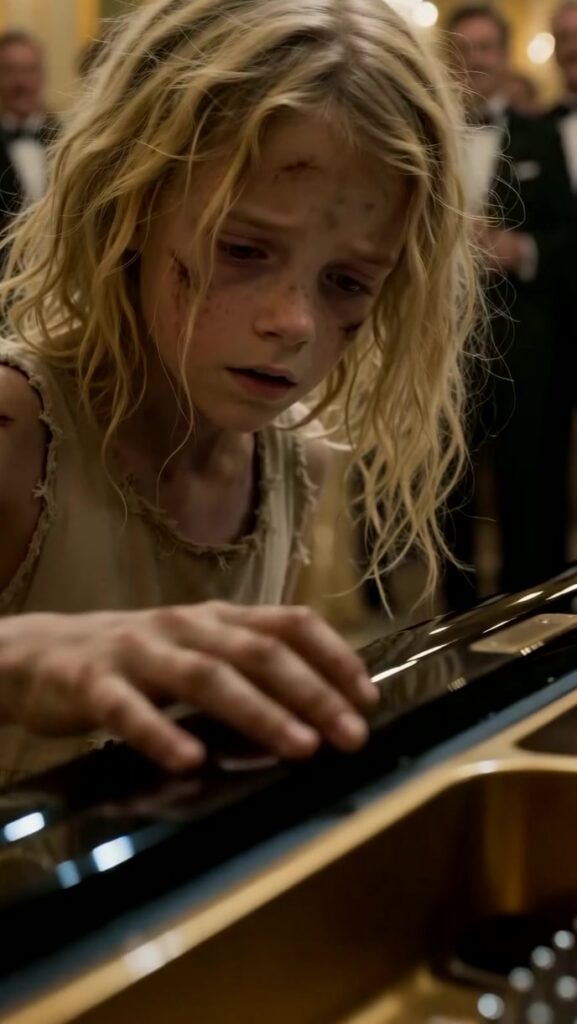
She was barefoot. Her dress was the color of dried grass and it hung in torn, uneven folds, dirt ground into the hem like an accusation. Pale hair clung to her temples in tangled ropes, and her cheeks bore smudges where hunger had rubbed her skin raw. She looked wrong in that room—not merely poor, but transported, a child who had walked out of a storm and into a painting.
The waltz kept going because the musicians had not yet noticed. The guests noticed all at once, as if the air had changed temperature. Heads turned. A ripple went through silk and satin. Someone choked on a laugh and pretended it was a cough.
The girl moved with a steady purpose, past the buffet that smelled like roasted butter and expensive spice, past the dancers’ polished shoes. She stopped in front of the grand piano—black as a well, wide as a coffin—and lifted her eyes to the people who had formed an instinctive circle around her, careful not to touch her with their clothes.
Her voice came out thin but clear. “Please,” she said. “Can I play… for something to eat?”
For a breath, everything held. Then amusement cracked the silence like a dropped glass.
It came from every side—bright, sharp, safe. A woman in a metallic gown pressed her fingers to her lips and laughed as if she had been gifted a joke. A man near the piano tilted his head and grinned, the way one might grin at a dog that had wandered in. Another voice, impatient and annoyed, muttered about the door staff and how a place like this was supposed to be sealed against the world’s grime.
The child’s shoulders tightened. She flinched at the first wave of sound, her lashes trembling as if they carried too much weight. Her mouth worked around a word that did not come. Her eyes shone, filling fast, but she did not step back. One hand reached out and clutched the edge of the piano as though the instrument were a railing above a drop.
In the corner, the musicians faltered, notes thinning. The waltz staggered, then died with a confused hush. The room waited for someone important to tell the child to vanish.
Instead, she climbed onto the bench.
Her feet did not reach the floor. She sat with her spine too straight, like a student bracing for a blow. Dirty fingers hovered above the perfect keys, trembling so hard it looked like she might not be able to lower them. The piano’s lid reflected her face in warped darkness: smudged, frightened, stubborn.
She pressed the first note as if she were touching something alive.
It was barely audible, a whisper of sound threaded through the gold air. A second note followed, softer still, and then, after a hesitation that felt like a prayer, a melody unfolded. It did not spill out prettily. It opened the way a wound opens—slow at first, then suddenly too deep, too honest to ignore.
The last laughter died mid-breath. A hand holding a flute of champagne froze halfway to a mouth. Someone’s smile slid off their face as though it had never belonged there. Even the chandeliers seemed to dim, not in brightness, but in arrogance, as if the room itself had been asked to listen.
The music carried the raw ache of winter streets, the hollow echo of empty kitchens, and beneath it—astonishingly—something tender, a memory of warmth that had been lost and kept alive by refusing to look away. The girl leaned into it, her uneven breathing audible between phrases. Tears gathered at the corners of her eyes and fell without permission, but her hands did not stop. It was as if the song was the only language that had ever answered her.
Near the piano, an older man in a dark tuxedo took a step forward.
He had been standing beside the host earlier, a figure of quiet authority with silver at his temples and a face trained to show nothing. He was known here. People greeted him with respect that looked like fear. His name was Elias Rook, and he owned half the city’s skyline, or so the rumors went. He had the kind of wealth that made others speak softly around him.
Now, as the melody climbed into a fragile, luminous turn, his composure cracked. His mouth opened slightly, as if the air had changed into something he needed. His eyes fixed on the girl’s hands, then lifted to her face, and the color seemed to drain from him.
He whispered, not to the room but to himself, “That song…”
His fingers tightened around the edge of his cuff. A memory rose with the music: a small apartment above a bakery, the smell of yeast and coal, a woman humming while she cleaned. The tune had been her favorite. She used to tap it on the table when she was nervous, when the rent was late, when his father’s temper was a storm building in the hallway. Elias had not heard it in decades—not since the night the fire took that building and left him with smoke in his lungs and a life that hardened like cooling metal.
The girl reached the refrain, and the melody became unmistakable. The room was no longer a ballroom. It was a corridor of time. Elias saw, with nauseating clarity, his mother’s hands—chapped, gentle—moving over a broken piano they could not afford to fix.
He stepped closer. Someone started to protest, perhaps about boundaries, but the sound of the piano swallowed it whole.
The child’s head lifted slightly as if she felt him there, though she did not look up. Her brow furrowed with concentration, and for the first time Elias noticed something else: a thin cord around her neck, hidden beneath the torn collar. When she shifted, a small pendant slid into view—an old brass key, worn smooth, the kind that belonged to a cheap apartment lock.
Elias’ throat tightened until it hurt. He knew that key. It had hung on a nail by their door, next to a grocery list written in his mother’s looping hand. After the fire, it had vanished with everything else, or so he had told himself. Seeing it now was like seeing a ghost choose flesh.
The final notes trembled, softened, and settled into silence. The child’s hands remained on the keys as if she were afraid that letting go would make the world come crashing back.
For a long moment, no one moved. The chandeliers buzzed faintly. A distant car horn in the street sounded impossibly far away.
Elias exhaled, and it was almost a sob. He spoke gently, the way one speaks to someone holding a fragile thing. “Where did you learn that?” he asked.
The child turned her face toward him at last. Her eyes were gray-green, bright with fear and defiance. “My mother,” she said. “She said it was for when you don’t have enough of anything. You play it, and it helps you remember you’re still… here.”
A murmur stirred, confused and suddenly uncomfortable. The guests looked away, as if shame had entered the room on bare feet and they didn’t know where to put their hands.
Elias crouched so he could see her levelly. Up close, the child was even smaller than he’d thought, bones delicate under dirt and fabric. “What is your mother’s name?” he asked, though his heart already knew the shape of the answer.
She swallowed. “Mara,” she said. “Mara Rook.”
The older man’s eyes shut, and when they opened, they were wet. The name moved through the room like a dropped match, catching on whispers. Mara Rook was not a name these people had spoken in years. It belonged to the life Elias had erased when he built his empire, to a woman who had been too poor to be remembered in rooms like this.
He reached into his jacket and drew out his handkerchief. He didn’t offer it like charity, but like an apology. “And you?” he asked softly.
The child’s chin lifted, stubborn as a candle flame. “Lena,” she said.
Lena. The name struck him with the force of an old promise. He had written it once, as a boy, on the back of a school paper—Lena, if I ever have a daughter, I’ll name her Lena—after his mother’s sister who disappeared into the city and never came back. The world had a cruel habit of returning what you thought you’d buried.
Behind him, someone shifted nervously and tried to recover the evening’s façade. “Mr. Rook, we can call security—”
Elias did not look back. His voice, when it came, carried across the ballroom with a quiet authority that made every glass tremble in its holder. “No,” he said. “We can call a doctor. And a kitchen.”
He held Lena’s gaze. “You asked to play for food,” he continued, the words deliberate, heavy with meaning. “You played. You’ve paid more than anyone in this room has ever paid for a meal.”
Lena’s mouth quivered, but she did not cry again. She watched him as if she expected the kindness to dissolve into laughter at any second.
Elias stood and turned to the stunned crowd. The gold light still glowed, the marble still shone, but the room had been altered beyond repair. “The music is over,” he said. “If you came here to be entertained, you can leave.”
Silence answered him, thick and chastened.
He leaned down once more, offering his hand to the barefoot girl by the piano. “Come with me,” he said. “Not because you played well.” His voice broke on the truth. “Because I think you’re the last piece of my life I didn’t deserve to find again.”
Lena stared at his hand as if it were a door. Then, slowly, she placed her small, dirty fingers into his palm. Her grip was surprisingly strong.
And as the chandeliers glittered above them, the grand piano behind them still humming with the memory of what had been played, the richest man in the room walked out with the poorest child—leaving the gold light, the soft music, and the old, careless laughter to echo in an emptier kind of silence.