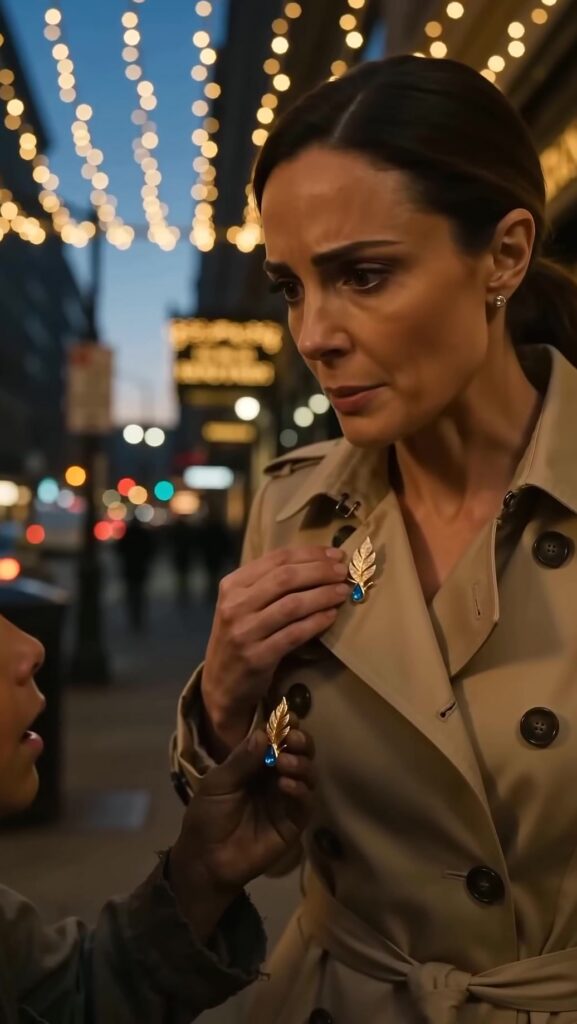
The woman moved like a metronome through the evening crowd—quick, elegant steps that neither hurried nor dawdled, a pace calibrated to keep the world at arm’s length. Above her, strings of lights stitched the street from awning to awning, each bulb a small warm sun. Their reflections slid across shop windows and polished brass door handles, then briefly caught in the folds of her beige trench coat as if trying to cling to her.
She did not look up. She did not look into windows. She did not look at faces. When she passed the bakery, cinnamon and butter rose to meet her, but she let the scent drift by without taking it in. Her gloved hand held the strap of her handbag close, the gold chain doubled around her wrist like a restraint she had chosen for herself. Tonight, she told herself, she would buy the file at the stationery shop, mail the envelope at the post office, return to her apartment, and sleep without dreams.
A small hand latched onto the gold chain.
The pull was light—so light that at first it seemed like the chain had snagged on a coat button. Then it jerked, a frantic tremor that made the links rattle softly, an insect sound swallowed by music spilling from a nearby café.
She spun, her heels clicking once, sharp as a warning. The motion was trained, automatic. The city offered opportunities for theft, and she had learned to treat every touch as a threat.
A boy stood there. He couldn’t have been older than eight or nine, narrow as a reed, clothes too thin for the season and scuffed at the knees. Dirt traced the lines of his knuckles and painted a crescent under his nails. His eyes were huge and flooded, and his hand shook so hard the chain quivered in his grip.
“Excuse me…” he breathed, as if the word hurt to say.
She yanked the bag free and stepped back. The movement exposed the hard edge beneath her composure, something she used so often it had become a second skin.
“Don’t touch me.”
The boy recoiled, shoulders folding inward. He did not run. Instead, he stood in the pool of light beneath a string of bulbs, trembling like a lamp about to go out. His breath came too fast, and she saw the raw panic in him—the kind that doesn’t belong to petty thieves but to children who have run out of choices.
“But…” He swallowed, and his voice wavered into a whisper. “You have the same pin.”
For a second she did not understand what he meant. Her anger, a bright blade, hovered in the air between them. Then the boy uncurling his fist brought his words into focus.
In his palm lay a delicate pin shaped like a leaf, its veins etched into gold. Set near the stem was a blue stone, a teardrop jewel that caught the warm streetlight and held it like captured water.
Something behind her ribs tightened. Without meaning to, she reached to her own coat collar.
The leaf pin there was identical.
Her fingers brushed its cool metal, a familiar texture she had touched during restless meetings and long solitary dinners. She had worn it tonight out of habit, not sentiment. It had been a gift—an heirloom, her mother had called it, though the word felt too grand for the cramped apartment where she’d grown up.
Her anger thinned, leaving confusion in its place. “What are you talking about?” she asked, but her voice had lost its edge.
The boy lifted his pin higher with shaking fingers, as if offering proof to a judge. “My mom has the same one.” He blinked hard, and a tear spilled down his cheek, carving a clean line through the grime. “She said it was… for family.”
The woman stared at the pin in his hand, then at the one on her collar, as though the street had tilted. She heard her own pulse louder than the café music, louder than passing laughter.
“That’s impossible,” she whispered.
The boy’s lip trembled. He looked at her with a terrible steadiness, like someone who’d carried a secret too heavy for his small bones. “She said the woman with the other pin…” His chest hitched. “…is my mother’s sister.”
The sentence landed with the force of a door thrown open onto a room she had boarded up years ago. She saw it all at once: her mother at the kitchen table, hands cupped around a chipped mug; the careful way she avoided certain names; the box in the closet that was never to be opened. Her mother’s stories had always been missing a chapter.
She forced her mouth to work. “What is your mother’s name?”
The boy hesitated, as if afraid the name might evaporate. “Mara,” he said. “Mara Kline.”
The woman’s breath caught. Mara. Not a stranger’s name. A name written once on the back of a photograph she had found as a teenager and confronted her mother with—only to be told it was a mistake, a friend from long ago. A name her mother had then insisted was never spoken again.
The woman’s knees went briefly weak. She steadied herself by gripping her bag. “Where is she?” she asked, and heard how thin her voice had become.
The boy’s gaze flicked toward the darker end of the street where the lights thinned. “At the shelter,” he whispered. “The one under the old bridge. She’s sick.”
The shelter. Under the bridge. Her mind conjured damp concrete, the smell of river rot, the echo of voices. She pictured Mara there, though she had no face to attach to the name—only the idea of a woman cut out of her life like a tumor.
“Why are you here?” she demanded, but the question shifted midway, softening into something else. “Why did you… grab me?”
The boy’s grip tightened around the pin. “I saw yours,” he said. “I knew it was you. Mom told me if I ever saw the other pin, I had to… I had to ask. Because… because you’d understand.” He looked down at his shoes as if ashamed. “I’m sorry. I didn’t want to steal. I just… I didn’t know how to stop you.”
She watched him—his hollow cheeks, the raw fear, the desperate courage it took to touch a stranger. He was not asking for money. He was asking for a door to open.
Her first instinct was to deny it, to step away and let the moment dissolve back into the safe anonymity of the lit street. For years, she had built her life on clean lines: a career, a locked apartment, controlled relationships that required no history. Family was a word she had learned to pronounce like a bruise.
But the pin at her collar burned against her skin now, no longer decorative but accusatory. She thought of her mother’s silence, of the way she had died without explaining the missing chapter. She thought of the box in the closet that she had never opened, even after the funeral, because she had been afraid of what she might find—afraid of what she might owe.
“What’s your name?” she asked.
“Leo.” The boy’s voice was barely audible, as if he expected the street to swallow it.
Leo. A name that sounded like a small flame.
The woman looked past him at the bright storefronts, the people with their paper bags and their easy laughter. Everything around them continued as if nothing had shifted. Yet her life had already been nudged off its axis by a shaking hand and a blue teardrop jewel.
She bent slightly, lowering herself to his height. The movement felt strange, like surrender. “Leo,” she said carefully, “I don’t know what you think you know. I don’t know your mother. Not the way you mean.”
His eyes widened with fear that she would walk away.
“But,” she continued, and the word scraped her throat, “I will come with you.”
His shoulders sagged with relief so sudden it looked like he might collapse. He clutched the pin to his chest as if it was the only solid thing in the world.
She straightened and glanced at the street again. The glowing string lights looked, for the first time, like a trail leading somewhere rather than decoration. She adjusted her trench coat, her hand lingering on the gold leaf pin—two sisters’ matching secrets, carried for years without meaning.
“Stay close,” she said. “And don’t grab anyone’s bag again.”
He nodded rapidly, already stepping in beside her like he belonged there.
Together they turned away from the warm storefront reflections and headed toward the thinning light, toward the old bridge, toward the part of the city that did not polish itself for visitors. With each step, the woman felt the neat boundaries of her life begin to fray, and beneath the fear, something else stirred—an old grief waking up, and with it, the possibility of an answer she had not dared to ask for.