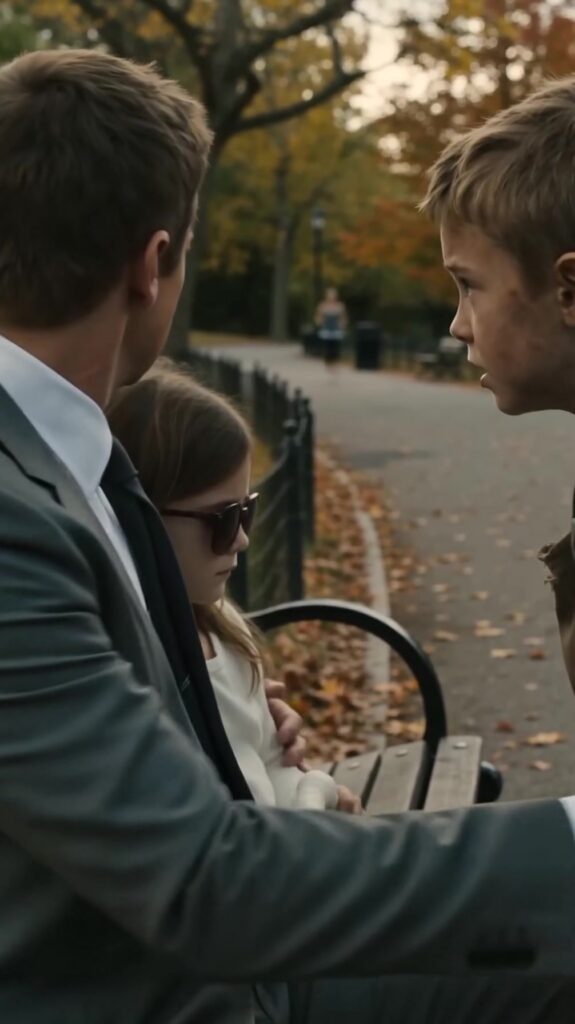
The father sat on the wooden bench with his little girl tucked close against his side, one arm around her shoulders, her white cane resting against the wood. The cane lay lengthwise like a promise: a tool, a proof, a sentence. The girl’s legs didn’t reach the ground, so her sneakers swung above the gravel in small, patient arcs. Leaves scuttled across the path with the dry whisper of paper being crumpled somewhere out of sight.
He kept his gaze on the pond because it was easier than watching the other families. A boy tossing bread. A grandmother laughing too loudly. A couple arguing under their breath. Ordinary things were sharp when you had been living in a story that refused to end.
“Tell me again about the ducks,” he said, not because she needed it, but because the rhythm steadied him.
“They’re arguing,” his daughter said. Her voice was soft and certain. “One wants the bread and one thinks it’s his. But it’s not his. It’s everyone’s.”
He forced a smile. “How do you know they’re arguing?”
“Because they sound rude.” She tipped her head as if listening to a distant radio station. Her dark sunglasses hid everything, and yet he felt watched by the empty mirror of them. “And because the lady duck is tired of them.”
“There’s a lady duck?”
“Yes. She’s the boss.”
The father’s hand tightened around the girl’s shoulder. He told himself it was affection. He told himself he wasn’t guarding her. He told himself he wasn’t guarding the lie that had become their family’s scaffolding, the one doctors had wrapped in gentle words and his wife had clutched like a life raft.
A gust pushed more leaves into a spiral over the path. One leaf rose, turned, then fell. It drifted slowly, like it couldn’t decide where to land.
His daughter’s chin lifted. Her head followed the leaf’s wavering descent.
The father’s throat closed.
She reached out a hand—too quick, too sure—caught the cane before it could slide off the bench, and tucked it back into place without even thinking about it.
He sat perfectly still, as if movement might shatter whatever spell had been holding the world together.
Footsteps pounded from the side trail. A child—thin, filthy, hair matted to his forehead—stumbled into view like he’d been thrown out of the trees. His backpack was ripped open at the seam, one strap dangling. He looked too young to carry that kind of terror, but terror didn’t ask permission.
The boy grabbed the father’s sleeve with trembling fingers.
The father jerked. Instinct flared—protect the girl, protect the fragile peace, protect the boundaries he had built around their pain.
“Hey!” he snapped, already pulling his daughter closer. “Don’t touch—”
“I know,” the boy gasped, words breaking as if he had run for miles. “I know and you have to listen.”
The father stared at him, annoyed, confused, ready to shake him off. “What are you talking about?”
The boy leaned in until the father could smell the sourness of sweat and the sharp bite of fear. “Your kid,” he whispered. “She’s not blind.”
The father’s mind refused it at first. It bounced off him like a stone hitting a wall. “What did you just say?”
His daughter stayed still. Too still. Her sunglasses faced the pond. Her hands folded neatly in her lap as if she had practiced being invisible.
The boy swallowed hard, his eyes flicking to the girl’s cane, to the father’s arm around her, to the families nearby. He lowered his voice further. “I saw her. I saw her look at something.”
The father’s pulse jumped so violently he could hear it. “How would you—who are you?”
“Doesn’t matter.” The boy’s voice thinned. “You don’t understand. It’s not… it’s not like a joke. It’s… someone is making her like that.”
The father’s fingers dug into the wood slats of the bench. “You’re lying.” He wanted to believe it. He wanted to reject it because the alternative—hope—felt dangerous, and he had lived too long learning how hope could turn into a blade.
The boy shook his head so fast his dirt-caked bangs slapped his brow. “I sleep behind the hedge near your place. Sometimes I watch the back door because… because it’s warm there. The vents. I don’t want trouble.”
The father’s stomach dropped. Behind the hedge. Near the kitchen window. Near the lighted square where his wife would stand late at night, stirring tea like it was prayer.
“What did you see?” he asked, and his voice sounded nothing like himself.
The boy’s gaze darted toward the jogging trail. A woman in a bright jacket moved through the distance, ponytail bouncing, pace steady and controlled. For one awful moment the father saw his wife’s silhouette in every passing figure, saw her everywhere like a stain on the air.
“It’s your wife,” the boy said, and the words were small but they landed like thunder. “She puts something in your daughter’s food. Not every time. But… often. Powder. Sometimes from a little bottle.”
The father’s mouth opened, but his tongue wouldn’t shape anything. He remembered his wife’s careful hands. Her sudden strictness with meals. The way she insisted, smiling too wide, that only she would pack their daughter’s snacks. The way she would watch the girl eat like it was proof of love.
“No,” he said, but it came out as breath.
His daughter shifted slightly. He felt the movement through his arm. She leaned closer against his side, the way she did when crowds made her nervous. She always said it was the noise that overwhelmed her, but now he wondered if it was something else—something she couldn’t name, something she had learned to endure in silence because silence was safer.
“Why would she do that?” the father asked. It was a ridiculous question, as if there were reasons that could ever make sense.
The boy’s face tightened. “I don’t know. But I heard her on the phone once. The window was cracked. She was mad. She said… she said you were going to leave if the girl got better. She said if she wasn’t… if she wasn’t needed, you’d go.”
The father’s vision tunneled. He saw flashes: his wife crying in the hospital corridor the day they said the words “unlikely to recover.” His wife’s hand clutching his, refusing to let go. His wife’s relentless devotion, the way she built their entire lives around protecting their daughter from a world of sharp corners and pitying stares. Devotion could be a cage, he realized. It could also be a weapon.
He looked down at his daughter. The sunglasses gave him nothing. He wanted to rip them away, to demand truth, to find her eyes and see—really see—what he had been missing.
Instead he asked quietly, “Sweetheart, can you tell me what color the pond is?”
Her shoulders rose with a small inhale. A pause, too long. Then, “It’s… it’s wet,” she said, trying to make it playful. “It sounds wet.”
The father’s chest constricted. He had asked a question she could not answer without betraying something—betraying her mother, betraying the role she had been taught to play, betraying the only version of the family she knew how to keep intact.
The boy tugged his sleeve again, urgent. “You have to check. Taste it. Smell it. I don’t know. But I saw her. She’s not blind.”
The father’s hand went to the girl’s hair, smoothing it back as if he could shield her with a gesture. His mind raced through steps like a man building a bridge out of panic. Call the police? Call the doctor? Confront his wife? Take his daughter and run? But run to where, and with what proof, and how would he keep his daughter safe when the danger lived in their home, wore his wife’s face, called itself love?
He looked at the boy again—at his torn bag, his scraped hands, the desperation that seemed to come from being ignored too many times. “Why are you telling me?” he asked, voice hoarse. “Why risk it?”
The boy’s jaw trembled. “Because once… once someone put something in my brother’s drink. He didn’t wake up. And everybody said it was an accident. Everybody wanted it to be an accident. But it wasn’t.” He blinked hard. “I can’t— I can’t watch it happen again.”
The father’s lungs filled with cold air that burned. He had been living in grief for so long he didn’t recognize the shape of rage until it arrived. Rage at his wife, if it was true. Rage at himself for not seeing. Rage at the world that had made his wife so afraid of losing him that she might have stolen their child’s sight to keep them bound together.
A shadow crossed the path. The woman in the bright jacket drew nearer, jogging past the pond now. The father’s heart slammed against his ribs. The woman’s face turned slightly, and in the curve of her cheekbone he saw his wife so vividly that nausea surged.
His daughter flinched as the jogger passed, and for an instant—too quick to be coincidence—her head turned toward the movement, tracking it.
The father’s blood went ice-cold again. Hope. Horror. Confirmation. All at once.
He rose from the bench, lifting his daughter with careful steadiness. The cane slipped and he caught it before it hit the ground, mirroring her earlier reflex. His hands shook. He hated that she could feel it.
“Daddy?” she murmured, the single word loaded with question and fear and a plea not to break what they had.
He pressed his lips to her forehead. “We’re going to see a doctor,” he said softly. “Today.”
“But Mom—”
“Today,” he repeated, making it a vow instead of an argument.
He turned to the boy. “What’s your name?”
The boy hesitated. “Milo.”
“Milo,” the father said, and his voice steadied on the name as if naming made the moment real. “Come with us. I don’t know what happens next, but you’re not standing alone with this.”
Milo’s eyes widened. “I… I can’t—”
“You can,” the father said, because he had to believe it. He looked down at his daughter again, at the sunglasses that hid everything, at the mouth that held secrets too big for a child. “And so can she.”
Leaves chased them as they moved away from the bench, skittering over the path like nervous thoughts. Behind them, the pond glimmered under the shifting light—blue, green, silver—every color the father had forgotten to ask about, every color his daughter might still be able to see, if he got her away from whatever darkness had been poured into her days.
And somewhere beyond the park, beyond the trees, beyond the fragile calm of this afternoon, a door waited to be opened—one that would lead either to salvation or to ruin. The father walked toward it anyway, carrying his child, because he had finally learned that love without truth was just another kind of blindness.